Marchant Gonzalo, Chevance Guillaume, Ladino Andrés, Lefèvre Brice, Jacquemond Nicolas
Center for the Study and the Transformation of Physical Activities UR 3832, Faculty of Sport Sciences, University of Rouen Normandy, Mont-Saint-Aignan, Normandy, 76130, France.
Barcelona Institute for Global Health, ISGlobal Barcelona, Barcelona, 08003, Spain.
F1000Res. 2025 Jan 29;11:568. doi: 10.12688/f1000research.117843.2. eCollection 2022.
The closure of universities due to the coronavirus disease 2019 (COVID-19) pandemic significantly affected students' behaviours, particularly regarding physical activity, sitting time, and screen use. This study aimed to determine the effect of active transportation duration, uninterrupted sitting time, and screen time to study on physical activity and sitting time during the confinement.
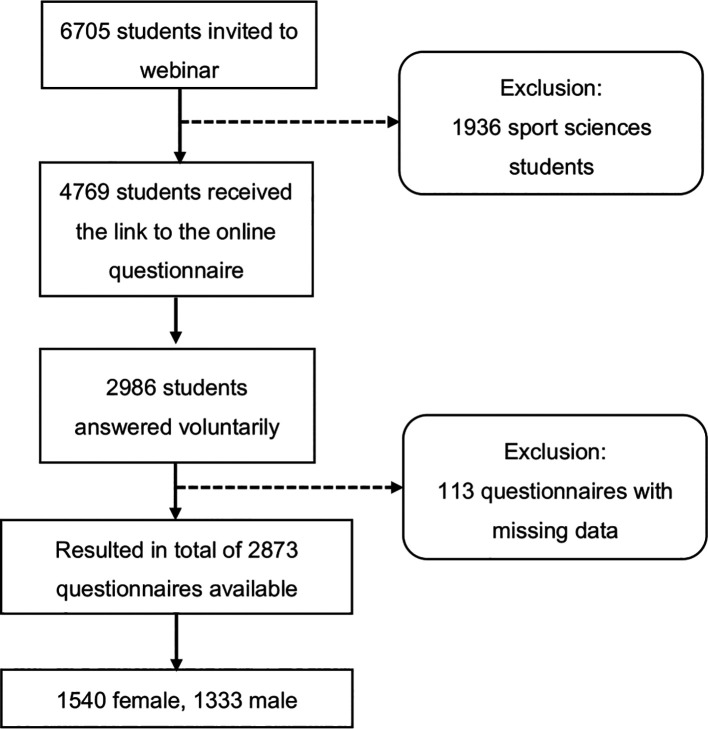
This was a cross-sectional study based on data collected via an online questionnaire for university students during the second confinement in France (between October and December 2020). The questionnaire assessed physical activity and sedentary behaviour, and contained questions about modes of transport, and perception of uninterrupted sitting time and screen time to study prior to confinement and during confinement. Participants (N=2873) completed the International Physical Activity Questionnaire (IPAQ) in an average time of around 15 minutes, after providing digital informed consent. Multiple regression models assessed how time duration of active transportation, uninterrupted sitting time, and screen time studying increased or reduced confinement effects on physical activity and sitting time.
The regression models showed that physical activity decreased during confinement for students who engaged in more prolonged periods of active transportation prior to confinement. Moreover, the perception of long, uninterrupted sitting time and high screen time prior to confinement significantly increased sitting time during confinement. Students who adopted the most active transport time prior to confinement were the least likely to increase their screen time during confinement.
Confinement reduced physical activity levels and increased sitting time, mainly among students who adopted active transport and accumulated longer uninterrupted sitting time prior to confinement. Students who combined-long periods of uninterrupted sitting time with high screen use could be a riskier profile for health. Analysis of physical activity time and sitting position should include its accumulation patterns.
2019年冠状病毒病(COVID-19)大流行导致大学关闭,这对学生的行为产生了重大影响,尤其是在体育活动、久坐时间和屏幕使用方面。本研究旨在确定积极出行时长、连续久坐时间和学习屏幕时间对隔离期间体育活动和久坐时间的影响。
这是一项横断面研究,基于法国第二次隔离期间(2020年10月至12月)通过在线问卷收集的大学生数据。问卷评估了体育活动和久坐行为,并包含有关交通方式以及隔离前和隔离期间对连续久坐时间和学习屏幕时间的感知的问题。参与者(N = 2873)在提供数字知情同意后,平均用时约15分钟完成了国际体育活动问卷(IPAQ)。多元回归模型评估了积极出行时长、连续久坐时间和学习屏幕时间如何增加或减少隔离对体育活动和久坐时间的影响。
回归模型显示,对于隔离前进行较长时间积极出行的学生,隔离期间体育活动减少。此外,隔离前对长时间连续久坐和高屏幕时间的感知显著增加了隔离期间的久坐时间。隔离前采用最积极出行时间的学生在隔离期间增加屏幕时间的可能性最小。
隔离降低了体育活动水平并增加了久坐时间,主要是在隔离前采用积极出行且积累了较长连续久坐时间的学生中。将长时间连续久坐与高屏幕使用相结合的学生可能对健康构成更高风险。对体育活动时间和坐姿的分析应包括其累积模式。