Alic Lejla, Dendinovic Kristina, Papac-Milicevic Nikolina
Department of Medical Biochemistry, Faculty of Medicine, University of Sarajevo, Sarajevo, Bosnia and Herzegovina.
Department of Neurophysiology and Neuropharmacology, Center for Physiology and Pharmacology, Medical University of Vienna, Vienna, Austria.
Front Immunol. 2024 Nov 20;15:1511886. doi: 10.3389/fimmu.2024.1511886. eCollection 2024.
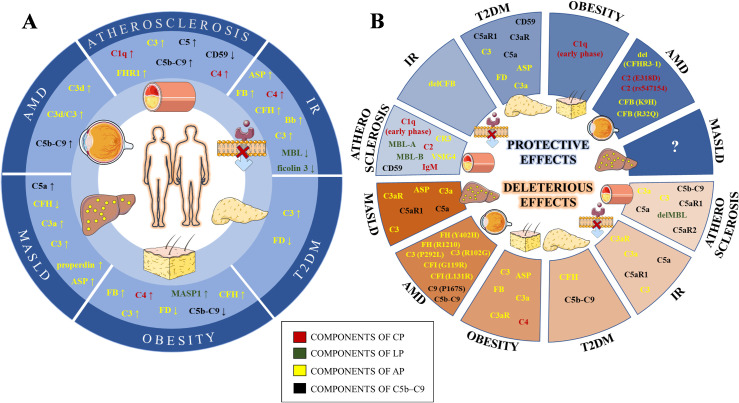
The complement system, a coordinator and facilitator of the innate immune response, plays an essential role in maintaining host homeostasis. It promotes clearance of pathogen- and danger-associated molecular patterns, regulates adaptive immunity, and can modify various metabolic processes such as energy expenditure, lipid metabolism, and glucose homeostasis. In this review, we will focus on the intricate interplay between complement components and lipid metabolism. More precisely, we will display how alterations in the activation and regulation of the complement system affect pathological outcome in lipid-associated diseases, such as atherosclerosis, obesity, metabolic syndrome, age-related macular degeneration, and metabolic dysfunction-associated steatotic liver disease. In addition to that, we will present and evaluate underlying complement-mediated physiological mechanisms, observed both and . Our manuscript will demonstrate the clinical significance of the complement system as a bridging figure between innate immunity and lipid homeostasis.
补体系统作为固有免疫应答的协调者和促进者,在维持宿主内环境稳定方面发挥着至关重要的作用。它促进病原体和危险相关分子模式的清除,调节适应性免疫,并可改变各种代谢过程,如能量消耗、脂质代谢和葡萄糖稳态。在本综述中,我们将聚焦于补体成分与脂质代谢之间复杂的相互作用。更确切地说,我们将展示补体系统激活和调节的改变如何影响脂质相关疾病(如动脉粥样硬化、肥胖、代谢综合征、年龄相关性黄斑变性和代谢功能障碍相关脂肪性肝病)的病理结局。除此之外,我们将呈现并评估所观察到的潜在补体介导的生理机制。我们的论文将证明补体系统作为固有免疫和脂质稳态之间的桥梁人物的临床意义。