Karamat Muhammad Irfan, Saleem Hira, Khakwani Minahil, Ahmed Abdullah
Department of Ophthalmology, Jinnah Hospital, Allama Shabbir Ahmad Usmani Road, Lahore, Punjab, 54550, Pakistan.
Nishtar Medical University, Multan, Punjab, 66000, Pakistan.
BMC Ophthalmol. 2024 Dec 5;24(1):523. doi: 10.1186/s12886-024-03795-x.
The "fellow-eye effect" in anti-vascular endothelial growth factor (anti-VEGF) therapy is a rare phenomenon, particularly with aflibercept. This case report documents the first instance of this effect in Pakistan, highlighting its significance in a resource-limited setting where recent regulatory changes have restricted treatment options for age-related macular degeneration (AMD).
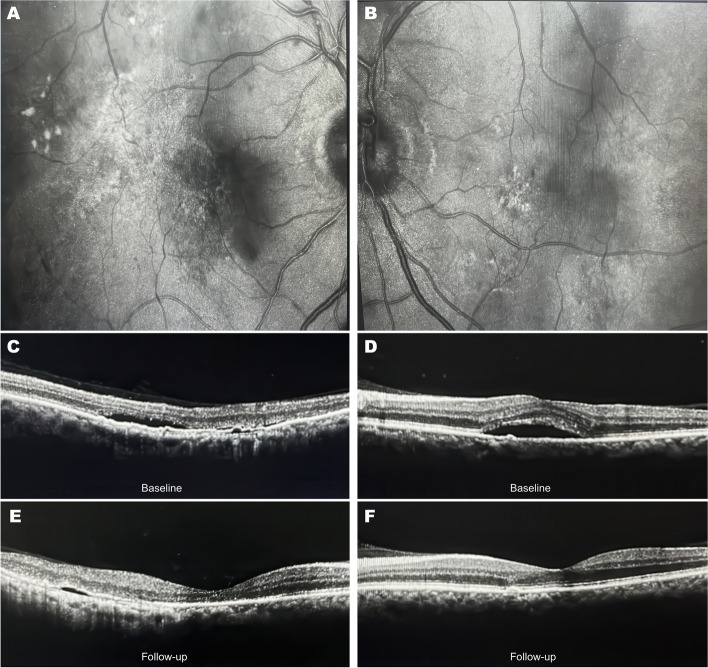
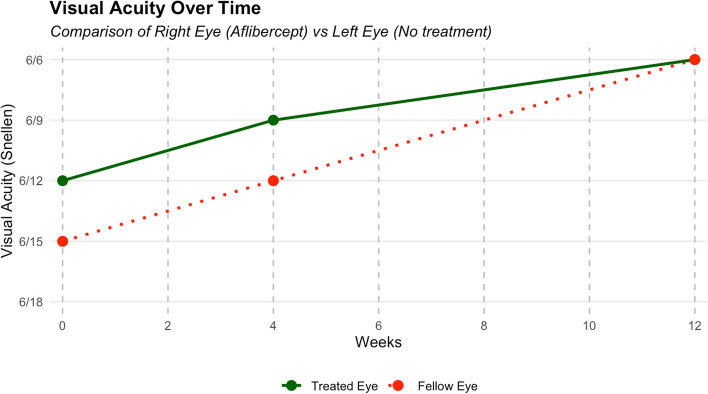
A 62-year-old male presented with bilateral central vision loss due to neovascular AMD. Optical Coherence Tomography revealed serous subretinal fluid in both eyes. Due to financial constraints, only the right eye received a single 2 mg intravitreal aflibercept injection. Remarkably, at the four-week follow-up, both eyes showed significant improvement. Visual acuity improved from 6/12 to 6/9 in the treated right eye and from 6/15 to 6/12 in the untreated left eye. OCT scans demonstrated bilateral resorption of subretinal fluid. At three months, complete fluid resorption was observed in both eyes, with visual acuity improving to 6/6 bilaterally.
This case underscores the potential of the "fellow-eye effect" in anti-VEGF therapy, particularly with aflibercept, in treating bilateral AMD. It highlights a possible strategy for optimizing treatment regimens and reducing costs in resource-limited settings. However, it also raises concerns about systemic absorption and potential risks. The findings emphasize the need for further research on the pharmacokinetics of anti-VEGF agents, personalized treatment plans, and alternative therapies. This case is particularly significant in the context of Pakistan's recent ban on bevacizumab, underscoring the urgent need for accessible and affordable AMD treatments in developing countries.
抗血管内皮生长因子(anti-VEGF)治疗中的“健眼效应”是一种罕见现象,尤其是使用阿柏西普时。本病例报告记录了巴基斯坦首例这种效应,凸显了其在资源有限环境中的重要性,在这种环境下,近期的监管变化限制了年龄相关性黄斑变性(AMD)的治疗选择。
一名62岁男性因新生血管性AMD出现双侧中心视力丧失。光学相干断层扫描显示双眼均有浆液性视网膜下积液。由于经济限制,仅右眼接受了一次2毫克玻璃体内阿柏西普注射。值得注意的是,在四周随访时,双眼均显示出显著改善。治疗的右眼视力从6/12提高到6/9,未治疗的左眼视力从6/15提高到6/12。OCT扫描显示双侧视网膜下积液吸收。三个月时,双眼均观察到积液完全吸收,视力双侧提高到6/6。
本病例强调了抗VEGF治疗中“健眼效应”的潜力,尤其是使用阿柏西普治疗双侧AMD时。它凸显了在资源有限环境中优化治疗方案和降低成本的一种可能策略。然而,它也引发了对全身吸收和潜在风险的担忧。这些发现强调了对抗VEGF药物的药代动力学、个性化治疗方案和替代疗法进行进一步研究的必要性。在巴基斯坦近期禁止使用贝伐单抗的背景下,本病例尤为重要,凸显了发展中国家对可及且负担得起之AMD治疗的迫切需求。