Ye Xinghua, Wang Jia, Hu Le, Zhang Ying, Li Yixuan, Xuan Jingchao, Han Silu, Qu Yifan, Yang Long, Yang Jun, Wang Junyu, Wei Bing
Emergency Medicine Clinical Research Center, Beijing Key Laboratory of Cardiopulmonary Cerebral Resuscitation, Beijing Chao-Yang Hospital, Capital Medical University, Beijing, China.
Front Med (Lausanne). 2024 Nov 21;11:1487443. doi: 10.3389/fmed.2024.1487443. eCollection 2024.
To determine the diagnostic and prognostic value of soluble suppression of tumorigenicity 2 (sST2) in patients with sepsis.
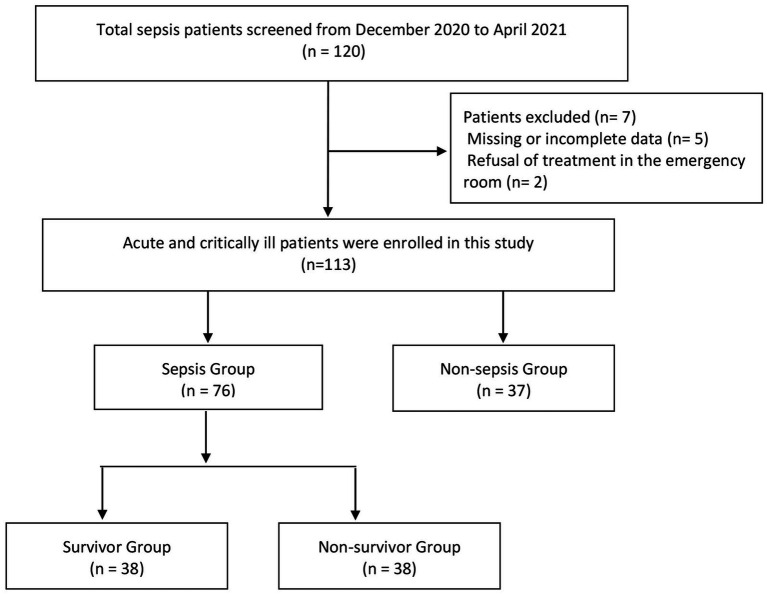
A total of 113 critically ill patients were enrolled at the emergency department of Beijing Chaoyang Hospital Jing Xi Branch. Venous blood levels of sST2 were measured using the AFIAS-6 dry fluorescence immunoassay analyzer. Based on Sepsis 3.0 criteria, patients were categorized into a sepsis group (76 cases) and a non-sepsis group (37 cases). The sepsis group was further divided into non-survivors (38 cases) and survivors (38 cases) based on 28-day survival outcomes. The vital signs, blood gas analysis, routine blood tests, liver and kidney function tests, procalcitonin (PCT), C-reactive protein (CRP), sST2, left ventricular ejection fraction (LVEF), and other basic characteristics of the patients were recorded. Further, the SOFA, qSOFA and APACHE II scores of each patient were calculated. Statistical analysis was performed using SPSS 25.0, including logistic regression and ROC curve analysis to assess prognostic factors.
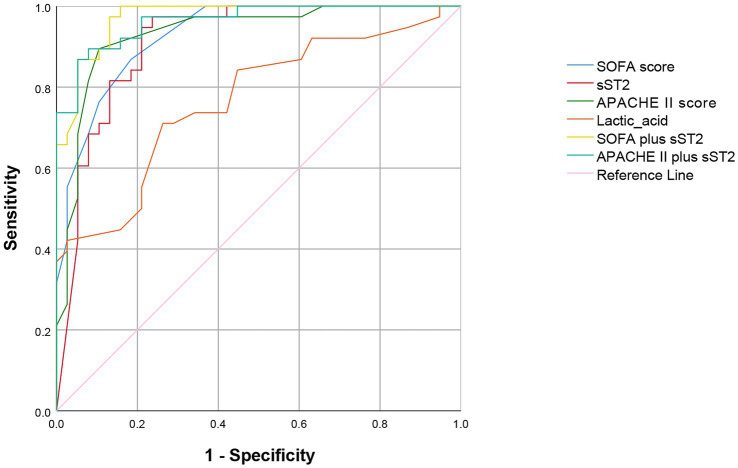
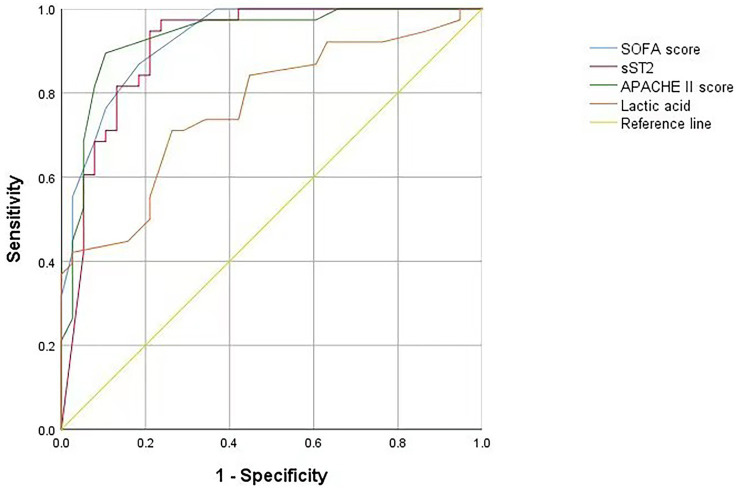
The serum sST2 levels in the sepsis group (125.00 ± 60.32 ng/mL) were significantly higher than in the non-sepsis group (58.55 ± 39.03 ng/mL) ( < 0.05). The SOFA score (8.08 ± 2.88), APACHE II score (18.00 ± 4.72), blood sST2 levels (168.06 ± 36.75 ng/mL) and lactic acid levels (2.89 ± 3.28) in the non-survivor group were significantly higher than the survivor group ( < 0.05). Multiple logistic regression analysis showed that sST2, SOFA score, APACHE II score and lactic acid levels were independent risk factors for poor prognosis in patients with sepsis. The ROC curve analysis of the above indexes showed no significant differences between the AUC of sST2 (0.912) and the SOFA score (0.929) ( = 0.389, = 0.697), or the APACHE II score (0.933) ( = 0.484, = 0.627). However, there was a significant difference between the AUC of sST2 (0.912) and lactic acid levels (0.768) ( = 2.153, = 0.030).
Blood levels of sST2 show a clinically diagnostic and prognostic value in sepsis. Further, sST2 shows a similar predictive ability as the SOFA and APACHE II scores in determining the prognosis of sepsis patients. However, sST2 has a higher predictive ability than lactic acid levels in determining prognosis in sepsis.
确定可溶性肿瘤抑制因子2(sST2)在脓毒症患者中的诊断和预后价值。
在北京朝阳医院京西院区急诊科纳入113例危重症患者。采用AFIAS - 6干式荧光免疫分析仪检测静脉血中sST2水平。根据脓毒症3.0标准,将患者分为脓毒症组(76例)和非脓毒症组(37例)。根据28天生存结局,脓毒症组进一步分为非存活者(38例)和存活者(38例)。记录患者的生命体征、血气分析、血常规、肝肾功能检查、降钙素原(PCT)、C反应蛋白(CRP)、sST2、左心室射血分数(LVEF)及其他基本特征。此外,计算每位患者的序贯器官衰竭评估(SOFA)、快速序贯器官衰竭评估(qSOFA)和急性生理与慢性健康状况评分系统II(APACHE II)评分。使用SPSS 25.0进行统计分析,包括逻辑回归和ROC曲线分析以评估预后因素。
脓毒症组血清sST2水平(125.00±60.32 ng/mL)显著高于非脓毒症组(58.55±39.03 ng/mL)(P<0.05)。非存活者组的SOFA评分(8.08±2.88)、APACHE II评分(18.00±4.72)、血sST2水平(168.06±36.75 ng/mL)和乳酸水平(2.89±3.28)显著高于存活者组(P<0.05)。多因素逻辑回归分析显示,sST2、SOFA评分、APACHE II评分和乳酸水平是脓毒症患者预后不良的独立危险因素。上述指标的ROC曲线分析显示,sST2的曲线下面积(AUC)(0.912)与SOFA评分(0.929)之间无显著差异(P=0.389,Z=0.697),与APACHE II评分(0.933)之间也无显著差异(P=0.484,Z=0.627)。然而,sST2的AUC(0.912)与乳酸水平的AUC(0.768)之间存在显著差异(Z=2.153,P=0.030)。
sST2血液水平在脓毒症中具有临床诊断和预后价值。此外,在确定脓毒症患者预后方面,sST2显示出与SOFA和APACHE II评分相似的预测能力。然而,在确定脓毒症预后方面,sST2比乳酸水平具有更高的预测能力。