Mancini P, Brandtner D, Veneri C, Bonanno Ferraro G, Iaconelli M, Puzelli S, Facchini M, Di Mario G, Stefanelli P, Lucentini L, Muratore A, Suffredini E, La Rosa G
National Center for Water Safety (CeNSiA), Istituto Superiore di Sanità, Viale Regina Elena 299, 00161, Rome, Italy.
Departments of Infectious Disease, Istituto Superiore di Sanità, Rome, Italy.
Food Environ Virol. 2024 Dec 7;17(1):6. doi: 10.1007/s12560-024-09622-2.
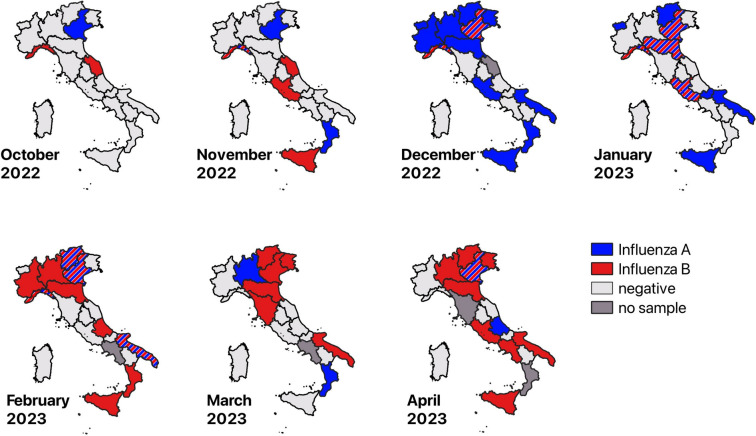
Wastewater-based epidemiology (WBE) is a recognized, dynamic approach to monitoring the transmission of pathogens in communities through urban wastewater. This study aimed to detect and quantify influenza A and B viruses in Italian wastewater during the 2022-2023 season (October 2022 to April 2023). A total of 298 wastewater samples were collected from 67 wastewater treatment plants (WTPs) across the country. These samples were analyzed for influenza A and B viruses (IAV, IBV) using primers originally developed by the Centers for Disease Control and Prevention (CDC) for real-time PCR and adapted for digital PCR. The overall detection rates of IAV and IBV across the entire study period were 19.1% and 16.8%, respectively. The prevalence of IAV in wastewater showed a gradual increase from October to December 2022, peaking at 61% in December. In contrast, IBV peaked at 36% in February 2023. This temporal discrepancy in peak concentrations suggests different seasonal patterns for the two influenza types. These trends mirrored human surveillance data, which showed influenza A cases peaking at 46% in late December and declining to around 2% by April 2023, and influenza B cases starting to increase significantly in January 2023 and peaking at about 14% in March. IAV concentrations ranged from 9.80 × 10 to 1.94 × 10 g.c./L, while IBV concentrations ranged from 1.07 × 10 to 1.43 × 10 g.c./L. Overall, the environmental data were consistent with the human surveillance trends observed during the study period in the country. These results demonstrate the value of WBE in tracking epidemiological patterns and highlight its potential as a complementary tool to infectious diseases surveillance systems.
基于废水的流行病学(WBE)是一种公认的、动态的方法,用于通过城市废水监测社区中病原体的传播。本研究旨在检测和量化2022 - 2023季节(2022年10月至2023年4月)意大利废水中的甲型和乙型流感病毒。共从全国67个污水处理厂(WTPs)收集了298份废水样本。使用美国疾病控制与预防中心(CDC)最初开发的用于实时PCR并适用于数字PCR的引物,对这些样本进行甲型和乙型流感病毒(IAV、IBV)分析。在整个研究期间,IAV和IBV的总体检出率分别为19.1%和16.8%。废水中IAV的流行率从2022年10月到12月逐渐上升,12月达到峰值61%。相比之下,IBV在2023年2月达到峰值36%。峰值浓度的这种时间差异表明两种流感类型的季节性模式不同。这些趋势与人类监测数据相符,人类监测数据显示甲型流感病例在12月下旬达到峰值46%,到2023年4月降至约2%,而乙型流感病例在2023年1月开始显著增加,3月达到峰值约14%。IAV浓度范围为9.80×10至1.94×10基因组拷贝数/升,而IBV浓度范围为1.07×10至1.43×10基因组拷贝数/升。总体而言,环境数据与该国研究期间观察到的人类监测趋势一致。这些结果证明了WBE在追踪流行病学模式方面的价值,并突出了其作为传染病监测系统补充工具的潜力。