Tomkinson Grant R, Lang Justin J, Rubín Lukáš, McGrath Ryan, Gower Bethany, Boyle Terry, Klug Marilyn G, Mayhew Alexandra J, Blake Henry T, Ortega Francisco B, Cadenas-Sanchez Cristina, Magnussen Costan G, Fraser Brooklyn J, Kidokoro Tetsuhiro, Liu Yang, Christensen Kaare, Leong Darryl P
Alliance for Research in Exercise, Nutrition and Activity (ARENA), Allied Health and Human Performance, University of South Australia, Adelaide, SA 5000, Australia.
Alliance for Research in Exercise, Nutrition and Activity (ARENA), Allied Health and Human Performance, University of South Australia, Adelaide, SA 5000, Australia; Centre for Surveillance and Applied Research, Public Health Agency of Canada, Ottawa, ON K1A 0K9, Canada; School of Epidemiology and Public Health, Faculty of Medicine, University of Ottawa, Ottawa, ON K1H 8M5, Canada.
J Sport Health Sci. 2024 Dec 6;14:101014. doi: 10.1016/j.jshs.2024.101014.
Muscular strength is a powerful marker of current health status and robust predictor of age-related disease and disability. Handgrip strength (HGS) using isometric dynamometry is a convenient, feasible, and widely used method of assessing muscular strength among people of all ages. While adult HGS norms have been published for many countries, no study has yet synthesized available data to produce international norms. The objective of this study was to generate international sex- and age-specific norms for absolute and body size-normalized HGS across the adult lifespan.
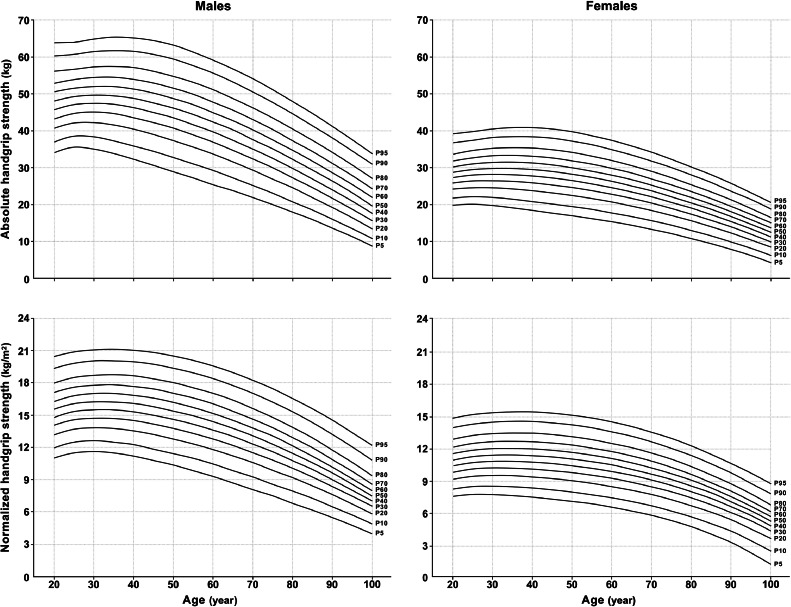
Systematic searches were conducted in 6 databases/web search engines (MEDLINE, SPORTDiscus, Embase, Web of Science, CINAHL, and Google Scholar) up to December 1, 2023. We included full-text peer-reviewed observational studies that reported normative HGS data for adults aged ≥20 years by sex and age. Pseudo data were generated using Monte Carlo simulation following harmonization for methodological variation. Population-weighted Generalized Additive Models for Location, Scale, and Shape were used to develop sex- and age-specific norms for absolute HGS (kg) and HGS normalized by height (Ht, m) squared (i.e., HGS/Ht in kg/m). Norms were tabulated as percentile values (5th to 95th) and visualized as smoothed percentile curves.
We included data from 100 unique observational studies representing 2,405,863 adults (51.9% female) aged 20 to 100+ years from 69 countries and regions tested from the year 2000 onward. On average, absolute and normalized HGS values negligibly improved throughout early adulthood, peaked from age 30-39 years (at 49.7 kg (males) and 29.7 kg (females) for absolute HGS or 16.3 kg/m (males) and 11.3 kg/m (females) for HGS/Ht), and declined afterwards. The age-related decline in HGS accelerated from middle to late adulthood and was slightly larger for males than for females during middle adulthood.
This study provides the world's largest and most geographically comprehensive international norms for adult HGS by sex and age. These norms have utility for global peer-comparisons, health screening, and surveillance.
肌肉力量是当前健康状况的有力指标,也是与年龄相关疾病和残疾的可靠预测因素。使用等长测力法测量握力(HGS)是一种方便、可行且广泛应用于各年龄段人群肌肉力量评估的方法。虽然许多国家已经公布了成人握力标准,但尚未有研究综合现有数据制定国际标准。本研究的目的是生成涵盖整个成年期的、按性别和年龄划分的绝对握力和按身体大小标准化握力的国际标准。
截至2023年12月1日,在6个数据库/网络搜索引擎(MEDLINE、SPORTDiscus、Embase、Web of Science、CINAHL和谷歌学术)中进行了系统检索。我们纳入了全文经同行评审的观察性研究,这些研究报告了≥20岁成年人按性别和年龄划分的握力标准数据。在对方法学差异进行协调后,使用蒙特卡洛模拟生成伪数据。使用位置、尺度和形状的总体加权广义相加模型来制定绝对握力(kg)和按身高(Ht,m)平方标准化的握力(即握力/身高,单位为kg/m)的按性别和年龄划分的标准。标准以百分位数(第5至95百分位数)形式列表,并可视化为平滑的百分位数曲线。
我们纳入了来自100项独特观察性研究的数据,这些研究代表了2000年以后在69个国家和地区测试的2405863名年龄在20至100岁以上的成年人(51.9%为女性)。平均而言,绝对握力和标准化握力值在成年早期略有改善,在30至39岁达到峰值(绝对握力男性为49.7kg,女性为29.7kg;握力/身高男性为16.3kg/m,女性为11.3kg/m),之后下降。握力随年龄的下降从中年到老年加速,中年男性的下降幅度略大于女性。
本研究提供了全球最大且地理覆盖范围最广的按性别和年龄划分的成人握力国际标准。这些标准可用于全球同行比较、健康筛查和监测。