Benatti de Oliveira Gabriela, Vilar Fernandes Lara, Amaral Teresa F, Vasques Ana Carolina Junqueira, Pires Corona Ligiana
Faculty of Medical Sciences, State University of Campinas, Campinas, São Paulo, Brazil.
Faculty of Applied Sciences, State University of Campinas, Limeira, São Paulo, Brazil.
Front Aging. 2025 Apr 25;6:1560097. doi: 10.3389/fragi.2025.1560097. eCollection 2025.
With the advancement of studies on the importance of sarcopenia in the aging process, new technologies have been developed to assess muscle mass and function. However, most research on portable devices has not considered a wide range of ages and clinical conditions. This study aimed to evaluate the reliability of the Gripwise digital dynamometer in measuring handgrip strength in older Brazilian adults, comparing its performance with the widely used Saehan device.
A cross-sectional study was conducted with 149 participants (32 men and 117 women), with an average age of 69.5 years. Handgrip strength was measured using both the Gripwise and Saehan dynamometers. Reliability was assessed using the intraclass correlation coefficient (ICC). Analyses considered three handgrip strength measurements from both devices, as well as the highest value obtained. The classification of dynapenia (low muscle strength) was compared using different cutoff points proposed by Villain et al. (2023), Spexoto et al. (2022), and Cruz-Jentoft et al. (2019).
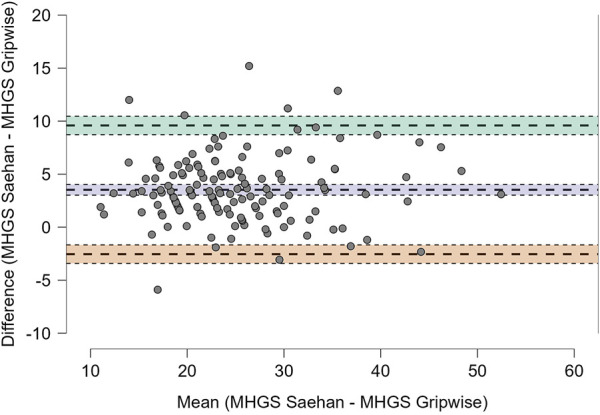
Both dynamometers demonstrated excellent reliability, with ICC values above 0.90. However, significant differences in mean handgrip strength values were observed between the devices (approximately 3.5-four kgf). These variations impacted the classification of dynapenia, with the Gripwise identifying more cases of low muscle strength compared to Saehan.
The lower values reported by the Gripwise may impact clinical decision-making in two ways. On one hand, lower values may lead to earlier detection of muscle weakness, allowing for quicker intervention in individuals with strength below typical thresholds. However, this could also result in an overestimation of the prevalence of dynapenia if the values do not accurately reflect true muscle strength, which could lead to unnecessary interventions. Therefore, it is crucial to consider the need for adjustments in the cutoff points when using Gripwise. These findings highlight the need to revise cutoff points for dynapenia classification, considering device variations and model differences in older age groups.
随着对肌肉减少症在衰老过程中的重要性研究的进展,已开发出新的技术来评估肌肉质量和功能。然而,大多数关于便携式设备的研究并未考虑广泛的年龄范围和临床状况。本研究旨在评估Gripwise数字测力计在测量巴西老年成年人握力方面的可靠性,并将其性能与广泛使用的Saehan设备进行比较。
对149名参与者(32名男性和117名女性)进行了一项横断面研究,平均年龄为69.5岁。使用Gripwise和Saehan测力计测量握力。使用组内相关系数(ICC)评估可靠性。分析考虑了两种设备的三次握力测量结果以及获得的最高值。使用Villain等人(2023年)、Spexoto等人(2022年)和Cruz-Jentoft等人(2019年)提出的不同临界值比较了肌无力(低肌肉力量)的分类。
两种测力计均显示出出色的可靠性,ICC值高于0.90。然而,观察到两种设备之间的平均握力值存在显著差异(约3.5 - 4千克力)。这些差异影响了肌无力的分类,与Saehan相比,Gripwise识别出更多低肌肉力量的病例。
Gripwise报告的较低值可能以两种方式影响临床决策。一方面,较低的值可能导致更早发现肌肉无力,从而能够对力量低于典型阈值的个体进行更快的干预。然而,如果这些值不能准确反映真正的肌肉力量,这也可能导致对肌无力患病率的高估,进而可能导致不必要的干预。因此,在使用Gripwise时考虑调整临界值的必要性至关重要。这些发现强调了考虑老年人群体中设备差异和模型差异来修订肌无力分类临界值的必要性。