Cestari Tania F, Souza Cacilda da Silva, Azulay-Abulafia Luna, Romiti Ricardo, Carvalho André V E, Silva de Castro Caio César, Marques Sílvio Alencar, Antonio João Roberto, Fabrício Lincoln, Soliman Ahmed M, Wu Tianshuang, Sinvhal Ranjeeta, Stakias Vassilis, Song Alexandra P, Kalabic Jasmina, Martin Naomi, Oyafuso Luiza Keiko Matsuka
Department of Dermatology, Hospital de Clínicas de Porto Alegre, Universidade Federal do Rio Grande do Sul, Porto Alegre, RS, Brazil.
Division of Dermatology, Faculdade de Medicina de Ribeirão Preto, Universidade de São Paulo, Ribeirão Preto, SP, Brazil.
An Bras Dermatol. 2025 Mar-Apr;100(2):260-271. doi: 10.1016/j.abd.2024.08.002. Epub 2024 Dec 7.
Psoriasis, a chronic, inflammatory skin disease, requires long-term therapy. Risankizumab is a humanized immunoglobulin G1 monoclonal antibody that specifically inhibits interleukin 23 by binding to its p19 subunit.
The authors assessed the efficacy and safety of risankizumab compared with methotrexate in adults with moderate-to-severe plaque psoriasis.
IMMbrace was a phase 3, multicenter, randomized, double-blind, double-dummy, active-controlled study. Patients received subcutaneous risankizumab 150 mg at weeks 0, 4, and 16 plus oral placebo weekly, or oral methotrexate 5 mg weekly (with dose escalation up to 25 mg based on response and tolerability) plus subcutaneous placebo at weeks 0, 4, and 16. Primary efficacy endpoints were the proportions of patients who achieved ≥ 90% improvement in Psoriasis Area and Severity Index (PASI90) and static Physician's Global Assessment of clear/almost clear (sPGA 0/1) at week 28. Safety was also assessed.
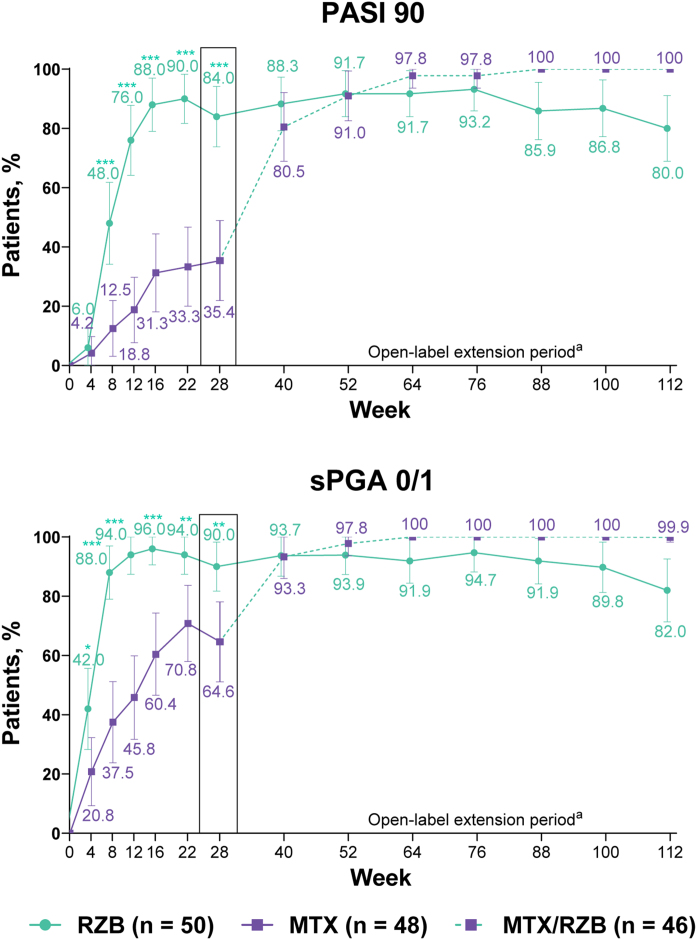
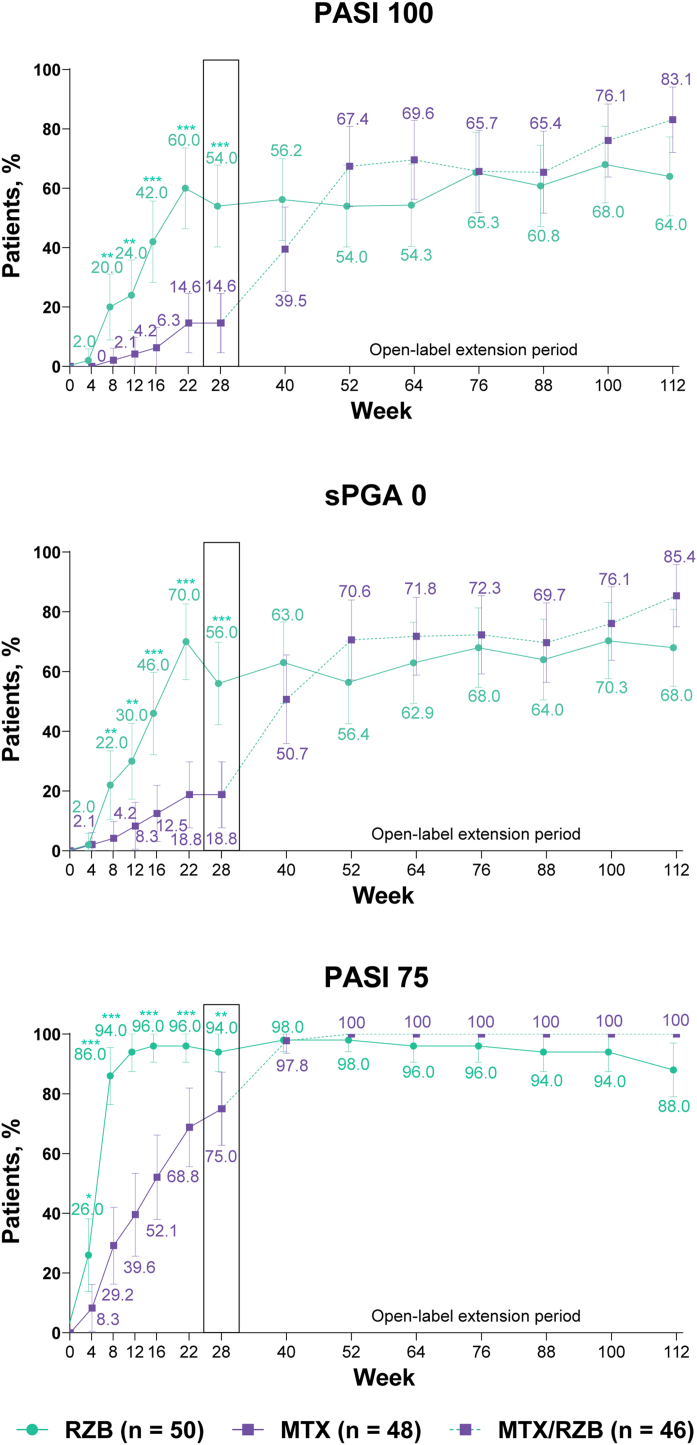
Among 98 patients randomized (risankizumab, n = 50; methotrexate, n = 48), 95 completed the double-blind period. At week 28, significantly higher proportions of patients treated with risankizumab versus methotrexate achieved PASI90 (84.0% vs. 35.4%; p < 0.001); sPGA 0/1 was achieved by 90.0% and 64.6% of patients in the risankizumab and methotrexate groups (p ≤ 0.001). Risankizumab efficacy was maintained throughout week 112. Adverse event rates were similar in the two groups.
The sample size was small due to the difficulty of recruiting patients without methotrexate use.
Risankizumab demonstrated superior efficacy over methotrexate at week 28; efficacy was maintained, and no new safety findings were observed through week 112.
银屑病是一种慢性炎症性皮肤病,需要长期治疗。瑞莎珠单抗是一种人源化免疫球蛋白G1单克隆抗体,通过与其p19亚基结合特异性抑制白细胞介素23。
作者评估了在中度至重度斑块状银屑病成人患者中,与甲氨蝶呤相比,瑞莎珠单抗的疗效和安全性。
IMMbrace是一项3期、多中心、随机、双盲、双模拟、活性对照研究。患者在第0、4和16周接受皮下注射150mg瑞莎珠单抗,每周口服安慰剂,或每周口服5mg甲氨蝶呤(根据反应和耐受性剂量可增至25mg),并在第0、4和16周接受皮下注射安慰剂。主要疗效终点是在第28周达到银屑病面积和严重程度指数改善≥90%(PASI90)以及静态医师整体评估为清除/几乎清除(sPGA 0/1)的患者比例。同时也评估了安全性。
在98例随机分组的患者中(瑞莎珠单抗组n = 50;甲氨蝶呤组n = 48),95例完成了双盲期。在第28周,与甲氨蝶呤相比,接受瑞莎珠单抗治疗的患者达到PASI90的比例显著更高(84.0%对35.4%;p < 0.001);瑞莎珠单抗组和甲氨蝶呤组分别有90.0%和64.6%的患者达到sPGA 0/1(p≤0.001)。瑞莎珠单抗的疗效在第112周期间一直维持。两组的不良事件发生率相似。
由于招募未使用过甲氨蝶呤的患者存在困难,样本量较小。
在第28周时,瑞莎珠单抗显示出优于甲氨蝶呤的疗效;疗效得以维持,并且在第112周期间未观察到新的安全性发现。