Syreeni Anna, Dahlström Emma H, Smyth Laura J, Hill Claire, Mutter Stefan, Gupta Yogesh, Harjutsalo Valma, Chen Zhuo, Natarajan Rama, Krolewski Andrzej S, Hirschhorn Joel N, Florez Jose C, Maxwell Alexander P, Groop Per-Henrik, McKnight Amy Jayne, Sandholm Niina
Folkhälsan Research Center, Helsinki, Finland.
Department of Nephrology, University of Helsinki and Helsinki University Hospital, Helsinki, Finland.
medRxiv. 2024 Nov 29:2024.11.28.24318055. doi: 10.1101/2024.11.28.24318055.
DNA methylation differences are associated with kidney function and diabetic kidney disease (DKD), but prospective studies are scarce. Therefore, we aimed to study DNA methylation in a prospective setting in the Finnish Diabetic Nephropathy Study type 1 diabetes (T1D) cohort.
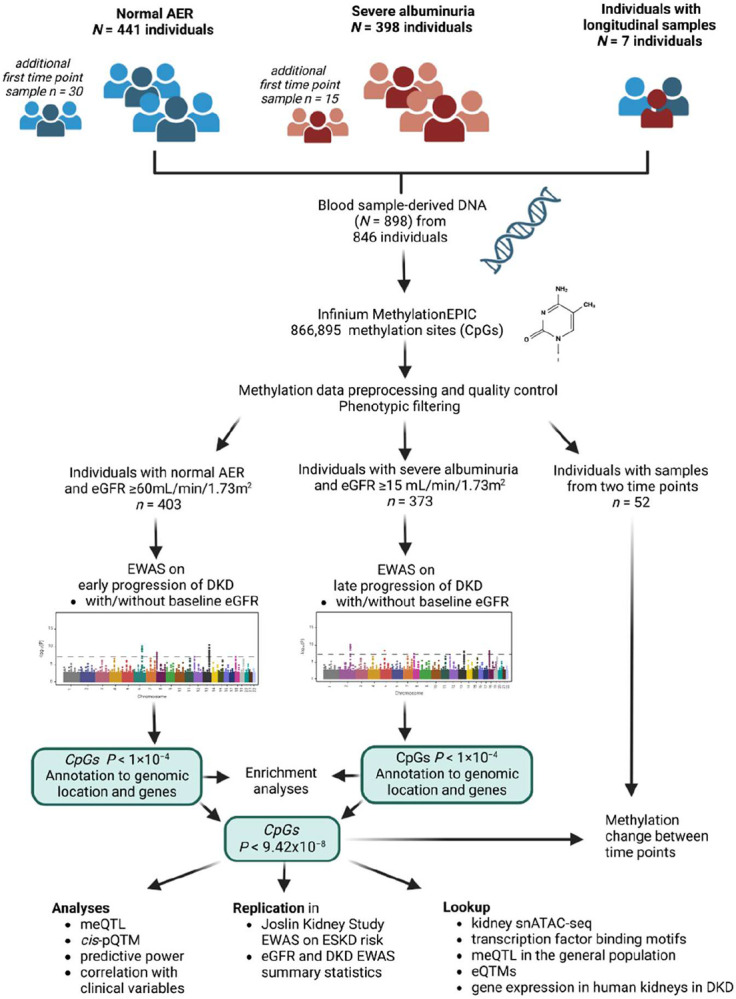
We analysed baseline blood sample-derived DNA methylation (Illumina's EPIC array) of 403 individuals with normal albumin excretion rate (early progression group) and 373 individuals with severe albuminuria (late progression group) and followed-up their DKD progression defined as decrease in eGFR to <60 mL/min/1.73m (early DKD progression group; median follow-up 13.1 years) or end-stage kidney disease (ESKD) (late DKD progression group; median follow-up 8.4 years). We conducted two epigenome-wide association studies (EWASs) on DKD progression and sought methylation quantitative trait loci (meQTLs) for the lead CpGs to estimate genetic contribution.
Altogether, 14 methylation sites were associated with DKD progression (<9.4×10). Methylation at cg01730944 near and at other CpGs associated with early DKD progression were not correlated with baseline eGFR, whereas late progression CpGs were strongly associated. Importantly, 13 of 14 CpGs could be linked to a gene showing differential expression in DKD or chronic kidney disease. Higher methylation at the lead CpG cg17944885, a frequent finding in eGFR EWASs, was associated with ESKD risk (HR [95% CI] = 2.15 [1.79, 2.58]). Additionally, we replicated meQTLs for cg17944885 and identified ten novel meQTL variants for other CpGs. Furthermore, survival models including the significant CpG sites showed increased predictive performance on top of clinical risk factors.
Our EWAS on early DKD progression identified a podocyte-specific locus. EWAS on late progression proposed novel CpGs for ESKD risk and confirmed previously known sites for kidney function. Since DNA methylation signals could improve disease course prediction, a combination of blood-derived methylation sites could serve as a potential prognostic biomarker.
DNA甲基化差异与肾功能及糖尿病肾病(DKD)相关,但前瞻性研究较少。因此,我们旨在芬兰糖尿病肾病研究1型糖尿病(T1D)队列的前瞻性研究中,研究DNA甲基化情况。
我们分析了403例白蛋白排泄率正常个体(早期进展组)和373例严重蛋白尿个体(晚期进展组)的基线血样来源的DNA甲基化情况(Illumina的EPIC芯片),并对他们的DKD进展情况进行随访,DKD进展定义为估算肾小球滤过率(eGFR)降至<60 mL/min/1.73m²(早期DKD进展组;中位随访13.1年)或终末期肾病(ESKD)(晚期DKD进展组;中位随访8.4年)。我们针对DKD进展进行了两项全表观基因组关联研究(EWAS),并寻找主要CpG位点的甲基化数量性状基因座(meQTL)以评估遗传贡献。
总共14个甲基化位点与DKD进展相关(<9.4×10)。靠近 处的cg01730944位点及其他与早期DKD进展相关的CpG位点的甲基化与基线eGFR无关,而晚期进展的CpG位点则密切相关。重要的是,14个CpG位点中的13个可与在DKD或慢性肾病中表现出差异表达的基因相关联。在eGFR的EWAS中经常发现的主要CpG位点cg17944885处的甲基化水平较高,与ESKD风险相关(风险比[95%置信区间]=2.15[1.79, 2.58])。此外,我们重复验证了cg17944885的meQTL,并为其他CpG位点鉴定了10个新的meQTL变体。此外,包含显著CpG位点的生存模型在临床风险因素之上显示出更高的预测性能。
我们针对早期DKD进展的EWAS确定了一个足细胞特异性 位点。针对晚期进展的EWAS提出了与ESKD风险相关的新CpG位点,并证实了先前已知的与肾功能相关的位点。由于DNA甲基化信号可改善疾病进程预测,血样来源的甲基化位点组合可作为潜在的预后生物标志物。