Molecular Epidemiology Research Group, Centre for Public Health, Queen's University Belfast, Belfast, UK.
Internal Medicine, Department of Nephrology, University of Michigan, Ann Arbor, MI, USA.
Clin Epigenetics. 2021 May 1;13(1):99. doi: 10.1186/s13148-021-01081-x.
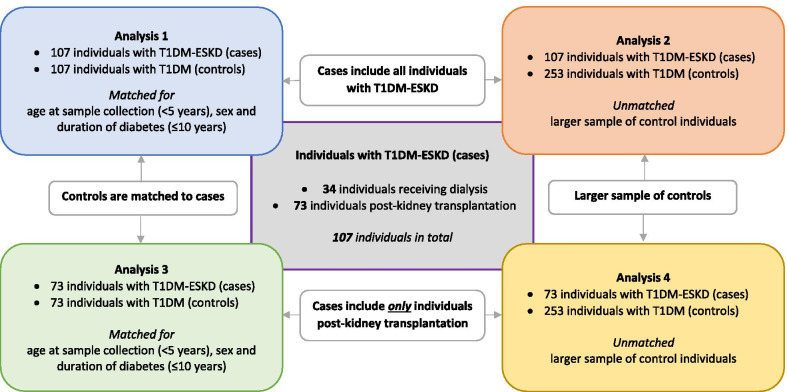
A subset of individuals with type 1 diabetes mellitus (T1DM) are predisposed to developing diabetic kidney disease (DKD), the most common cause globally of end-stage kidney disease (ESKD). Emerging evidence suggests epigenetic changes in DNA methylation may have a causal role in both T1DM and DKD. The aim of this exploratory investigation was to assess differences in blood-derived DNA methylation patterns between individuals with T1DM-ESKD and individuals with long-duration T1DM but no evidence of kidney disease upon repeated testing to identify potential blood-based biomarkers. Blood-derived DNA from individuals (107 cases, 253 controls and 14 experimental controls) were bisulphite treated before DNA methylation patterns from both groups were generated and analysed using Illumina's Infinium MethylationEPIC BeadChip arrays (n = 862,927 sites). Differentially methylated CpG sites (dmCpGs) were identified (false discovery rate adjusted p ≤ × 10 and fold change ± 2) by comparing methylation levels between ESKD cases and T1DM controls at single site resolution. Gene annotation and functionality was investigated to enrich and rank methylated regions associated with ESKD in T1DM.
Top-ranked genes within which several dmCpGs were located and supported by functional data with methylation look-ups in other cohorts include: AFF3, ARID5B, CUX1, ELMO1, FKBP5, HDAC4, ITGAL, LY9, PIM1, RUNX3, SEPTIN9 and UPF3A. Top-ranked enrichment pathways included pathways in cancer, TGF-β signalling and Th17 cell differentiation.
Epigenetic alterations provide a dynamic link between an individual's genetic background and their environmental exposures. This robust evaluation of DNA methylation in carefully phenotyped individuals has identified biomarkers associated with ESKD, revealing several genes and implicated key pathways associated with ESKD in individuals with T1DM.
一小部分 1 型糖尿病(T1DM)患者易患糖尿病肾病(DKD),这是全球范围内导致终末期肾病(ESKD)的最常见原因。新出现的证据表明,DNA 甲基化的表观遗传变化可能在 T1DM 和 DKD 中都具有因果关系。本探索性研究的目的是评估 T1DM-ESKD 个体与长期 T1DM 但经多次检测无肾脏疾病证据的个体之间血液源性 DNA 甲基化模式的差异,以确定潜在的基于血液的生物标志物。对个体的血液源性 DNA(107 例病例、253 例对照和 14 例实验对照)进行亚硫酸氢盐处理,然后生成两组的 DNA 甲基化模式,并使用 Illumina 的 Infinium 甲基化 EPIC BeadChip 阵列(n=862927 个位点)进行分析。通过比较 ESKD 病例和 T1DM 对照之间的单个位点分辨率的甲基化水平,鉴定出差异甲基化的 CpG 位点(dmCpGs)(调整后的假发现率 p≤×10 和 2±倍变化)。通过在其他队列中进行甲基化查找,对包含多个 dmCpGs 的基因注释和功能进行了研究,以富集和排列与 T1DM 中 ESKD 相关的甲基化区域。
在功能数据中,几个 dmCpGs 位于排名靠前的基因内,并且得到了支持,并且在其他队列中进行了甲基化查找,包括 AFF3、ARID5B、CUX1、ELMO1、FKBP5、HDAC4、ITGAL、LY9、PIM1、RUNX3、SEPTIN9 和 UPF3A。排名靠前的富集途径包括癌症途径、TGF-β 信号转导和 Th17 细胞分化途径。
表观遗传改变为个体的遗传背景与其环境暴露之间提供了动态联系。对精心表型个体的 DNA 甲基化进行了稳健评估,鉴定出与 ESKD 相关的生物标志物,揭示了与 T1DM 中 ESKD 相关的几个基因和关键途径。