Folkhälsan Institute of Genetics, Folkhälsan Research Center, Helsinki, Finland.
Department of Nephrology, University of Helsinki and Helsinki University Hospital, Helsinki, Finland.
Diabetologia. 2022 Sep;65(9):1495-1509. doi: 10.1007/s00125-022-05735-0. Epub 2022 Jun 28.
AIMS/HYPOTHESIS: Diabetic kidney disease (DKD) is the leading cause of kidney failure and has a substantial genetic component. Our aim was to identify novel genetic factors and genes contributing to DKD by performing meta-analysis of previous genome-wide association studies (GWAS) on DKD and by integrating the results with renal transcriptomics datasets.
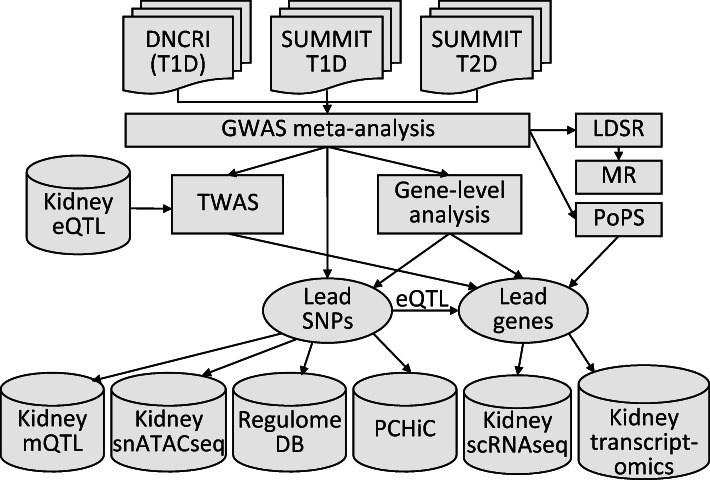
We performed GWAS meta-analyses using ten phenotypic definitions of DKD, including nearly 27,000 individuals with diabetes. Meta-analysis results were integrated with estimated quantitative trait locus data from human glomerular (N=119) and tubular (N=121) samples to perform transcriptome-wide association study. We also performed gene aggregate tests to jointly test all available common genetic markers within a gene, and combined the results with various kidney omics datasets.
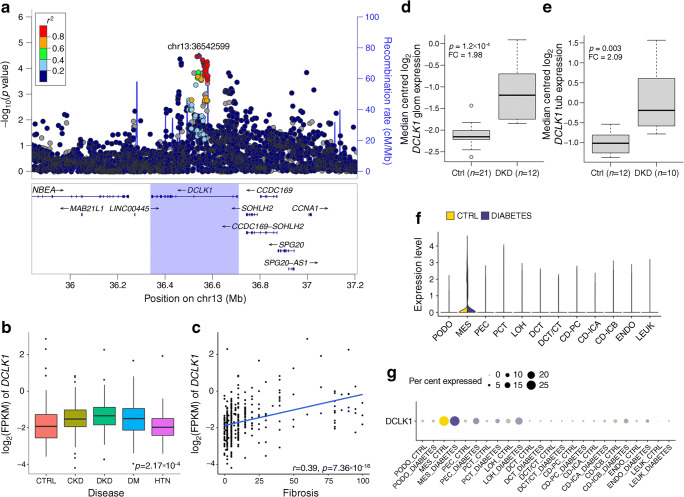
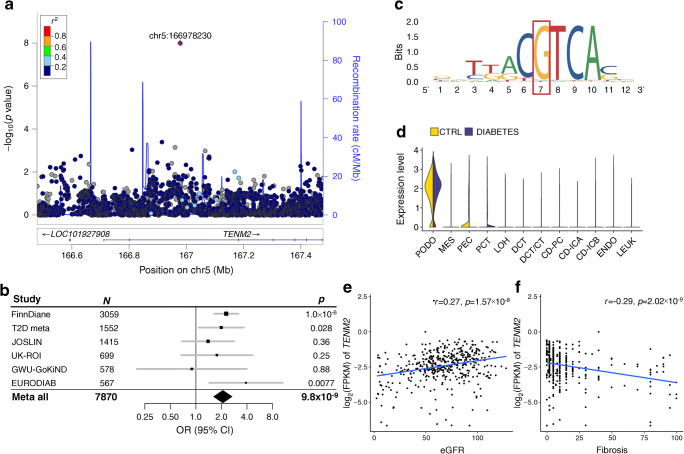
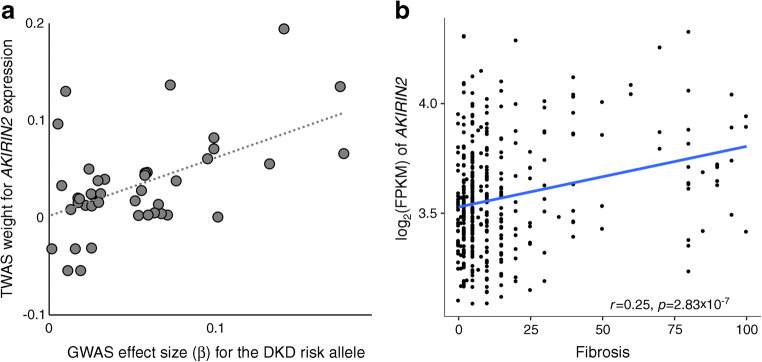
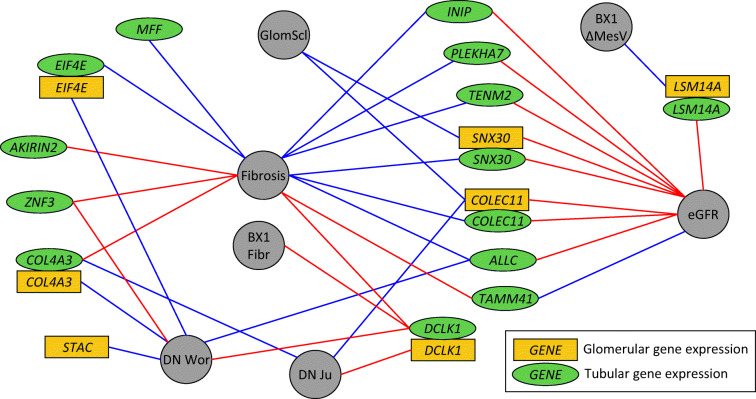
The meta-analysis identified a novel intronic variant (rs72831309) in the TENM2 gene associated with a lower risk of the combined chronic kidney disease (eGFR<60 ml/min per 1.73 m) and DKD (microalbuminuria or worse) phenotype (p=9.8×10; although not withstanding correction for multiple testing, p>9.3×10). Gene-level analysis identified ten genes associated with DKD (COL20A1, DCLK1, EIF4E, PTPRN-RESP18, GPR158, INIP-SNX30, LSM14A and MFF; p<2.7×10). Integration of GWAS with human glomerular and tubular expression data demonstrated higher tubular AKIRIN2 gene expression in individuals with vs without DKD (p=1.1×10). The lead SNPs within six loci significantly altered DNA methylation of a nearby CpG site in kidneys (p<1.5×10). Expression of lead genes in kidney tubules or glomeruli correlated with relevant pathological phenotypes (e.g. TENM2 expression correlated positively with eGFR [p=1.6×10] and negatively with tubulointerstitial fibrosis [p=2.0×10], tubular DCLK1 expression correlated positively with fibrosis [p=7.4×10], and SNX30 expression correlated positively with eGFR [p=5.8×10] and negatively with fibrosis [p<2.0×10]).
CONCLUSIONS/INTERPRETATION: Altogether, the results point to novel genes contributing to the pathogenesis of DKD.
The GWAS meta-analysis results can be accessed via the type 1 and type 2 diabetes (T1D and T2D, respectively) and Common Metabolic Diseases (CMD) Knowledge Portals, and downloaded on their respective download pages ( https://t1d.hugeamp.org/downloads.html ; https://t2d.hugeamp.org/downloads.html ; https://hugeamp.org/downloads.html ).
目的/假设:糖尿病肾病(DKD)是肾衰竭的主要原因,具有重要的遗传成分。我们的目的是通过对 DKD 进行先前全基因组关联研究(GWAS)的荟萃分析,并将结果与肾脏转录组数据集整合,来确定导致 DKD 的新的遗传因素和基因。
我们使用十种 DKD 的表型定义进行了 GWAS 荟萃分析,包括近 27000 名糖尿病患者。荟萃分析结果与人类肾小球(N=119)和肾小管(N=121)样本中估计的数量性状基因座数据相结合,进行全转录组关联研究。我们还进行了基因集合检验,以共同检验一个基因内所有可用的常见遗传标记,并将结果与各种肾脏组学数据集相结合。
荟萃分析在 TENM2 基因中发现了一个新的内含子变异(rs72831309),与较低的慢性肾脏疾病(eGFR<60 ml/min per 1.73 m)和 DKD(微量白蛋白尿或更差)表型风险相关(p=9.8×10;尽管未经过多次检验校正,p>9.3×10)。基因水平分析确定了 10 个与 DKD 相关的基因(COL20A1、DCLK1、EIF4E、PTPRN-RESP18、GPR158、INIP-SNX30、LSM14A 和 MFF;p<2.7×10)。将 GWAS 与人类肾小球和肾小管表达数据相结合,表明 DKD 患者的肾小管 AKIRIN2 基因表达更高(p=1.1×10)。六个位点内的先导 SNP 显著改变了肾脏中附近 CpG 位点的 DNA 甲基化(p<1.5×10)。在肾脏的肾小管或肾小球中,先导基因的表达与相关的病理表型相关(例如,TENM2 表达与 eGFR 呈正相关(p=1.6×10),与肾小管间质纤维化呈负相关(p=2.0×10),肾小管 DCLK1 表达与纤维化呈正相关(p=7.4×10),而 SNX30 表达与 eGFR 呈正相关(p=5.8×10),与纤维化呈负相关(p<2.0×10))。
结论/解释:总之,结果表明有新的基因导致 DKD 的发病机制。
全基因组关联研究荟萃分析结果可通过 1 型和 2 型糖尿病(T1D 和 T2D)和常见代谢疾病(CMD)知识门户访问,并可在各自的下载页面下载(https://t1d.hugeamp.org/downloads.html;https://t2d.hugeamp.org/downloads.html;https://hugeamp.org/downloads.html)。