Spaans O K, Roche J R, Burke C R, Phyn C V C, McDougall S, Reed C B, Kuhn-Sherlock B, Hickey A, Heiser A, Crookenden M A
DairyNZ Limited, Hamilton, 3240, New Zealand.
School of Biological Sciences, University of Auckland, Auckland, 1142, New Zealand.
JDS Commun. 2024 Apr 20;5(6):613-617. doi: 10.3168/jdsc.2023-0509. eCollection 2024 Nov.
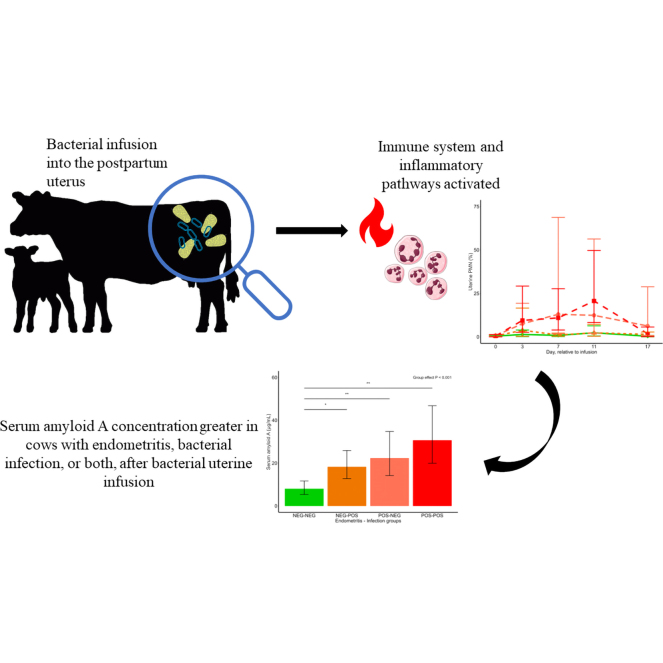
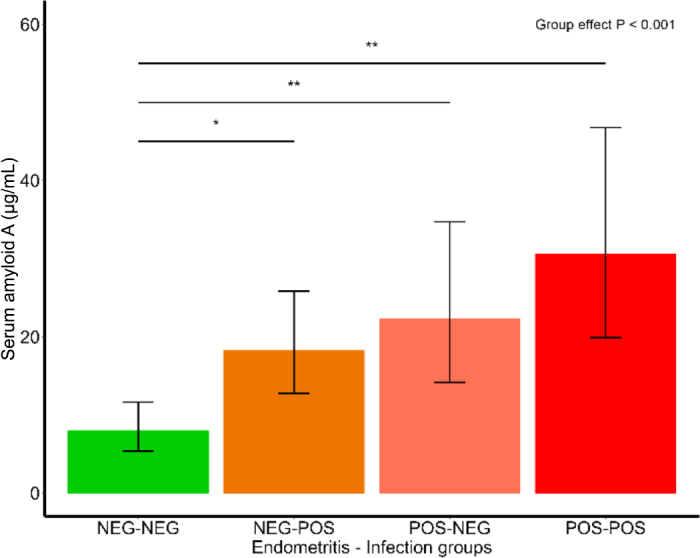
A delayed recovery of the reproductive tract from natural inflammatory processes associated with postpartum involution will compromise further reproductive function. Following a literature review, we selected serum amyloid A (SAA) and α1-acid glycoprotein (α1-AGP) to assess as potential circulating markers of acute uterine inflammation, as concentrations of these 2 acute phase proteins were reported to be elevated early postpartum in dairy cows with active uterine infection. Convenience serum samples from an induced model of uterine infection were used to measure concentrations of these markers. Infection was induced by infusing either 10 or 10 cfu of (n = 9 cows each; bacteria group n = 18) or saline as a control (n = 18) into the uterus at 48 d postpartum. Although infection stimulated an increase in uterine polymorphonuclear neutrophils, SAA and α1-AGP concentrations in serum were not different between infusion groups. Cows were subsequently classified into uterine health groups based on the presence of endometritis, with or without the presence of in uterine culture in response to uterine infusion. Mean SAA concentrations were greater in cows that were either endometritis negative-infection positive (n = 9), endometritis positive-infection negative (n = 5), or endometritis positive-infection positive, compared with the endometritis negative-infection negative (n = 11) cows. There was no difference between uterine health groups for α1-AGP concentrations.
与产后 involution 相关的自然炎症过程中生殖道恢复延迟会损害进一步的生殖功能。在文献综述之后,我们选择血清淀粉样蛋白 A(SAA)和α1-酸性糖蛋白(α1-AGP)作为急性子宫炎症的潜在循环标志物进行评估,因为据报道,在患有活动性子宫感染的奶牛产后早期,这两种急性期蛋白的浓度会升高。使用来自子宫感染诱导模型的便利血清样本测量这些标志物的浓度。在产后 48 天,通过向子宫内注入 10 或 10 cfu 的 (每组 n = 9 头奶牛;细菌组 n = 18)或生理盐水作为对照(n = 18)来诱导感染。尽管感染刺激子宫多形核中性粒细胞增加,但各注入组血清中的 SAA 和α1-AGP 浓度并无差异。随后根据子宫内膜炎的存在情况将奶牛分为子宫健康组,根据子宫注入后子宫培养物中是否存在 进行分类。与子宫内膜炎阴性-感染阴性(n = 11)的奶牛相比,子宫内膜炎阴性-感染阳性(n = 9)、子宫内膜炎阳性-感染阴性(n = 5)或子宫内膜炎阳性-感染阳性的奶牛的平均 SAA 浓度更高。子宫健康组之间的α1-AGP 浓度没有差异。