Tian Ya, Zhang Junze, Li Zonghan, Wu Kai, Cao Min, Lin Jian, Pradhan Prajal, Lai Shengjie, Meng Jia, Fu Bojie, Chen Min, Lin Hui
School of Geography and Environment, Jiangxi Normal University, Nanchang 330022, China.
Key Laboratory of Virtual Geographic Environment, Ministry of Education, Nanjing Normal University, Nanjing 210023, China.
iScience. 2024 Nov 9;27(12):111357. doi: 10.1016/j.isci.2024.111357. eCollection 2024 Dec 20.
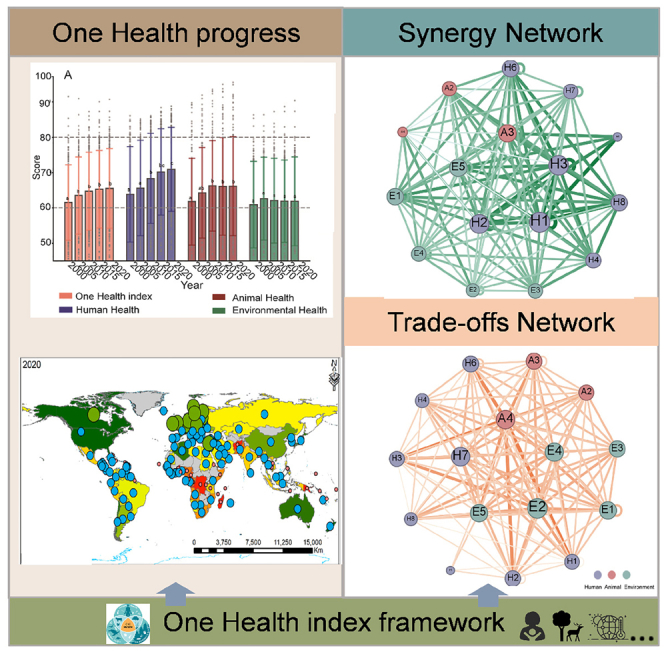
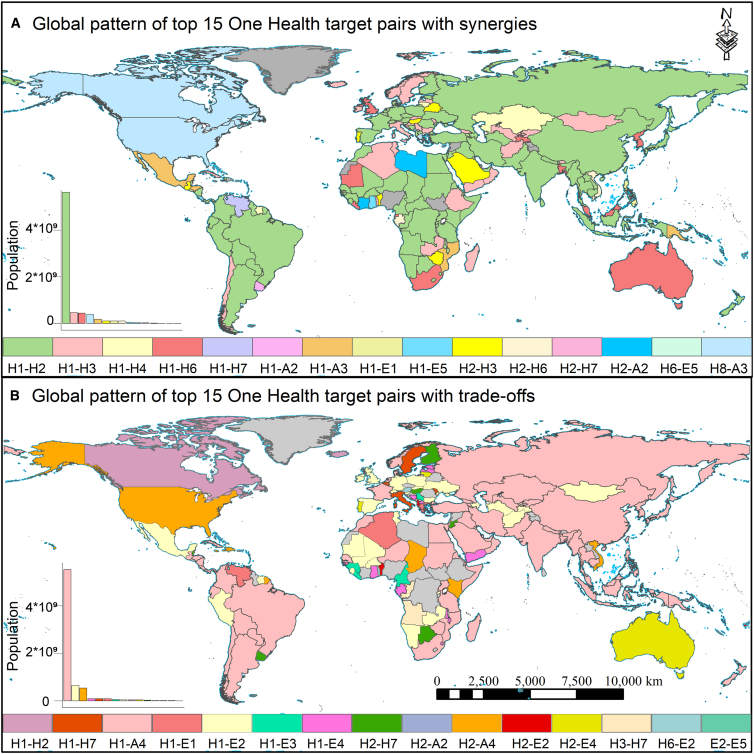
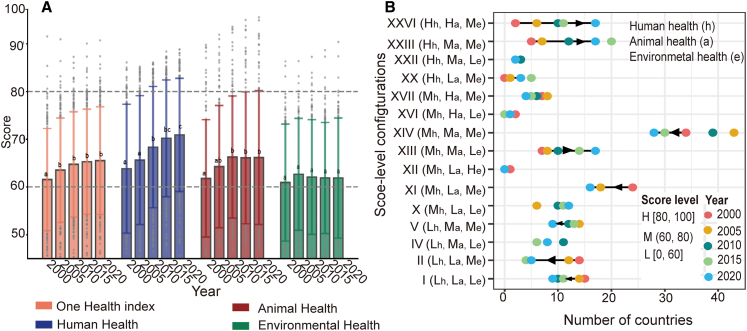
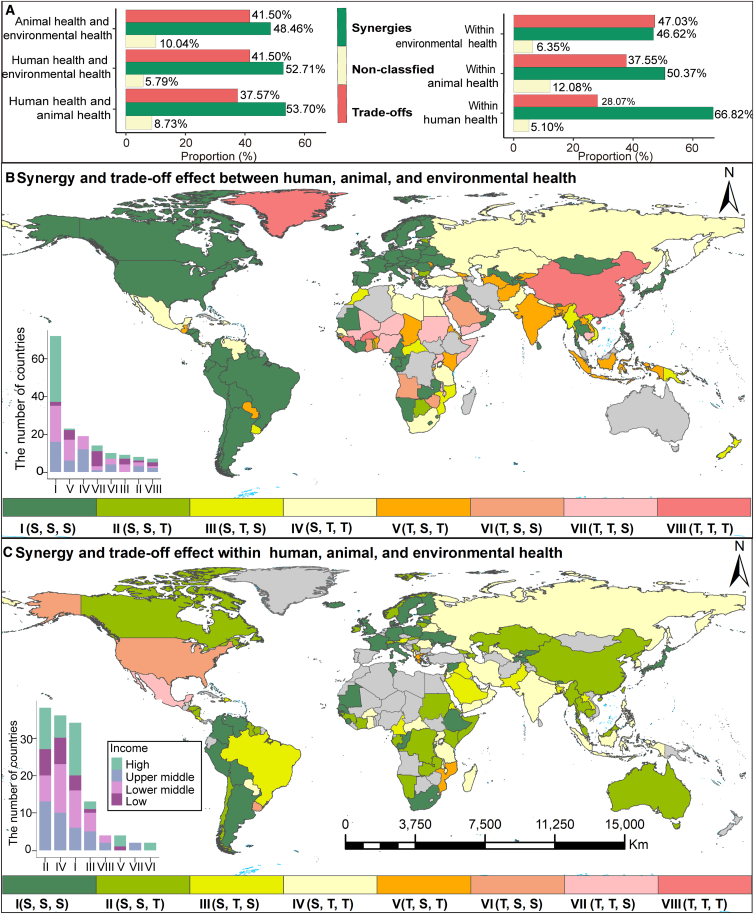
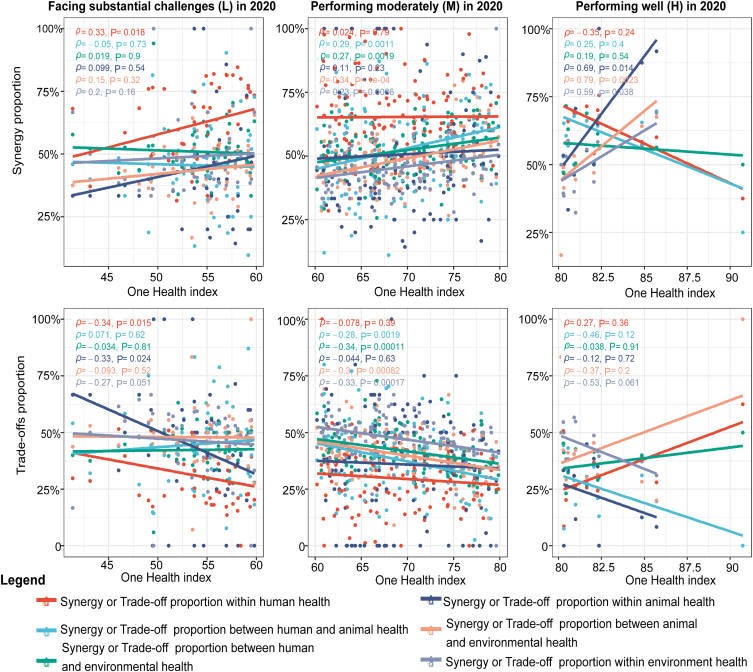
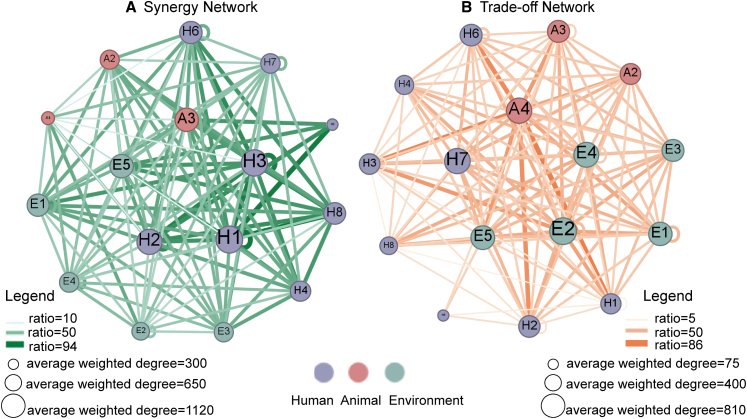
The One Health (OH) approach, integrating aspects of human, animal, and environmental health, still lacks robustly quantified insights into its complex relationships. To fill this knowledge gap, we devised a comprehensive assessment scheme for OH to assess its progress, synergies, trade-offs, and priority targets. From 2000 to 2020, we find evidence for global progress toward OH, albeit uneven, with its average score rising from 61.6 to 65.5, driven primarily by better human health although environmental health lags. Despite synergies prevalent within and between the three health dimensions, over half of the world's countries, mainly low-income ones, still incur substantial trade-offs impeding OH's advancement, especially between animal and environmental health. Our in-depth analysis of synergy and trade-off networks reveals that maternal, newborn, and child health are critical synergistic targets, whereas biodiversity and land resources dominate trade-offs. We provide key information for the synergetic and uniform development of global OH and policymaking.
“同一健康”(OH)方法整合了人类、动物和环境健康的各个方面,但对于其复杂关系仍缺乏强有力的量化见解。为填补这一知识空白,我们设计了一项针对“同一健康”的全面评估方案,以评估其进展、协同效应、权衡取舍和优先目标。从2000年到2020年,我们发现全球在“同一健康”方面取得了进展,尽管并不均衡,其平均得分从61.6上升到65.5,主要得益于人类健康状况的改善,尽管环境卫生有所滞后。尽管在三个健康维度内部和之间普遍存在协同效应,但世界上超过一半的国家,主要是低收入国家,仍然面临着重大的权衡取舍,阻碍了“同一健康”的推进,尤其是在动物和环境卫生之间。我们对协同和权衡网络的深入分析表明,孕产妇、新生儿和儿童健康是关键的协同目标,而生物多样性和土地资源则在权衡中占主导地位。我们为全球“同一健康”的协同和统一发展以及政策制定提供了关键信息。