Can Geylani, Shyian Maksym, Krishnamoorthy Archana, Lim Yang, Wu R Alex, Zaher Manal S, Raschle Markus, Walter Johannes C, Pellman David S
Department of Cell Biology, Blavatnik Institute, Harvard Medical School, Boston, MA 02115, USA.
Department of Pediatric Oncology, Dana-Farber Cancer Institute, Boston, MA 02215, USA.
bioRxiv. 2024 Nov 30:2024.11.30.626186. doi: 10.1101/2024.11.30.626186.
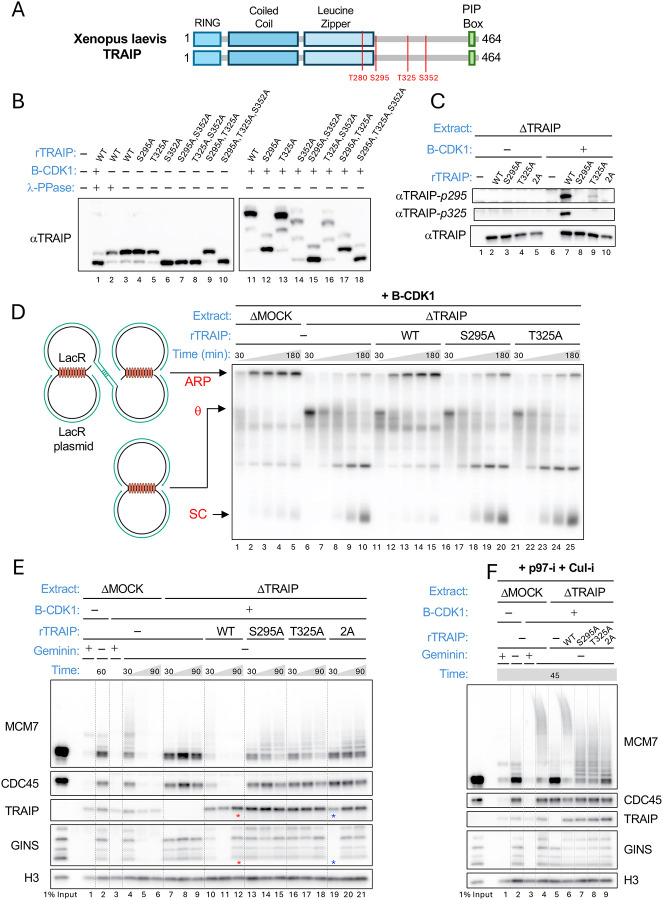
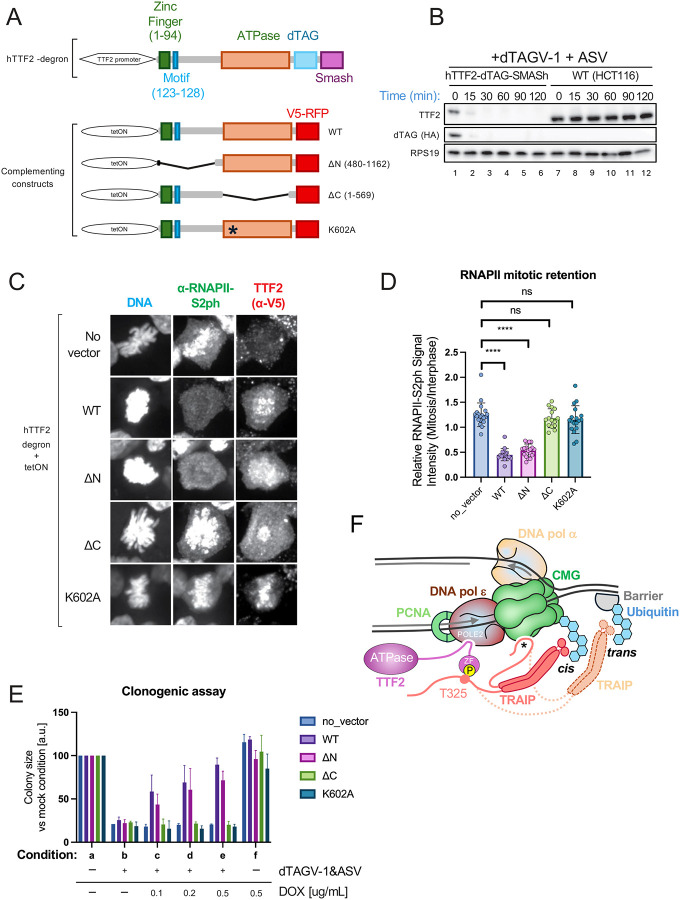
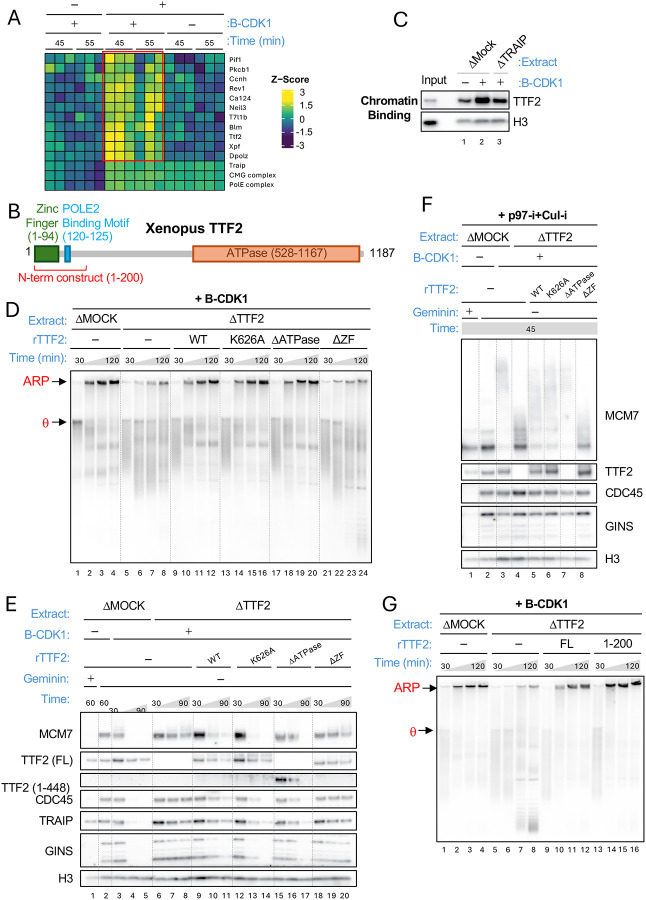
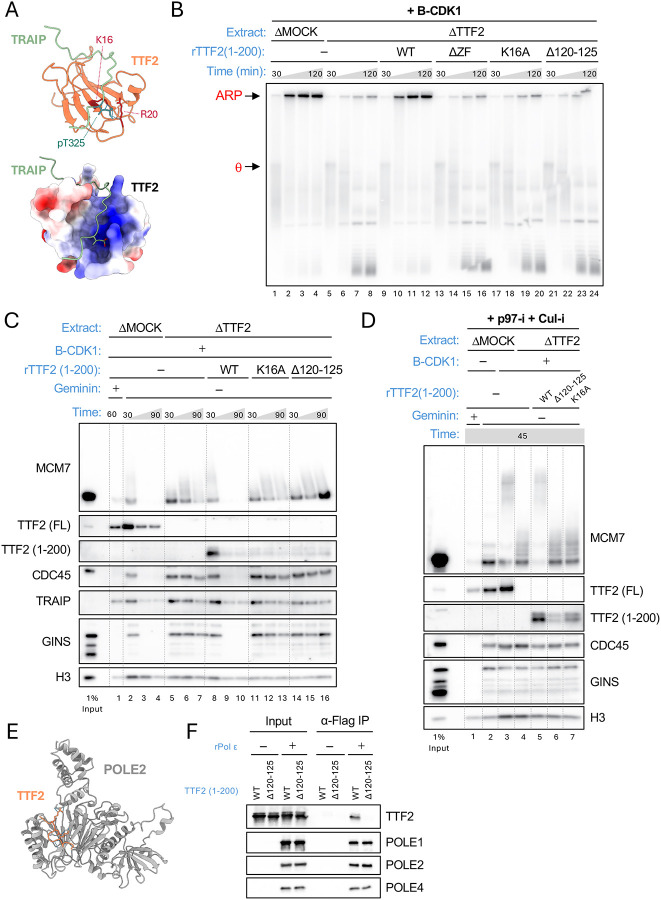
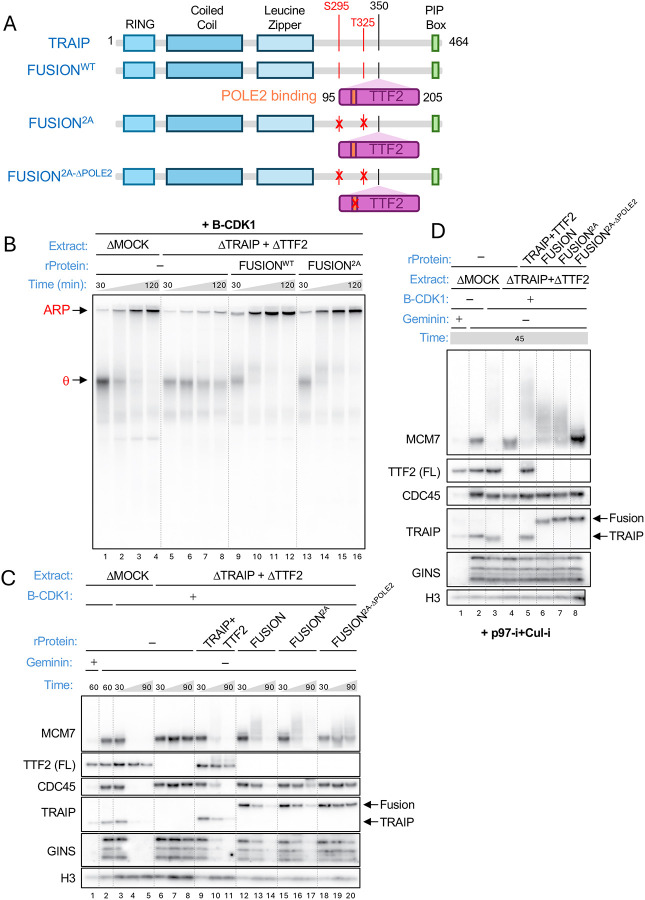
When cells enter mitosis with under-replicated DNA, sister chromosome segregation is compromised, which can lead to massive genome instability. The replisome-associated E3 ubiquitin ligase TRAIP mitigates this threat by ubiquitylating the CMG helicase in mitosis, leading to disassembly of stalled replisomes, fork cleavage, and restoration of chromosome structure by alternative end-joining. Here, we show that replisome disassembly requires TRAIP phosphorylation by the mitotic Cyclin B-CDK1 kinase, as well as TTF2, a SWI/SNF ATPase previously implicated in the eviction of RNA polymerase from mitotic chromosomes. We find that TTF2 tethers TRAIP to replisomes using an N-terminal Zinc finger that binds to phosphorylated TRAIP and an adjacent TTF2 peptide that contacts the CMG-associated leading strand DNA polymerase ε. This TRAIP-TTF2-pol ε bridge, which forms independently of the TTF2 ATPase domain, is essential to promote CMG unloading and stalled fork breakage. Conversely, RNAPII eviction from mitotic chromosomes requires the ATPase activity of TTF2. We conclude that in mitosis, replisomes undergo a CDK- and TTF2-dependent structural reorganization that underlies the cellular response to incompletely replicated DNA.
当细胞带着未完全复制的DNA进入有丝分裂时,姐妹染色单体的分离会受到损害,这可能导致大规模的基因组不稳定。与复制体相关的E3泛素连接酶TRAIP通过在有丝分裂中使CMG解旋酶泛素化来减轻这种威胁,导致停滞的复制体解体、叉状切割,并通过替代末端连接恢复染色体结构。在这里,我们表明复制体的解体需要有丝分裂周期蛋白B-CDK1激酶对TRAIP进行磷酸化,以及TTF2,一种先前与从有丝分裂染色体上驱逐RNA聚合酶有关的SWI/SNF ATP酶。我们发现TTF2使用一个与磷酸化的TRAIP结合的N端锌指和一个与CMG相关的前导链DNA聚合酶ε接触的相邻TTF2肽将TRAIP拴系到复制体上。这种TRAIP-TTF2-pol ε桥独立于TTF2 ATP酶结构域形成,对于促进CMG卸载和停滞叉状断裂至关重要。相反,从有丝分裂染色体上驱逐RNAPII需要TTF2的ATP酶活性。我们得出结论,在有丝分裂中,复制体经历了依赖于CDK和TTF2的结构重组,这是细胞对未完全复制的DNA做出反应的基础。