Pham Pierce, Biswas Oindrila, Hilty Christian
Chemistry Department, Texas A&M University, 3255 TAMU, College Station, Texas 77843, United States.
J Am Chem Soc. 2024 Dec 18;146(50):34274-34278. doi: 10.1021/jacs.4c13177. Epub 2024 Dec 9.
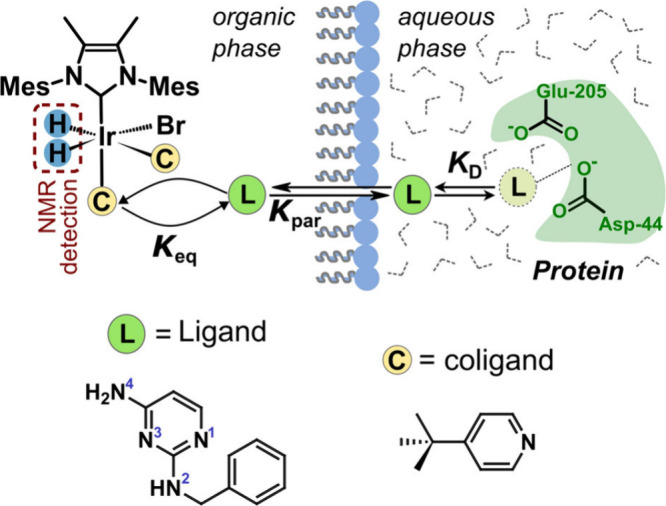
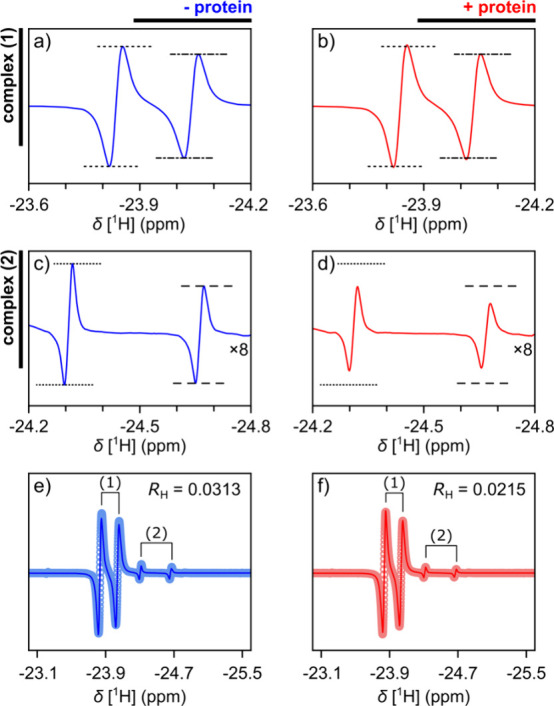
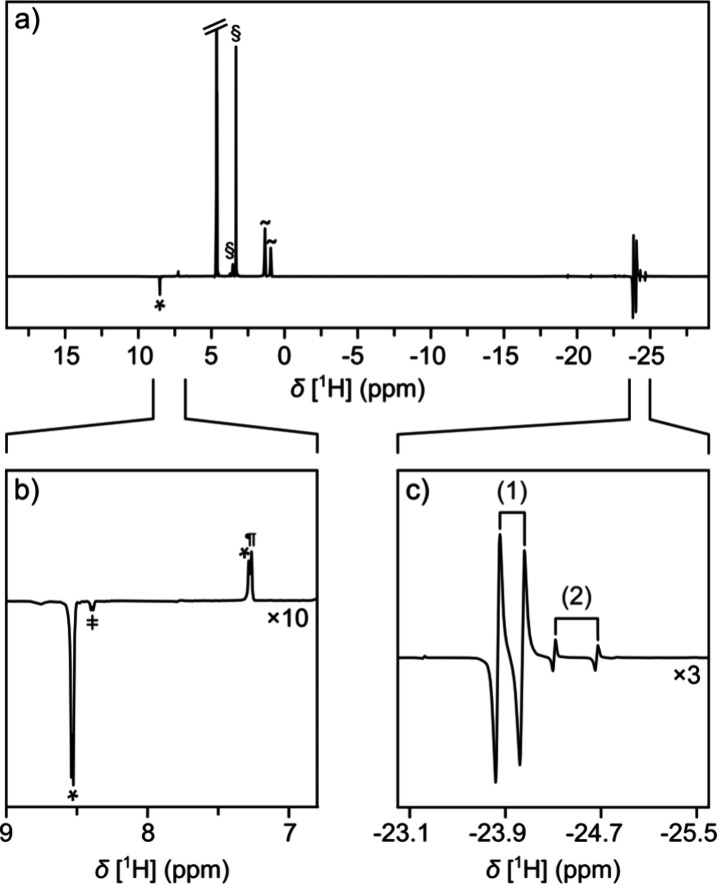
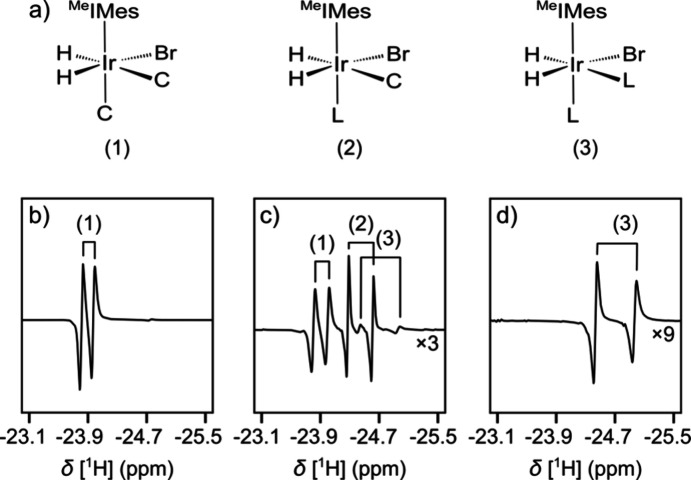
A medium containing reverse micelles supports non-hydrogenative parahydrogen induced polarization (nhPHIP) in the organic phase while solubilizing a protein in the aqueous phase. Strongly enhanced NMR signals from iridium hydride complexes report on a ligand, 4-amino-2-benzylaminopyrimidine, which crosses the phase boundary and interacts with the thiaminase protein TenA. The calculation of binding equilibria reveals a of 39.7 ± 8.9 μM for protein binding. The nanoscale separation of the two phases allows the separate optimization of the parahydrogen polarization and solubilization of a biological macromolecule. The reverse micelles may be used to study other biological questions using signal enhancement by parahydrogen polarization, such as enzyme reactions, protein-protein interactions, and protein binding epitopes.
一种含有反胶束的介质在有机相中支持非氢化对氢诱导极化(nhPHIP),同时在水相中溶解蛋白质。来自氢化铱配合物的强烈增强的NMR信号显示一种配体,即4-氨基-2-苄基氨基嘧啶,它穿过相界并与硫胺素酶蛋白TenA相互作用。结合平衡的计算表明蛋白质结合的解离常数为39.7±8.9μM。两相的纳米级分离允许分别优化对氢极化和生物大分子的溶解。反胶束可用于通过对氢极化增强信号来研究其他生物学问题,如酶反应、蛋白质-蛋白质相互作用和蛋白质结合表位。