Liu Li, Zhang Jianping, Li Jingbo, He Yahui, Gao Zhongzhe, Jiang Leping
Department of East Asian Languages and Cultures, Stanford University, Stanford, CA 94305.
State Key Laboratory of Lithospheric and Environmental Coevolution, Institute of Geology and Geophysics, Chinese Academy of Sciences, Beijing 100029, China.
Proc Natl Acad Sci U S A. 2024 Dec 17;121(51):e2412274121. doi: 10.1073/pnas.2412274121. Epub 2024 Dec 9.
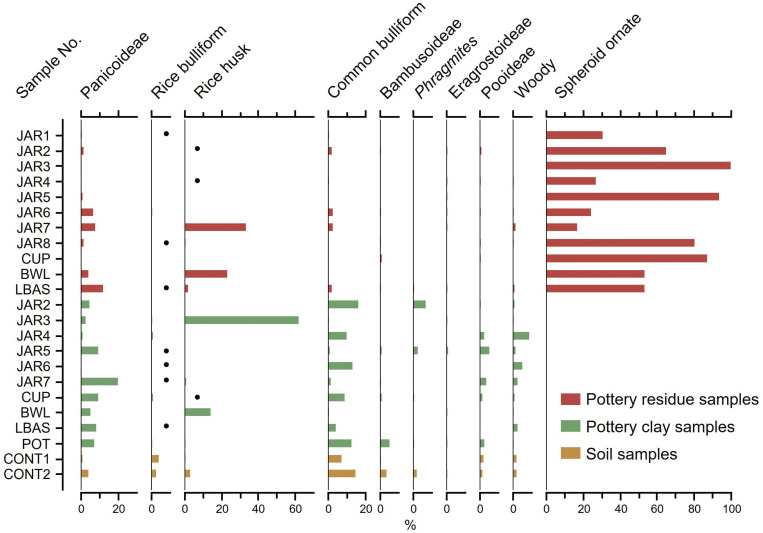
The origins of rice domestication and the beginnings of alcoholic fermentation in China are intriguing research topics, with the Shangshan culture in the Lower Yangzi River region being a focal point of archaeological investigations. This study employs a multiproxy approach (phytolith, starch, and fungi) to analyze microfossil remains associated with pottery vessels from the earliest phase of the Shangshan site (ca. 10,000 to 9,000 cal. BP). The results indicate that rice was consumed as a dietary staple and used for brewing fermented beverages with a starter containing mold and yeast as fermentation agents. The fermentation ingredients included rice, supplemented with other cereals (Job's tears, Panicoideae, and Triticeae), acorn, and lily. This rice-fungi-based multiplant brewing method marked the earliest-known alcoholic fermentation technique in East Asia. The emergence of this fermentation technology is attributable to the early development of rice domestication and the arrival of the wet-warm Holocene climate, which was favorable for fungal growth. These alcoholic beverages likely played a pivotal role in ceremonial feasting, highlighting their ritual function as a driving factor that may have stimulated the intensive utilization and widespread cultivation of rice in Neolithic China.
中国水稻驯化的起源以及酒精发酵的开端是引人入胜的研究课题,长江下游地区的上山文化是考古调查的重点。本研究采用多指标方法(植物硅酸体、淀粉和真菌),分析了上山遗址最早阶段(约公元前10000至9000年校正年代)与陶器相关的微化石遗迹。结果表明,水稻是主要食物,并被用于酿造发酵饮料,其发酵剂包含霉菌和酵母。发酵原料包括水稻,还补充了其他谷物(薏米、黍亚科和小麦族)、橡子和百合。这种基于水稻-真菌的多种植物酿造方法标志着东亚已知最早的酒精发酵技术。这种发酵技术的出现归因于水稻驯化的早期发展以及温暖湿润的全新世气候的到来,这有利于真菌生长。这些酒精饮料可能在仪式盛宴中发挥了关键作用,突出了它们作为一种驱动因素的仪式功能,这可能刺激了新石器时代中国对水稻的密集利用和广泛种植。