Kleinsmith Rebekah M, Huyke-Hernandez Fernando A, Abernathy Bailey R, Sibley Andrew, Ammons Jordan, Qian Lily, Switzer Julie A, Onizuka Naoko
Department of Orthopaedic Surgery, TRIA Orthopaedic Center, Bloomington, MN, USA.
Department of Orthopaedic Surgery, Methodist Hospital, St. Louis Park, MN, USA.
Geriatr Orthop Surg Rehabil. 2024 Dec 8;15:21514593241307157. doi: 10.1177/21514593241307157. eCollection 2024.
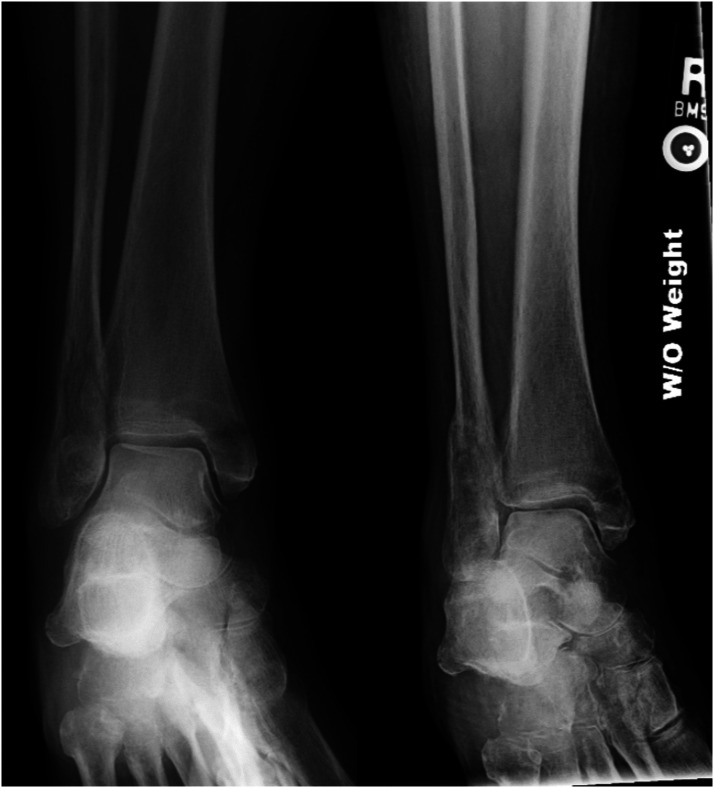
There is ongoing debate regarding the optimal management of older adult ankle fractures. The purpose of this study was to describe baseline characteristics and functional outcomes including complications in older adult patients receiving nonoperative treatment for low-energy ankle fracture and compare the outcomes of those with unstable vs stable fracture patterns.
Patients aged ≥65 from January 2012 to March 2019 that sustained an ankle fracture were identified. Those who had surgical treatment, age <65, high-energy trauma, bilateral ankle fractures, and patients without adequate follow-up (minimum 12 weeks) were excluded. Baseline demographics, injury characteristics, Charlson Comorbidity Index (CCI) score, and functioning regarding ambulatory status, living environment, and assistance personnel in the household were collected for all patients. The primary outcome of interest was retention of baseline ambulation, living environment, and assistance requirements at follow-up (>12 weeks). Pain improvement, radiographic changes, and adverse clinical events were also assessed.
A total of 158 patients were included with an average follow-up timeframe of 41.6 weeks. Eighty-six percent of patients (n = 136) retained their ambulatory status at long-term follow up. Most patients retained the same living environment (n = 145, 91.8%). Thirty-five patients (22.2%) required additional assistance long-term. Approximately 67.1% of the entire cohort retained all three functional metrics. Patients who experienced functional decline were older (77.8 vs 71.6, < 0.001), had higher CCI (3.2 vs 1.6, < 0.001), had a diagnosis of dementia or cognitive impairment (36.5% vs 3.8%, < 0.001), had lower baseline functional status (ambulation, living environment, and assistance required; all < 0.001), and had an unstable fracture pattern ( = 0.003).
Understanding the functional outcomes of non-operative treatment in geriatric ankle fracture cases can contribute to a shared decision-making among healthcare providers, patients, and families.
关于老年踝关节骨折的最佳治疗方法一直存在争议。本研究的目的是描述接受非手术治疗的低能量踝关节骨折老年患者的基线特征和功能结局,包括并发症,并比较不稳定骨折模式与稳定骨折模式患者的结局。
确定2012年1月至2019年3月期间年龄≥65岁的踝关节骨折患者。排除接受手术治疗、年龄<65岁、高能量创伤、双侧踝关节骨折以及随访不足(至少12周)的患者。收集所有患者的基线人口统计学、损伤特征、Charlson合并症指数(CCI)评分以及有关步行状态、生活环境和家庭护理人员的功能情况。感兴趣的主要结局是随访(>12周)时基线步行能力、生活环境和护理需求的维持情况。还评估了疼痛改善情况、影像学变化和不良临床事件。
共纳入158例患者,平均随访时间为41.6周。86%的患者(n = 136)在长期随访中保持了步行能力。大多数患者保持相同的生活环境(n = 145,91.8%)。35例患者(22.2%)长期需要额外护理。整个队列中约67.1%的患者保持了所有三项功能指标。出现功能下降的患者年龄较大(77.8岁对71.6岁,<0.001),CCI较高(3.2对1.6,<0.001),患有痴呆或认知障碍(36.5%对3.8%,<0.001),基线功能状态较低(步行能力、生活环境和护理需求;均<0.001),且骨折模式不稳定(=0.003)。
了解老年踝关节骨折非手术治疗的功能结局有助于医疗保健提供者、患者和家庭之间的共同决策。