Prestigiacomo Christiana, Fisher-Fox Lindsey, Cyders Melissa A
Department of Psychology, Indiana University Indianapolis, Indianapolis, IN, United States.
Drug Alcohol Depend Rep. 2024 Nov 19;13:100300. doi: 10.1016/j.dadr.2024.100300. eCollection 2024 Dec.
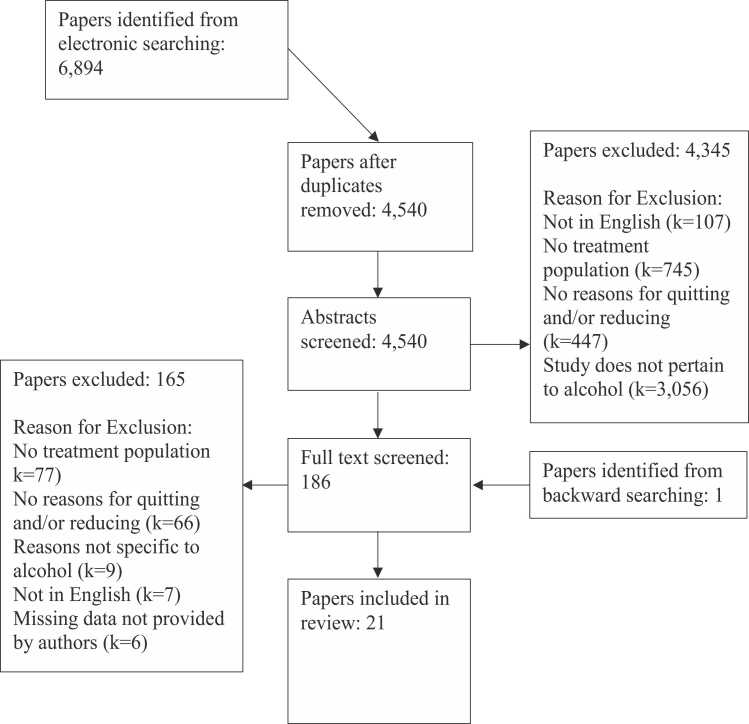
Research has primarily studied reasons for quitting and/or reducing alcohol use in non-treatment samples. This systematic review aimed to characterize the reasons for quitting and/or reducing alcohol use among those who have received treatment for AUD and examine how reasons endorsed differ across measurement methods used. Articles were identified through PsycINFO, Web of Science, PubMed, and CINAHL. Twenty-one articles met inclusion criteria. Thematic coding revealed 21 unique themes in reasons for quitting and/or reducing. Common reasons included physical health issues, misalignment with personal goals, family influence, and social factors-also noted in non-treatment populations. Unique themes like hitting rock bottom and avoiding disapproval were identified, potentially linked to treatment initiation or development. The measurement approach influenced the reasons reported, highlighting the need for standardized methods. Common reasons are fundamental and are not a result of treatment, while others are unique to individuals who have received AUD treatment, which may suggest that they are critical in leading one to seek treatment or may be developed during treatment. Assessing and tailoring treatment based on these reasons may enhance outcomes. Standardizing how we measure reasons for quitting or reducing alcohol is crucial for comparing studies and improving treatment. Future research should evaluate reasons over time, assess their importance at different treatment stages, and use varied assessment strategies for comprehensive insights.
研究主要集中在非治疗样本中戒酒和/或减少饮酒的原因。本系统评价旨在描述酒精使用障碍(AUD)患者戒酒和/或减少饮酒的原因,并研究不同测量方法所认可的原因有何差异。通过PsycINFO、科学网、PubMed和护理学与健康领域数据库检索相关文章。21篇文章符合纳入标准。主题编码揭示了21个戒酒和/或减少饮酒原因的独特主题。常见原因包括身体健康问题、与个人目标不符、家庭影响和社会因素,这些在非治疗人群中也有提及。还发现了诸如跌至谷底和避免他人不满等独特主题,这些可能与开始治疗或治疗过程有关。测量方法影响了所报告的原因,凸显了标准化方法的必要性。常见原因是根本性的,并非治疗的结果,而其他原因则是接受AUD治疗的个体所特有的,这可能表明这些原因对于促使人们寻求治疗至关重要,或者可能是在治疗过程中形成的。基于这些原因评估和调整治疗方案可能会提高治疗效果。标准化我们测量戒酒或减少饮酒原因的方式对于比较研究和改善治疗至关重要。未来的研究应长期评估这些原因,评估它们在不同治疗阶段的重要性,并使用多种评估策略以获得全面的见解。