Nascimento Filipe, Özyurt M Görkem, Halablab Kareen, Bhumbra Gardave Singh, Caron Guillaume, Bączyk Marcin, Zytnicki Daniel, Manuel Marin, Roselli Francesco, Brownstone Rob, Beato Marco
Department of Neuroscience Physiology and Pharmacology (NPP), University College London, Gower Street, WC1E 6BT London, UK; Department of Neuromuscular Diseases, UCL Queen Square Institute of Neurology, University College London, WC1N 3BG London, UK.
Department of Neuroscience Physiology and Pharmacology (NPP), University College London, Gower Street, WC1E 6BT London, UK; Department of Neuromuscular Diseases, UCL Queen Square Institute of Neurology, University College London, WC1N 3BG London, UK.
Cell Rep. 2024 Dec 24;43(12):115046. doi: 10.1016/j.celrep.2024.115046. Epub 2024 Dec 9.
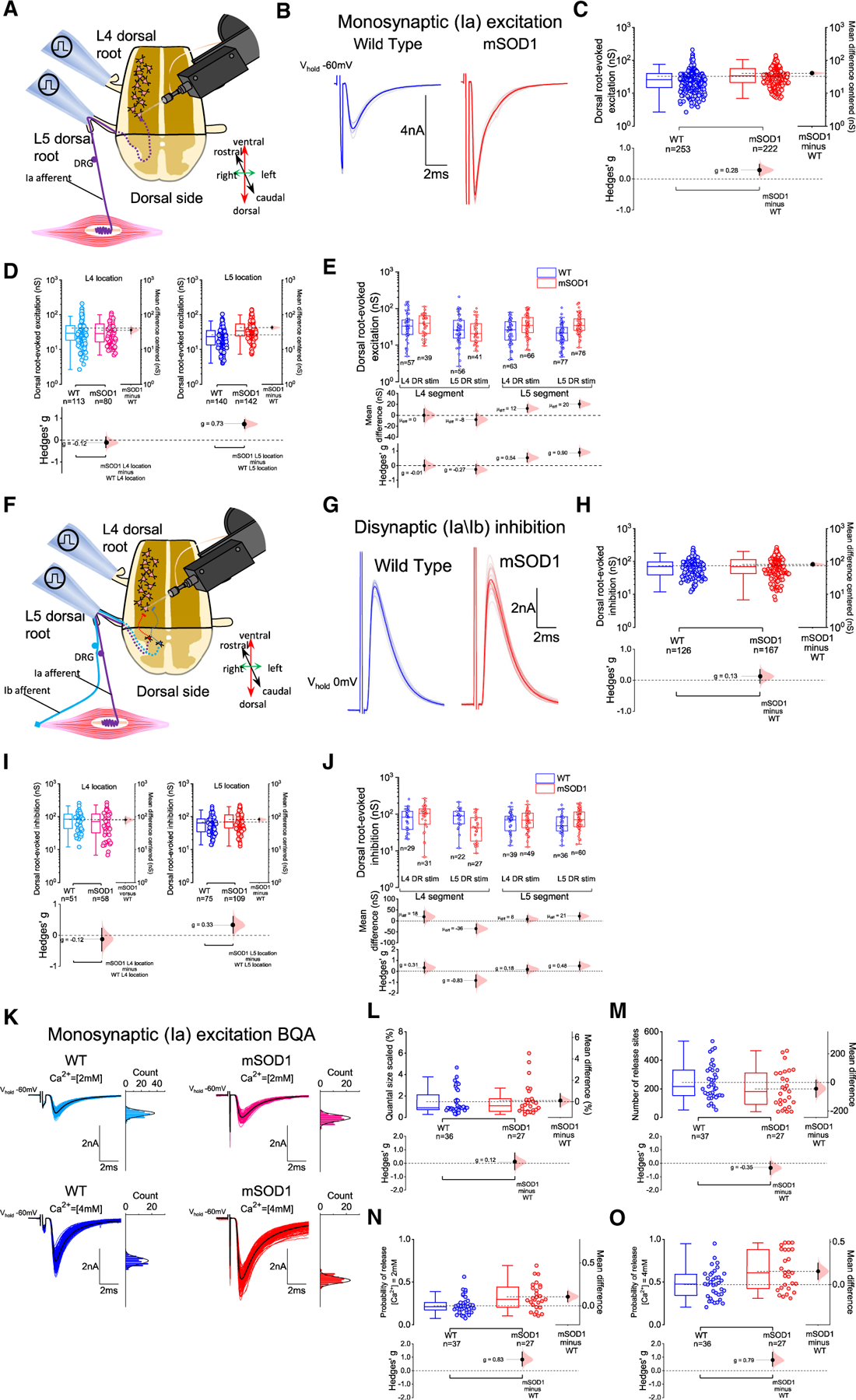
In many neurological conditions, early-stage neural circuit adaptation preserves relatively normal behavior. In some diseases, spinal motoneurons progressively degenerate yet movement remains initially preserved. This study investigates whether these neurons and associated microcircuits adapt in a mouse model of progressive motoneuron degeneration. Using a combination of in vitro and in vivo electrophysiology and super-resolution microscopy, we find that, early in the disease, neurotransmission in a key pre-motor circuit, the recurrent inhibition mediated by Renshaw cells, is reduced by half due to impaired quantal size associated with decreased glycine receptor density. This impairment is specific and not a widespread feature of spinal inhibitory circuits. Furthermore, it recovers at later stages of disease. Additionally, an increased probability of release from proprioceptive afferents leads to increased monosynaptic excitation of motoneurons. We reveal that, in this motoneuron degenerative condition, spinal microcircuits undergo specific multiphasic homeostatic compensations that may contribute to preservation of force output.
在许多神经疾病中,早期神经回路适应性变化能维持相对正常的行为。在某些疾病中,脊髓运动神经元会逐渐退化,但运动最初仍能保持。本研究调查了在进行性运动神经元退化的小鼠模型中,这些神经元及相关微回路是否会发生适应性变化。通过结合体外和体内电生理学以及超分辨率显微镜技术,我们发现,在疾病早期,一个关键的运动前回路(由闰绍细胞介导的回返抑制)中的神经传递因量子大小受损(与甘氨酸受体密度降低相关)而减少了一半。这种损伤具有特异性,并非脊髓抑制性回路的普遍特征。此外,它在疾病后期会恢复。另外,本体感觉传入神经释放概率的增加导致运动神经元单突触兴奋增强。我们揭示,在这种运动神经元退化状态下,脊髓微回路会经历特定的多相稳态补偿,这可能有助于维持力量输出。