Fisk Alexandra E, Smith Michael L, Richert Brian T, Olynk Widmar Nicole J
Department of Animal Sciences, Purdue University, West Lafayette, IN 47907, USA.
Department of Agricultural Economics, Purdue University, West Lafayette, IN 47907, USA.
Transl Anim Sci. 2024 Nov 12;8:txae155. doi: 10.1093/tas/txae155. eCollection 2024.
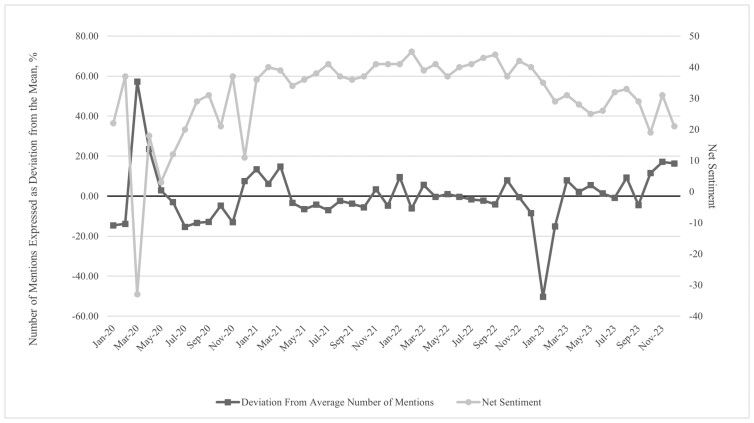
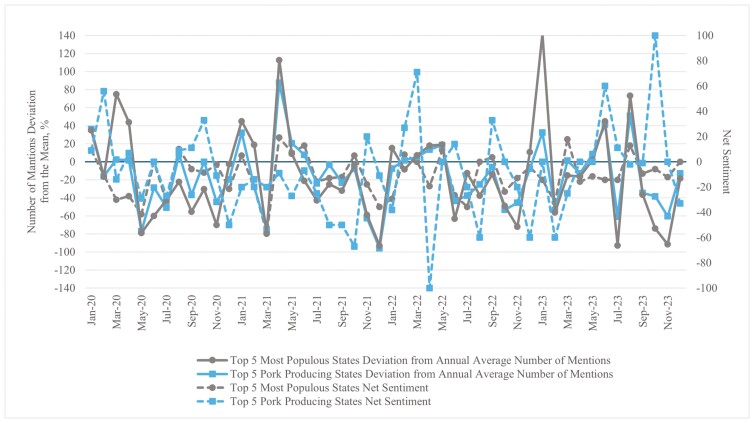
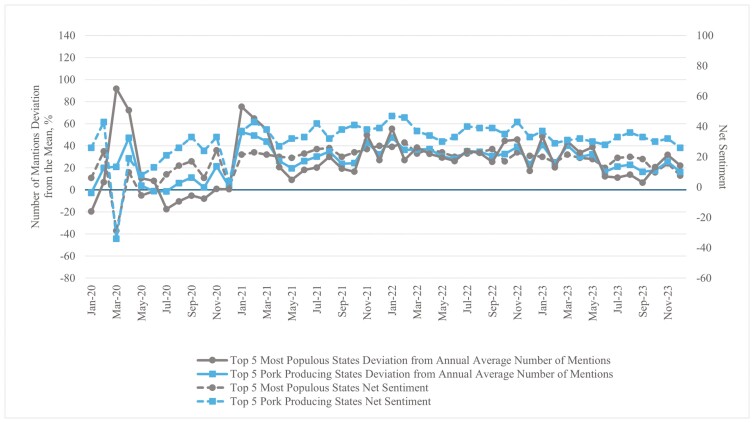
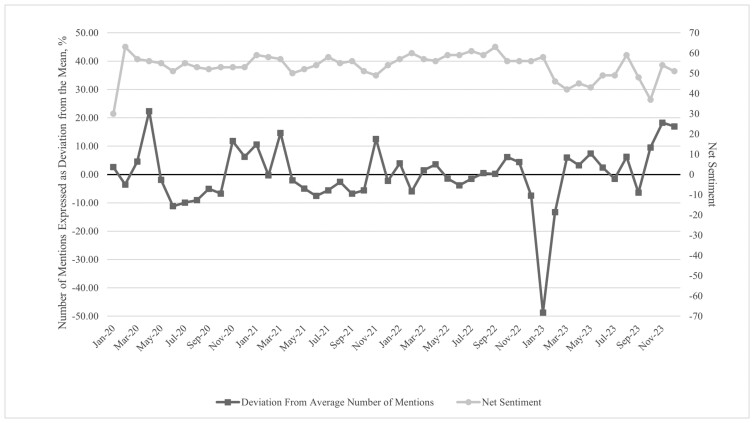
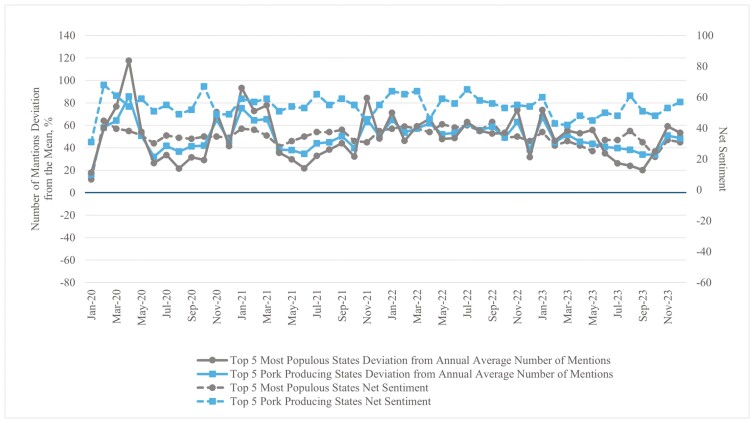
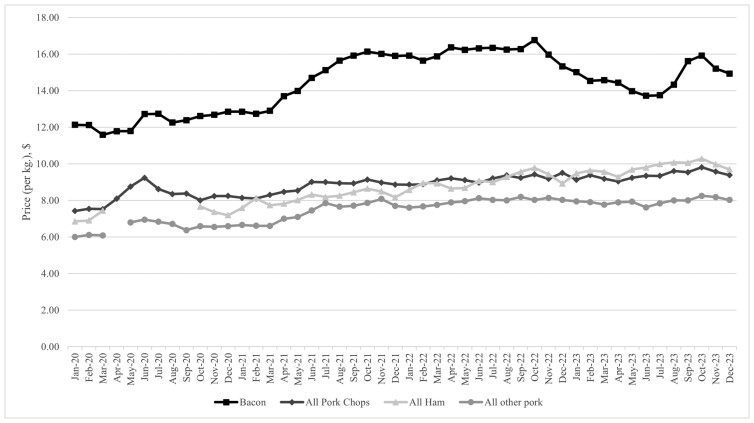
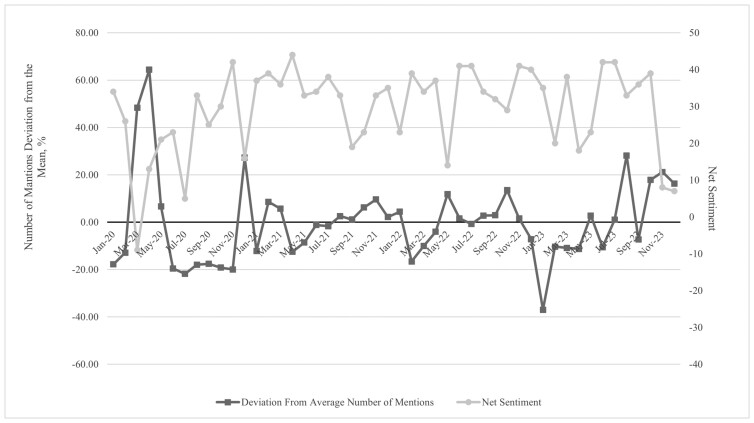
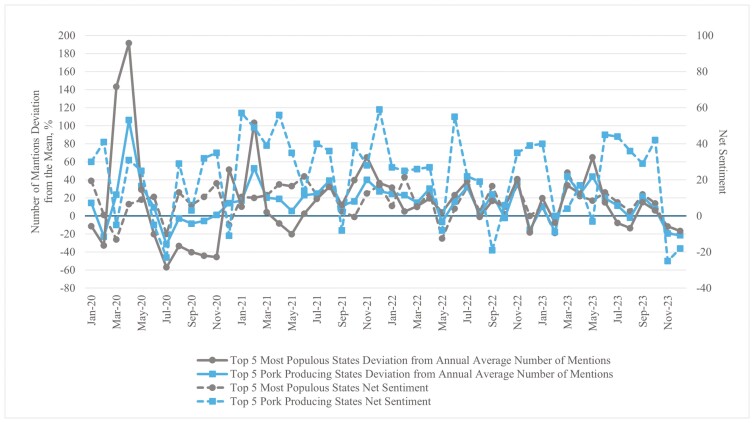
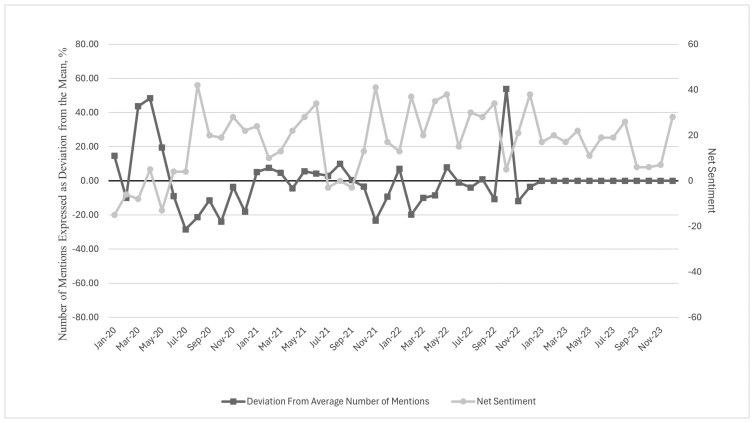
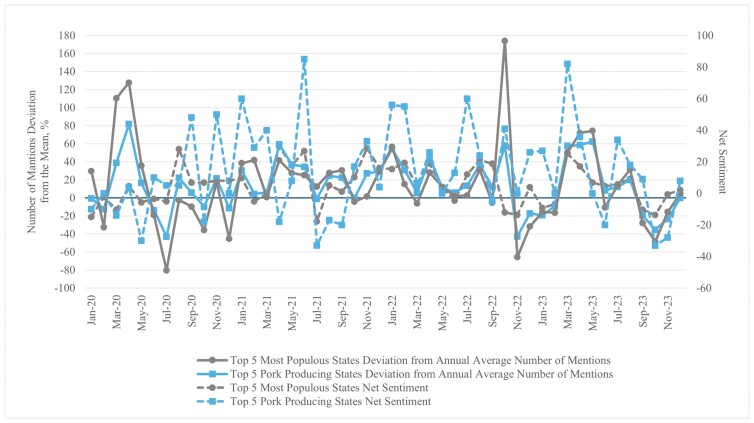
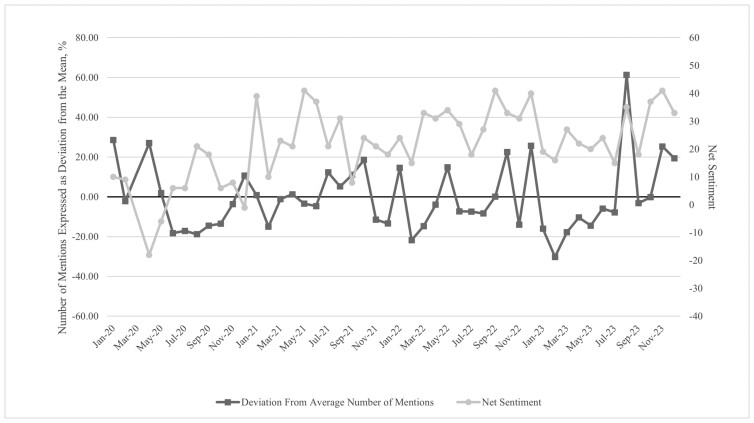
With the majority of the U.S. swine industry being generally bounded by social licensing, there is a growing need to understand social perspectives to better adapt to consumer demands. Online and social media data are rich datasets that researchers are leveraging to tackle economic and societal challenges. The information that can be gleaned from online media regarding public perceptions makes it an important tool for producers to understand driving topics of interest to the public. This study utilized a prominent online and social media listening and data analytics platform to identify and quantify online and social media mentions related to the U.S. swine industry from January 1, 2020, to December 31, 2023. A general search for online media referencing pork and pigs was designed resulting in a total of 41,093,309 mentions. The search was further queried to specific topics of food and cooking (20,580,068 mentions), price (2,866,548 mentions), welfare (1,615,208 mentions), sustainability (771,819 mentions), and top authors/organizations within the U.S. swine industry (1,430 mentions). The study spanned the geographic locations of the overall US (including U.S. Minor Outlying Islands), the top 5 most populous states, and the top 5 pork-producing states as of 2024. Of all mentions, X/Twitter was the largest domain for nearly all mentions related to pork and pigs. Major organizations designed to spread information between the general public and pork producers had a minor impact on the overall conversation and no online media presence in the top 5 most populous states. Net sentiment was overall positive across all 4 yr and all geographies except for major events such as the COVID-19 pandemic, the H1N1 Swine Flu, the passing of California Proposition 12, environmental events, and inflation-associated pork prices. Overall, most media presence had positive net sentiments and with most interest surrounding ways to cook pork and how to keep bacon cheap. Understanding public perceptions of the U.S. swine industry provides the opportunity to make informed decisions on marketing strategies and production practices.
由于美国养猪业的大部分通常受到社会许可的限制,因此越来越需要了解社会观点,以便更好地适应消费者需求。在线和社交媒体数据是丰富的数据集,研究人员正在利用这些数据集来应对经济和社会挑战。从在线媒体中收集到的有关公众认知的信息,使其成为生产者了解公众感兴趣的热门话题的重要工具。本研究利用一个著名的在线和社交媒体倾听与数据分析平台,识别并量化了2020年1月1日至2023年12月31日期间与美国养猪业相关的在线和社交媒体提及。设计了一项对提及猪肉和猪的在线媒体的总体搜索,共产生了41093309次提及。该搜索进一步针对食品和烹饪(20580068次提及)、价格(2866548次提及)、福利(1615208次提及)、可持续性(771819次提及)以及美国养猪业内的顶级作者/组织(1430次提及)等特定主题进行查询。该研究涵盖了美国整体(包括美国小离岛)、人口最多的前5个州以及截至2024年猪肉产量最高的前5个州的地理位置。在所有提及中,X/推特是几乎所有与猪肉和猪相关提及的最大来源。旨在在公众和猪肉生产者之间传播信息的主要组织对整体对话影响较小,且在人口最多的前5个州没有在线媒体影响力。除了新冠疫情、甲型H1N1猪流感、加利福尼亚州第12号提案的通过、环境事件以及与通胀相关的猪肉价格等重大事件外,所有年份和所有地区的净情绪总体上都是积极的。总体而言,大多数媒体呈现出积极的净情绪,且最受关注的是猪肉烹饪方法以及如何保持培根价格低廉。了解公众对美国养猪业的看法为就营销策略和生产实践做出明智决策提供了机会。