Chen Lu-Xi, Zhang Mei-Di, Xu Hai-Feng, Ye Hai-Qin, Chen Dian-Fu, Wang Pei-Shan, Bao Zhi-Wei, Zou Sheng-Mei, Lv Yong-Ting, Wu Zhi-Ying, Li Hong-Fu
Department of Medical Genetics and Center for Rare Diseases, Second Affiliated Hospital, Zhejiang University School of Medicine, Hangzhou, Zhejiang, China.
Nanhu Brain-Computer Interface Institute, Hangzhou, China.
Research (Wash D C). 2024 Dec 11;7:0548. doi: 10.34133/research.0548. eCollection 2024.
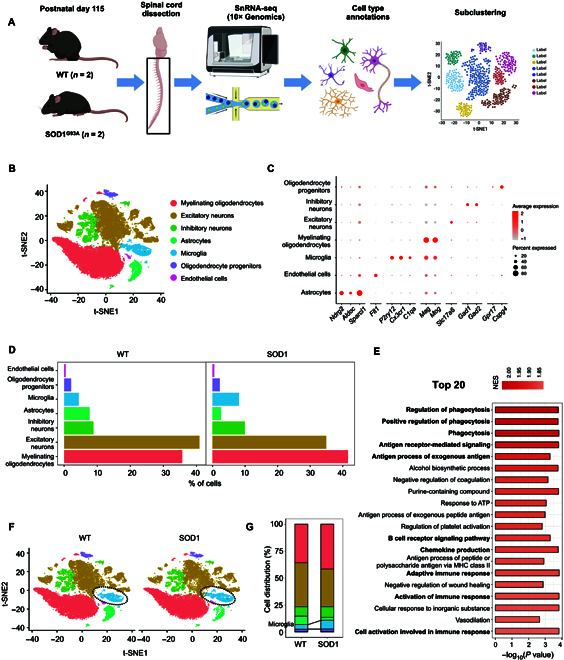
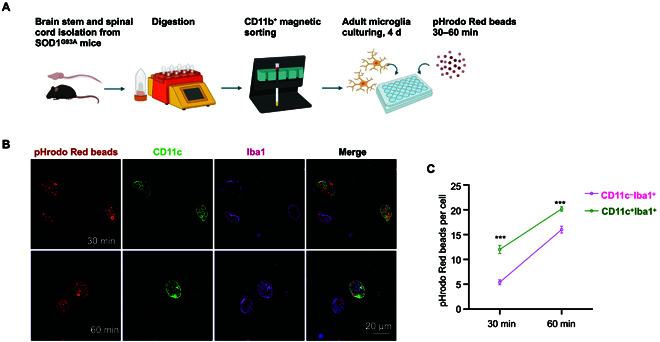
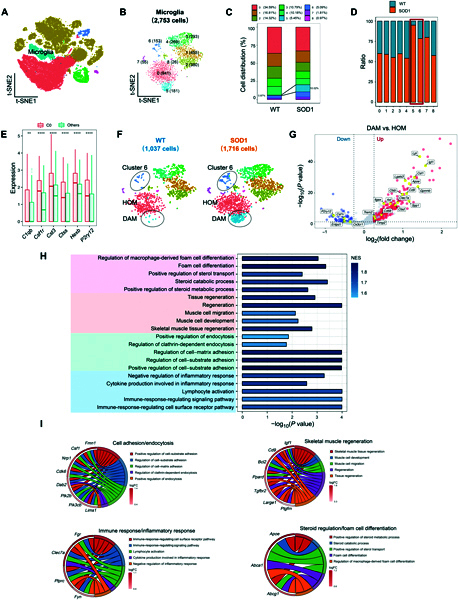
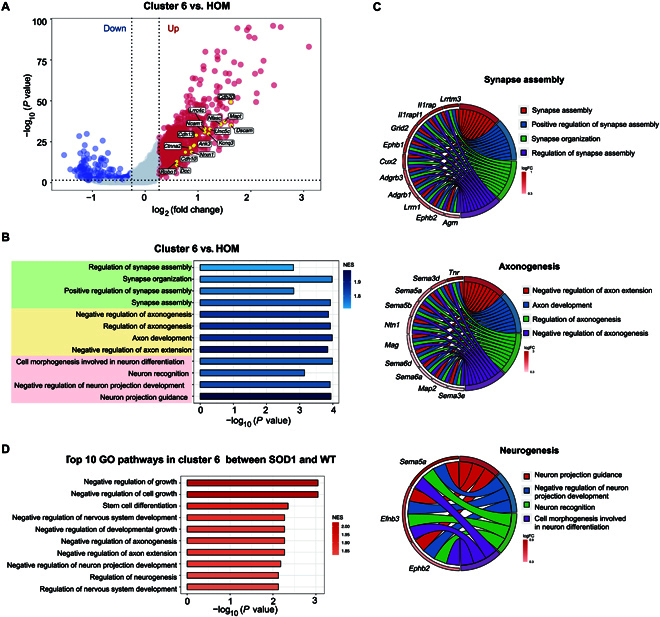
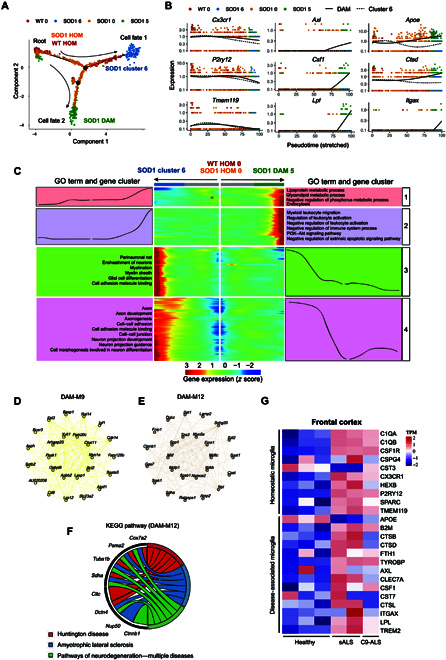
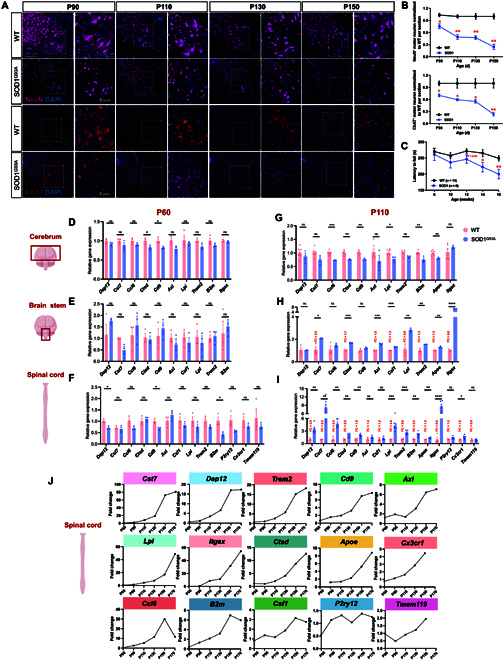
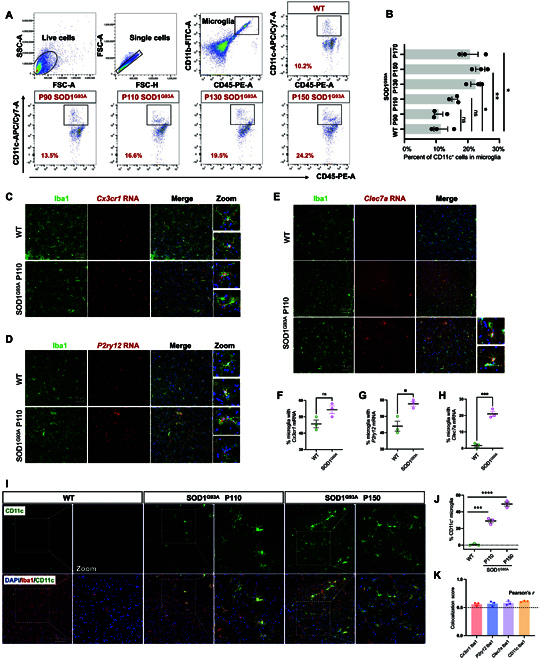
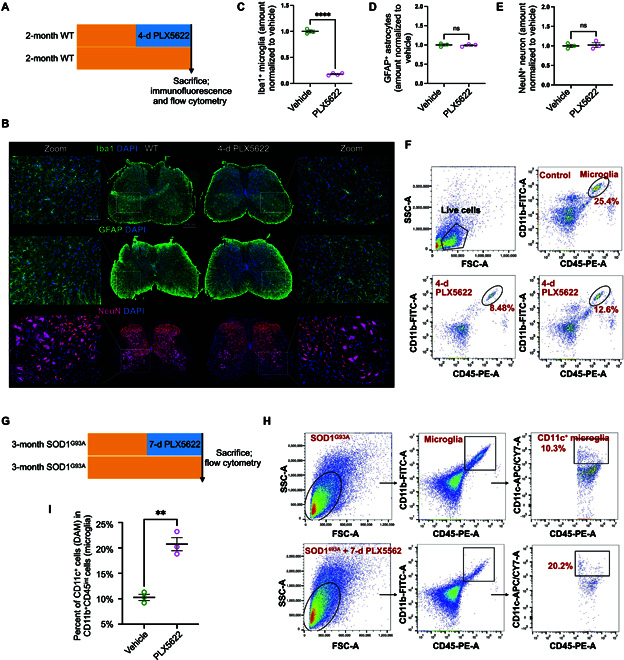
Disease-associated microglia (DAM) are observed in neurodegenerative diseases, demyelinating disorders, and aging. However, the spatiotemporal dynamics and evolutionary trajectory of DAM during the progression of amyotrophic lateral sclerosis (ALS) remain unclear. Using a mouse model of ALS that expresses a human gene mutation, we found that the microglia subtype DAM begins to appear following motor neuron degeneration, primarily in the brain stem and spinal cord. Using reverse transcription quantitative polymerase chain reaction, RNAscope in situ hybridization, and flow cytometry, we found that DAM increased in number as the disease progressed, reaching their peak in the late disease stage. DAM responded to disease progression in both SOD1 mice and sporadic ALS and -mutated patients. Motor neuron loss in SOD1 mice exhibited 2 accelerated phases: P90 to P110 (early stage) and P130 to P150 (late stage). Some markers were synchronized with the accelerated phase of motor neuron loss, suggesting that these proteins may be particularly responsive to disease progression. Through pseudotime trajectory analysis, we tracked the dynamic transition of homeostatic microglia into DAM and cluster 6 microglia. Interestingly, we used the colony-stimulating factor 1 receptor (CSF1R) inhibitor PLX5622 to deplete microglia in SOD1 mice and observed that DAM survival is independent of CSF1R. An in vitro phagocytosis assay directly confirmed that DAM could phagocytose more beads than other microglia subtypes. These findings reveal that the induction of the DAM phenotype is a shared cross-species and cross-subtype characteristic in ALS. Inducing the DAM phenotype and enhancing its function during the early phase of disease progression, or the time window between P130 and P150 where motor neuron loss slows, could serve as a neuroprotective strategy for ALS.
在神经退行性疾病、脱髓鞘疾病和衰老过程中可观察到疾病相关小胶质细胞(DAM)。然而,在肌萎缩侧索硬化症(ALS)进展过程中DAM的时空动态和进化轨迹仍不清楚。利用表达人类基因突变的ALS小鼠模型,我们发现小胶质细胞亚型DAM在运动神经元变性后开始出现,主要出现在脑干和脊髓。通过逆转录定量聚合酶链反应、RNAscope原位杂交和流式细胞术,我们发现随着疾病进展DAM数量增加,在疾病晚期达到峰值。DAM在SOD1小鼠和散发性ALS及突变患者中均对疾病进展有反应。SOD1小鼠的运动神经元损失呈现2个加速阶段:P90至P110(早期)和P130至P150(晚期)。一些标志物与运动神经元损失的加速阶段同步,表明这些蛋白质可能对疾病进展特别敏感。通过伪时间轨迹分析,我们追踪了稳态小胶质细胞向DAM和簇6小胶质细胞的动态转变。有趣的是,我们使用集落刺激因子1受体(CSF1R)抑制剂PLX5622清除SOD1小鼠中的小胶质细胞,并观察到DAM的存活不依赖于CSF1R。体外吞噬试验直接证实DAM比其他小胶质细胞亚型能吞噬更多珠子。这些发现揭示了DAM表型的诱导是ALS中一种跨物种和跨亚型的共同特征。在疾病进展的早期阶段,即P130至P150运动神经元损失减缓的时间窗口内,诱导DAM表型并增强其功能,可能是ALS的一种神经保护策略。