Stringfellow Andy, Wang Chih-Hsuan, Farias Claudio F G, Hastie Peter A
Department of Curriculum, Instruction and Foundations, Marshall University, Huntington, WV, United States.
Department of Educational Foundations, Leadership and Technology, Auburn University, Auburn, AL, United States.
Front Sports Act Living. 2024 Nov 27;6:1460267. doi: 10.3389/fspor.2024.1460267. eCollection 2024.
The purpose of this paper is to present a scale that assesses students' perceptions of their engagement in physical education. The scale assesses all four dimensions of engagement (agentic, cognitive, behavioral, and emotional) in order to be consistent with the contemporary notion of engagement used in current educational research.
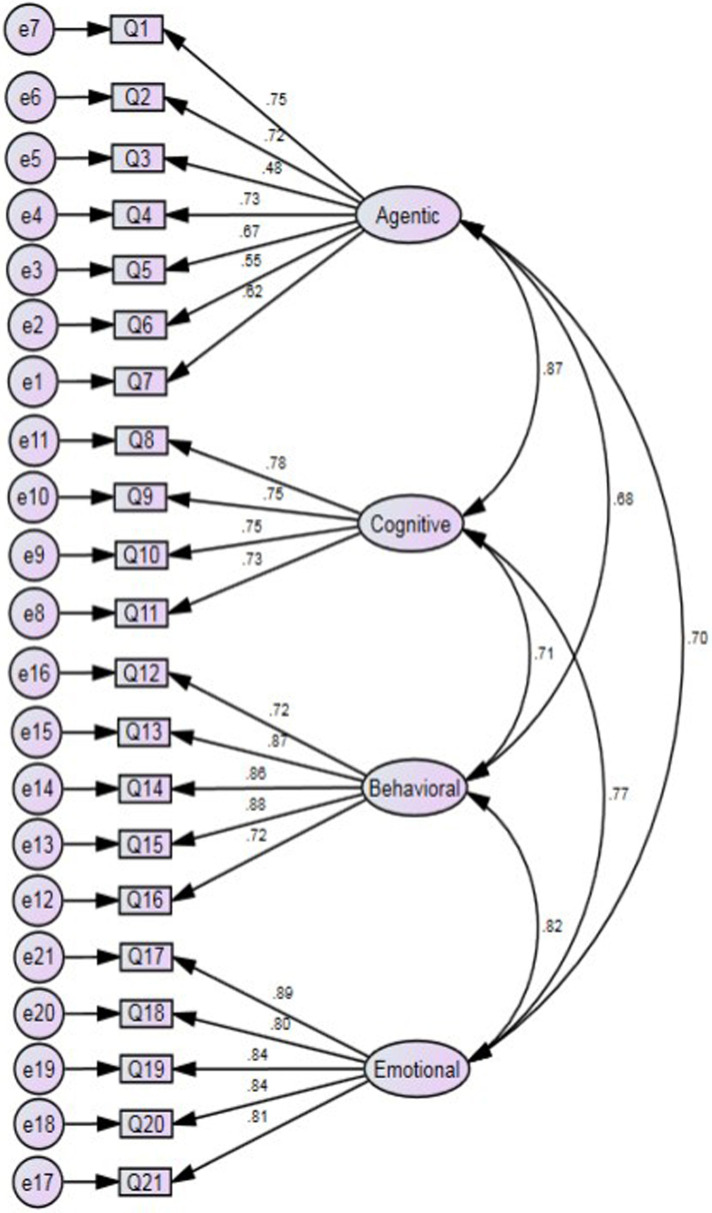
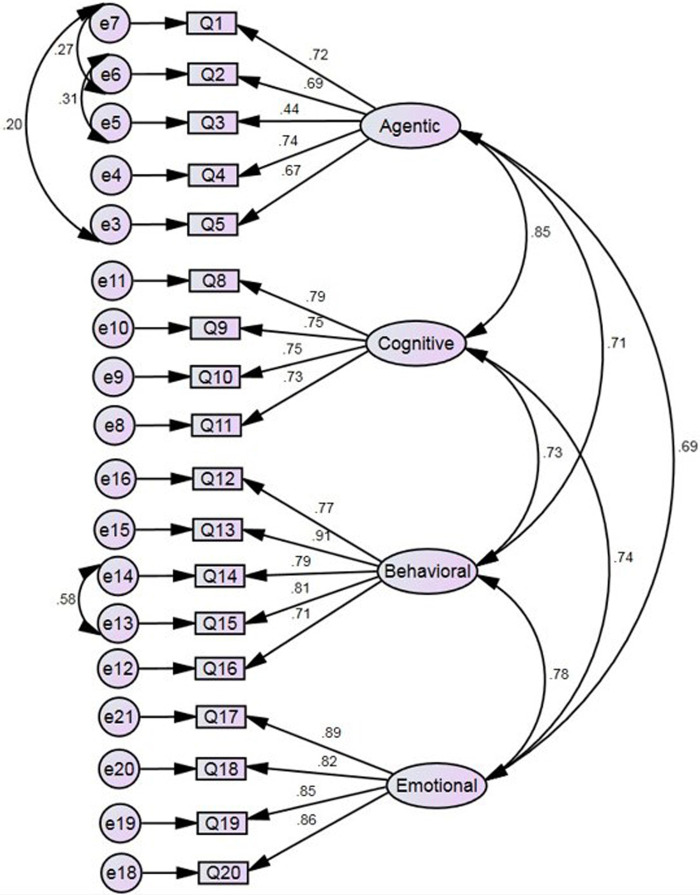
A total of 231 eighth and ninth-grade students (108 boys, Mage = 14.55) completed a 21-item scale, with items taken from previously validated scales, but with an added string relating to physical education lessons. Following model respecification by the examination of standardized residual covariances to remove items, the factor loading for each of the items on the scale was examined.
The results from a confirmatory factor analysis showed that there was psychometric support for an 18-item survey in which each of the four latent variables was kept in the validation of the four-factor hypothesized model. [ = 226.01, df = 125, /df = 1.808, GFI = .903, RMSEA (90% CI) = .061 (.048-.073)].
Given the research on engagement within physical education has been beleaguered by the lack of a robust operational definition, this scale allows for the comprehensive measurement of the different components of engagement.
本文旨在呈现一种评估学生对体育参与度认知的量表。该量表评估参与度的所有四个维度(能动、认知、行为和情感),以便与当前教育研究中使用的当代参与概念保持一致。
共有231名八年级和九年级学生(108名男生,平均年龄Mage = 14.55岁)完成了一份包含21个条目的量表,这些条目取自先前经过验证的量表,但增加了与体育课相关的内容。通过检查标准化残差协方差以去除条目来重新指定模型后,对量表中每个条目的因子载荷进行了检查。
验证性因子分析的结果表明,对于一个包含18个条目的调查问卷存在心理测量学支持,其中四个潜在变量中的每一个都保留在四因子假设模型的验证中。[χ² = 226.01,自由度df = 125,χ²/df = 1.808,GFI = 0.903,RMSEA(90%置信区间)= 0.061(0.048 - 0.073)]。
鉴于体育教育中关于参与度的研究一直因缺乏强有力的操作性定义而受到困扰,该量表能够全面测量参与度的不同组成部分。