Thieron Hannah, Krassini Laura, Kwon Seomun, Fricke Sebastian, Nasfi Sabrine, Oberkofler Lorenz, Ruf Alessa, Kehr Julia, Kogel Karl-Heinz, Weiberg Arne, Feldbrügge Michael, Robatzek Silke, Panstruga Ralph
Unit for Plant Molecular Cell Biology, Institute for Biology I, RWTH Aachen University, Aachen, Germany.
LMU Munich Biocenter, Ludwig-Maximilian-University of Munich, Munich, Germany.
J Extracell Vesicles. 2024 Dec;13(12):e70022. doi: 10.1002/jev2.70022.
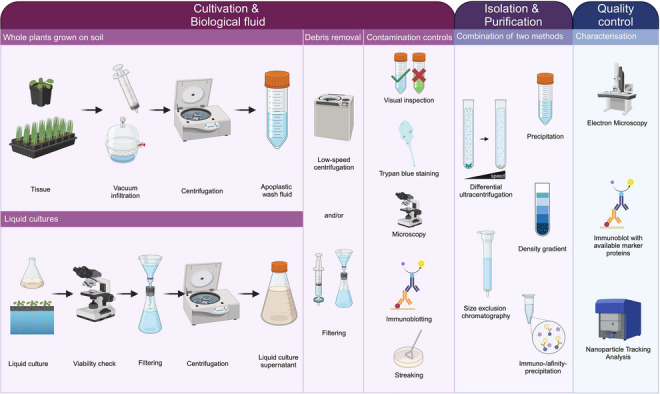
In recent years, extracellular vesicles (EVs) have emerged as novel key players in plant-microbe interactions. While it is immensely useful to draw on the established "minimal information for studies of extracellular vesicles" (MISEV) guidelines and precedents in mammalian systems, working with plants and their associated microbes poses specific challenges. To navigate researchers through these obstacles, we offer detailed step-by-step suggestions for those embarking on EV research in the context of plant-microbe interactions. The advice is based on recent publications and our collective experience from the diverse plant and microbe systems studied in a dedicated research consortium. We provide considerations for experimental design, optimization, quality control, and recommendations on how to increase yield, purity, and reproducibility of EV isolation. With this perspective article, we aim not only to assist researchers in our field but also to promote discussions on plant and microbe EVs in the broader EV community.
近年来,细胞外囊泡(EVs)已成为植物 - 微生物相互作用中的新型关键参与者。虽然借鉴哺乳动物系统中已确立的“细胞外囊泡研究的最小信息”(MISEV)指南和先例非常有用,但研究植物及其相关微生物存在特定挑战。为帮助研究人员克服这些障碍,我们为那些在植物 - 微生物相互作用背景下开展细胞外囊泡研究的人员提供详细的逐步建议。这些建议基于近期的出版物以及我们在一个专门研究联盟中对多种植物和微生物系统的集体经验。我们提供了实验设计、优化、质量控制方面的注意事项,以及关于如何提高细胞外囊泡分离的产量、纯度和可重复性的建议。通过这篇观点文章,我们不仅旨在协助本领域的研究人员,还旨在促进更广泛的细胞外囊泡领域对植物和微生物细胞外囊泡的讨论。