Yusuf Osman M, Ramalingam Sandeep, Norrie John, Graham Catriona, Kakakhail Ahmad, Rextin Aimal T, Baig Ramsha T, Yusuf Shahida O, Ahmad Bakhtawar, Zahra Summan, Sheikh Aziz
The Allergy & Asthma Institute, Islamabad, Pakistan.
National Health Service (NHS) Lothian, Edinburgh, UK.
J Glob Health. 2024 Dec 13;14:05027. doi: 10.7189/jogh.14.05027.
In a previous pilot randomised controlled trial conducted on UK adults, we found that hypertonic saline nasal irrigation and gargling (HSNIG) reduced common cold symptoms, the need for over-the-counter medications, viral shedding, and the duration and transmission of the illness. It is unclear whether HSNIG improves outcomes of the coronavirus disease 2019 (COVID-19). Hypertonic saline can be prepared and HSNIG performed at home, making it a safe and scalable intervention, particularly well-suited for low- and middle-income countries.
We conducted a pragmatic randomised controlled trial in Pakistan on adults with suspected or confirmed COVID-19, initially within 48 hours of symptom onset, later extended to within five days due to recruitment challenges. Participants were randomised to one of two groups: the intervention group received instructions on preparing a 2.6% hypertonic saline solution for HSNIG, while the control group was instructed on performing ablution for Muslim prayers (wudu), which involves nasal washing and gargling with tap water. Our primary outcome was the time to symptom resolution, measured by two consecutive days of scoring zero on relevant questions from the validated, self-reported, adapted short form of the Wisconsin Upper Respiratory Symptom Survey (WURSS-24). Secondary outcomes included the severity of all symptoms, the severity and time to resolution of individual symptoms, health care contacts (GP/physician, emergency contacts), hospital attendance (and length of stay if admitted), over-the-counter (OTC) medication (frequency and cost), and transmission to household contacts. The analysis was conducted on an intention-to-treat basis. Logistic regression was used to calculate adjusted odds ratios (aORs) of improvement and Cox regression to calculate adjusted hazard ratios (aHRs) for the time to improvement with accompanying 95% confidence intervals (CIs).
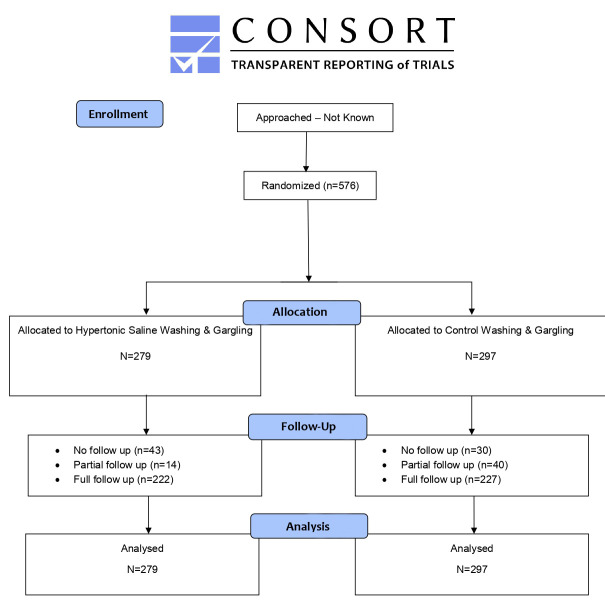
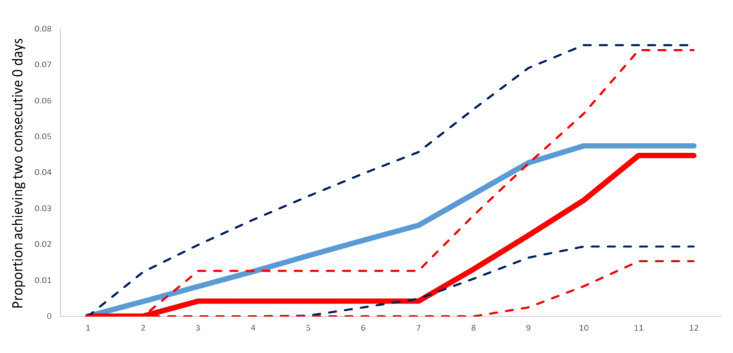
We randomised 576 people: 279 to the HSNIG group and 297 to the control group. Among those, 10 out of 279 (3.6%) in the HSNIG had symptom resolution, compared with 11 out of 297 (3.7%) in the control group (aOR = 1.20, 95% CI = 0.46- 3.22). The time-to-event analysis also showed no significant benefit (aHR = 1.23, 95% CI = 0.51-2.97). Excluding the 127 participants with no data on the primary outcome (who did not complete the study), 10 out of 222 (4.5%) in the HSNIG group had symptom resolution, compared to 11 out of 227 (4.8%) in the control group.
HSNIG was not effective for individuals with suspected or confirmed COVID-19 who began the intervention within five days of symptoms onset and therefore cannot be recommended for use. Further investigation is needed for interventions started within 48 hours of illness onset.
ClinicalTrials.gov (NCT05104372).
在之前针对英国成年人开展的一项先导性随机对照试验中,我们发现高渗盐水鼻腔冲洗和漱口(HSNIG)可减轻普通感冒症状、减少非处方药物的使用、减少病毒排出,以及缩短疾病持续时间和传播。目前尚不清楚HSNIG是否能改善2019冠状病毒病(COVID-19)的预后。高渗盐水可在家中自行配制,且可在家中进行HSNIG,这使其成为一种安全且可推广的干预措施,尤其适合低收入和中等收入国家。
我们在巴基斯坦对疑似或确诊COVID-19的成年人进行了一项实用随机对照试验,最初在症状出现后的48小时内纳入,后因招募困难将时间延长至五天内。参与者被随机分为两组:干预组接受关于制备2.6%高渗盐溶液用于HSNIG的指导,而对照组接受关于穆斯林祈祷净礼(小净)的指导,小净包括用自来水洗鼻和漱口。我们的主要结局是症状缓解时间,通过对经过验证的、自我报告的、改编后的威斯康星上呼吸道症状调查问卷简表(WURSS-24)中相关问题连续两天得分为零来衡量。次要结局包括所有症状的严重程度、个体症状的严重程度及缓解时间、医疗保健接触(全科医生/内科医生、紧急联系人)、住院情况(若住院则为住院时间)、非处方(OTC)药物(使用频率和费用)以及传播给家庭接触者。分析基于意向性治疗原则进行。使用逻辑回归计算改善的调整比值比(aOR),使用Cox回归计算改善时间的调整风险比(aHR)以及相应的95%置信区间(CI)。
我们将576人随机分组:279人分到HSNIG组,297人分到对照组。其中,HSNIG组279人中有10人(3.6%)症状缓解,而对照组297人中有11人(3.7%)症状缓解(aOR = 1.20,95% CI = 0.46 - 3.22)。生存时间分析也未显示出显著益处(aHR = 1.23,95% CI = 0.51 - 2.97)。排除127名无主要结局数据(未完成研究)的参与者后,HSNIG组222人中有10人(4.5%)症状缓解,而对照组227人中有11人(4.8%)症状缓解。
对于在症状出现五天内开始干预的疑似或确诊COVID-19个体,HSNIG无效,因此不建议使用。对于在疾病发作48小时内开始的干预措施,需要进一步研究。
ClinicalTrials.gov(NCT05104372)