Buß A M, Wittmann F G, Pabst A, Luppa M, Oey A, Blotenberg I, Cardona M I, Weise S, Bauer A, Kosilek R P, Bader F, Brettschneider C, Wiese B, Hoffmann W, Frese T, Gensichen J S, König H-H, Thyrian J R, Riedel-Heller S G
Institute of Social Medicine, Occupational Health and Public Health (ISAP), University of Leipzig, Leipzig, Germany.
Institute for General Practice, Work Group Medical Statistics and IT-Infrastructure, Hannover Medical School, Hannover, Germany.
Front Public Health. 2024 Nov 28;12:1435945. doi: 10.3389/fpubh.2024.1435945. eCollection 2024.
Health disparities pose a considerable challenge for older adults individuals, particularly those with a heightened risk of developing dementia. Discrepancies in health status among various income brackets are only partially attributable to structural factors such as working and living conditions or the quality of food. The aim of this study was therefore to explore whether and to what extent various health-promoting behaviors can explain the association between household income and self-rated health among older people at risk of dementia.
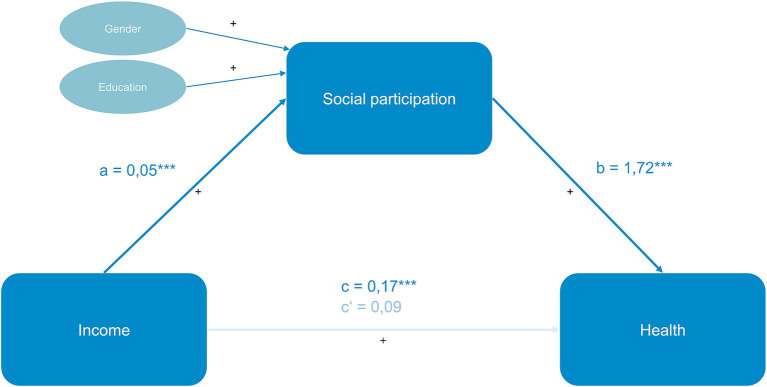
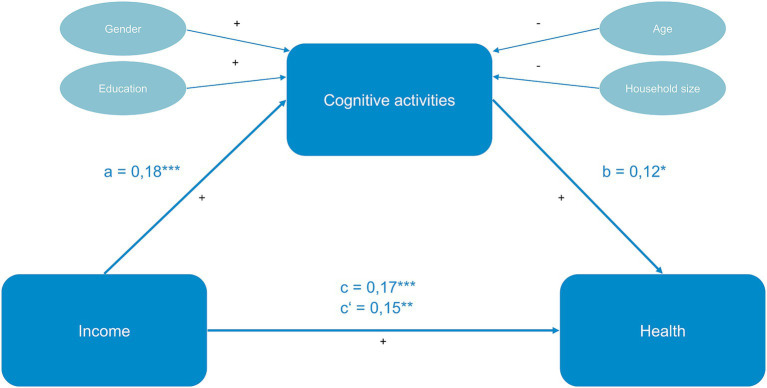
The sample consisted of 845 participants (average age 68.9 years; 52.6% female) from the AgeWell.de study, an intervention trial aiming to preserve cognitive function. The participants exhibited an increased risk of dementia, defined by a CAIDE (Cardiovascular Risk Factors, Aging and Dementia) score of at least nine points. To explore the relationship between household income and self-rated health, measured using the EQ-5D-VAS, a regression analysis was conducted. This association was then examined using four mediation analyses that included health-promoting behaviors such as fruit and vegetable consumption, social participation, physical activities, and cognitive activities.
The results reveal a positive association between higher income and self-rated health. This relationship is mediated by social participation. Additionally, cognitive activities were found to partially mediate this correlation. Neither physical activities nor fruit and vegetable consumption could account for the association between income and self-rated health.
The findings have the potential to advance research on the correlation between income and health among older age cohorts at risk of developing dementia. They highlight the potential significance of social engagement and cognitive activities for health and may inspire the development of strategies aimed at enhancing accessibility to activities such as cultural events, educational institutions, and participation in courses for a wider audience.
健康差距给老年人带来了巨大挑战,尤其是那些患痴呆症风险较高的人。不同收入阶层之间的健康状况差异,仅有部分可归因于工作和生活条件或食物质量等结构性因素。因此,本研究的目的是探讨各种促进健康的行为能否以及在多大程度上解释有患痴呆症风险的老年人家庭收入与自评健康之间的关联。
样本包括来自AgeWell.de研究的845名参与者(平均年龄68.9岁;52.6%为女性),该研究是一项旨在保持认知功能的干预试验。参与者患痴呆症的风险增加,由CAIDE(心血管危险因素、衰老和痴呆症)评分至少9分来定义。为了探讨家庭收入与使用EQ-5D-VAS测量的自评健康之间的关系,进行了回归分析。然后使用四项中介分析来检验这种关联,这些分析包括促进健康的行为,如水果和蔬菜消费、社会参与、体育活动和认知活动。
结果显示较高收入与自评健康之间存在正相关。这种关系由社会参与介导。此外,发现认知活动部分介导了这种相关性。体育活动和水果及蔬菜消费均不能解释收入与自评健康之间的关联。
这些发现有可能推进对有患痴呆症风险的老年人群体中收入与健康相关性的研究。它们突出了社会参与和认知活动对健康的潜在重要性,并可能激发旨在提高文化活动、教育机构等活动的可及性以及让更广泛受众参与课程的策略的制定。