Koleilat Alaa, Tang Hongwei, Sharma Neeraj, Yan Huihuang, Tian Shulan, Smadbeck James, Shivaram Suganti, Meyer Reid, Pearce Kathryn, Baird Michael, Zepeda-Mendoza Cinthya J, Xu Xinjie, Greipp Patricia T, Peterson Jess F, Ketterling Rhett P, Bergsagel P Leif, Vachon Celine, Rajkumar S Vincent, Kumar Shaji, Asmann Yan W, Elhaik Eran, Baughn Linda B
Division of Laboratory Genetics and Genomics, Department of Laboratory Medicine and Pathology, Mayo Clinic, Rochester, MN.
Division of Computational Biology, Department of Quantitative Health Sciences, Mayo Clinic, Rochester, MN.
Genet Med Open. 2023 May 9;1(1):100816. doi: 10.1016/j.gimo.2023.100816. eCollection 2023.
Fluorescence in situ hybridization (FISH) is the current gold standard assay that provides information related to risk stratification and therapeutic selection for individuals with plasma cell neoplasms. The differential hybridization of FISH probe sets in association with individuals' genetic ancestry has not been previously reported.
This retrospective study included 1224 bone marrow samples from individuals who had an abnormal plasma cell proliferative disorder FISH result and a concurrent conventional G-banded chromosome study. DNA from bone marrow samples obtained from the G-banded chromosome study was genotyped, and a biogeographical ancestry prediction was carried out.
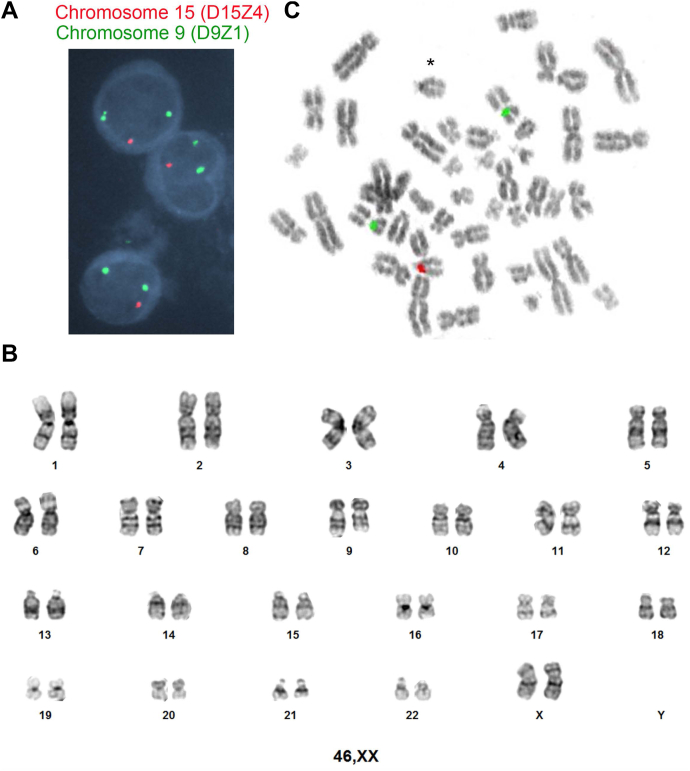
Using a cohort of individuals with a plasma cell neoplasm, we identified reduced hybridization of a chromosome 15 centromere FISH probe (D15Z4). Metaphase FISH studies of cells with 2 copies of chromosome 15 demonstrated a failure of the D15Z4 FISH probe to hybridize to one chromosome 15 centromere, revealing a false-positive monosomy 15 FISH result in some individuals. Surprisingly, individuals with a monosomy 15 FISH result had a median African ancestry of 77.2% (95% CI 74.1%-80.3%), compared with a median African ancestry of 2.2% (95% CI 2.0%-2.5%) in the non-monosomy 15 cohort ( value = 9.4 × 10). Thus, individuals with African ancestry had an 8.02-fold (95% CI 3.73-17.25) increased probability of having a false-positive monosomy 15 result ( value = 9.92 × 10).
This study emphasizes a concern regarding the reliability of diagnostic genomic tools and their application in interpreting genetic testing results in diverse patient populations. We discuss alternative methodologies to better represent different ancestry groups in clinical diagnostic testing.
荧光原位杂交(FISH)是目前的金标准检测方法,可为浆细胞肿瘤患者提供与风险分层和治疗选择相关的信息。此前尚未有关于FISH探针组与个体遗传血统相关的差异杂交的报道。
这项回顾性研究纳入了1224例骨髓样本,这些样本来自浆细胞增殖性疾病FISH检测结果异常且同时进行了传统G带染色体研究的个体。对从G带染色体研究中获得的骨髓样本DNA进行基因分型,并进行生物地理血统预测。
通过一组浆细胞肿瘤患者,我们发现15号染色体着丝粒FISH探针(D15Z4)的杂交减少。对具有2条15号染色体拷贝的细胞进行中期FISH研究表明,D15Z4 FISH探针未能与一条15号染色体着丝粒杂交,在一些个体中显示出假阳性的15号染色体单体FISH结果。令人惊讶的是,15号染色体单体FISH结果的个体非洲血统中位数为77.2%(95%可信区间74.1%-80.3%),而非15号染色体单体组的非洲血统中位数为2.2%(95%可信区间2.0%-2.5%)(P值 = 9.4×10⁻¹⁰)。因此,具有非洲血统的个体出现假阳性15号染色体单体结果的概率增加了8.02倍(95%可信区间3.73-17.25)(P值 = 9.92×10⁻¹⁰)。
本研究强调了对诊断基因组工具的可靠性及其在不同患者群体中解释基因检测结果的应用的关注。我们讨论了在临床诊断检测中更好地代表不同血统群体的替代方法。