van der Sluijs P J, Gösgens M, Dingemans A J M, Striano P, Riva A, Mignot C, Faudet A, Vasileiou G, Walther M, Schrier Vergano S A, Alders M, Alkuraya F S, Alorainy I, Alsaif H S, Anderlid B, Bache I, van Beek I, Blanluet M, van Bon B W, Brunet T, Brunner H, Carriero M L, Charles P, Chatron N, Coccia E, Dubourg C, Earl R K, Eichler E E, Faivre L, Foulds N, Graziano C, Guerrot A M, Hashem M O, Heide S, Heron D, Hickey S E, Hopman S M J, Kattentidt-Mouravieva A, Kerkhof J, Klein Wassink-Ruiter J S, Kurtz-Nelson E C, Kušíková K, Kvarnung M, Lecoquierre F, Leszinski G S, Loberti L, Magoulas P L, Mari F, Maystadt I, Merla G, Milunsky J M, Moortgat S, Nicolas G, Leary M O ', Odent S, Ozmore J R, Parbhoo K, Pfundt R, Piccione M, Pinto A M, Popp B, Putoux A, Rehm H L, Reis A, Renieri A, Rosenfeld J A, Rossi M, Salzano E, Saugier-Veber P, Seri M, Severi G, Sonmez F M, Strobl-Wildemann G, Stuurman K E, Uctepe E, Van Esch H, Vitetta G, de Vries B B A, Wahl D, Wang T, Zacher P, Heitink K R, Ropers F G, Steenbeek D, Rybak T, Santen G W E
Department of Clinical Genetics, Leiden University Medical Center, Leiden, the Netherlands.
Department of Human Genetics, Donders Institute for Brain, Cognition and Behaviour, Radboud University Medical Center, Nijmegen, the Netherlands.
Genet Med Open. 2024 Jul 23;2:101873. doi: 10.1016/j.gimo.2024.101873. eCollection 2024.
is one of the most frequently mutated genes in intellectual disability cohorts. Thus, far few adult-aged patients with -related disorder have been described, which limits our understanding of the disease's natural history and our ability to counsel patients and their families.
Data on patients aged 18+ years with -related disorder were collected through an online questionnaire completed by clinicians and parents.
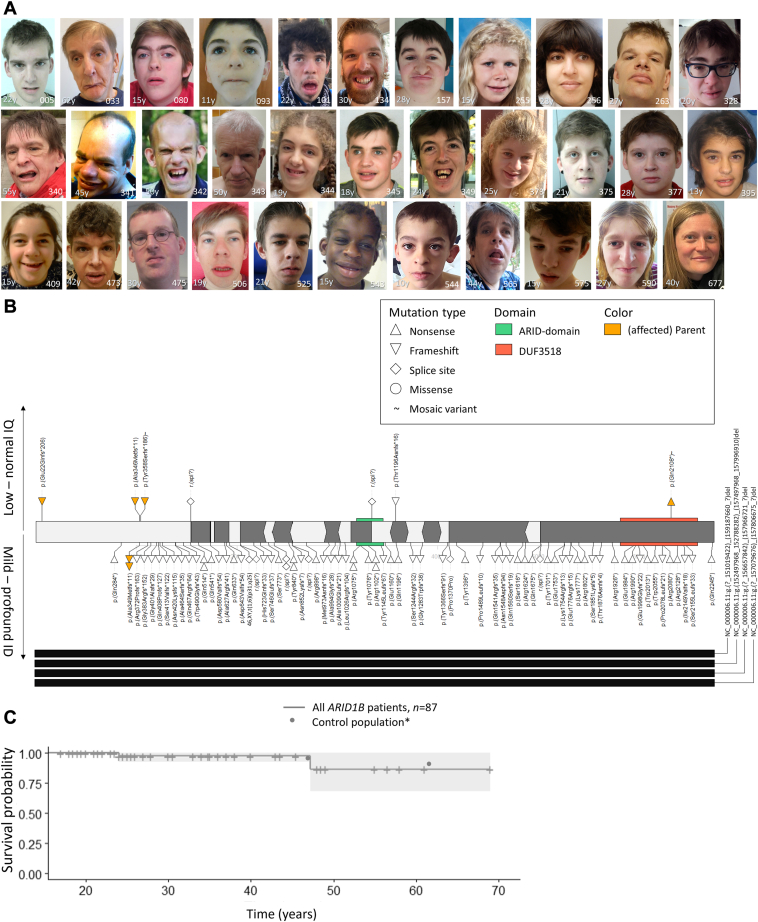
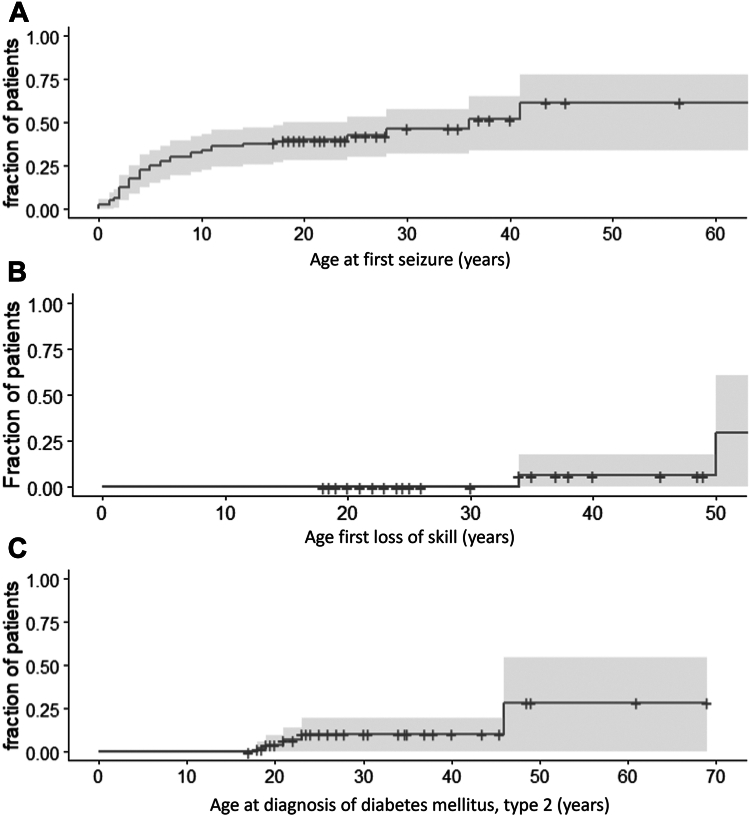
Eighty-seven adult patients with were included. Cognitive functioning ranged from borderline to severe intellectual disability. Patients identified through the genetic workup of their child were either mosaic or had a variant in exon 1. New clinical features identified in this population are loss of skill (16/64, 25%) and recurrent patella luxation (12/45, 32%). Self-sustainability data showed that 88% (45/51) could eat independently, and 16% (7/45) could travel alone by public transport. Facial photo analysis showed that patients' photographs taken at different ages clustered consistently, separate from matched controls.
The spectrum is broad, and as patients age, there is a significant shift in the medical aspects requiring attention. To address the changing medical needs with increasing age, we have formulated recommendations to promote timely intervention in an attempt to mitigate disease progression.
是智力障碍队列中最常发生突变的基因之一。然而,迄今为止,很少有关于相关疾病的成年患者的描述,这限制了我们对该疾病自然史的了解以及为患者及其家属提供咨询的能力。
通过临床医生和家长填写的在线问卷收集18岁及以上患有相关疾病患者的数据。
纳入了87名成年患者。认知功能从边缘智力障碍到重度智力障碍不等。通过对其子女进行基因检查确定的患者要么是嵌合体,要么在外显子1中有变异。在该人群中发现的新临床特征是技能丧失(16/64,25%)和复发性髌骨脱位(12/45,32%)。自我维持能力数据显示,88%(45/51)的患者能够独立进食,16%(7/45)的患者能够独自乘坐公共交通工具出行。面部照片分析表明,患者在不同年龄拍摄的照片始终聚集在一起,与匹配的对照组不同。
相关疾病谱广泛,随着患者年龄增长,需要关注的医学方面有显著变化。为了应对随着年龄增长而不断变化的医疗需求,我们制定了建议,以促进及时干预,试图减轻疾病进展。