Schranc Álmos, Daniels John, Südy Roberta, Fontao Fabienne, Bijlenga Philippe, Plourde Guillaume, Quintard Hervé
Unit for Anaesthesiological Investigation, Department of Anaesthesiology, Pharmacology, Intensive Care and Emergency Medicine, University of Geneva, 1 rue Michel-Servet, Geneva, Switzerland.
Division of Neurosurgery, Department of Clinical Neurosciences, Geneva University Hospitals, 4 rue Gabrielle-Perret-Gentil, Geneva, Switzerland.
Intensive Care Med Exp. 2024 Dec 13;12(1):117. doi: 10.1186/s40635-024-00703-x.
Patients with brain damage often require mechanical ventilation. Although lung-protective ventilation is recommended, the application of increased positive end-expiratory pressure (PEEP) has been associated with elevated intracranial pressure (ICP) due to altered cerebral venous return. This study investigates the effects of flow-controlled ventilation (FCV) using negative end-expiratory pressures (NEEP), on cerebral hemodynamics in a swine model of intracranial hypertension.
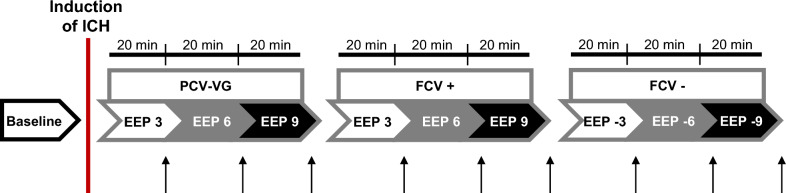
A model of intracranial hypertension involving bilateral trepan bolt holes was performed in 14 pigs. Pressure-controlled volume-guaranteed ventilation (PCV-VG) with PEEP and FCV using PEEP and then NEEP were applied. Intracranial pressure and oxygenation, as well as systemic hemodynamics and gas exchange parameters, were continuously monitored. Data were collected at baseline and at varying PEEP levels for both PCV-VG and FCV ventilation modalities. Following this, FCV ventilation and NEEP levels of -3, -6 and -9 cmHO were applied.
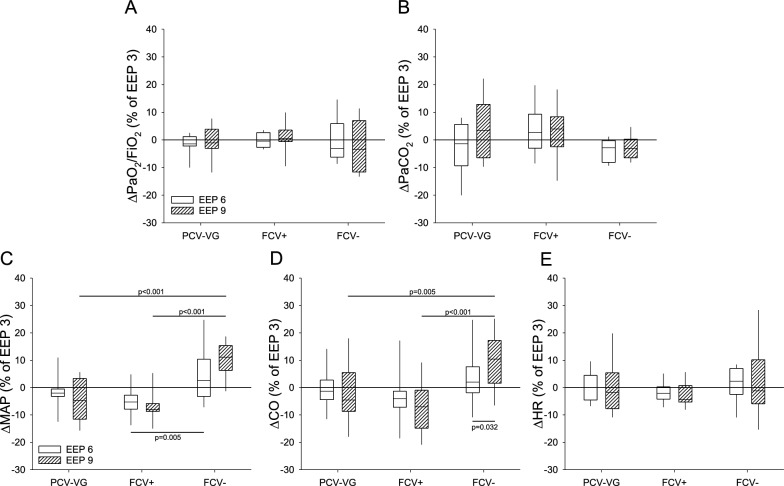
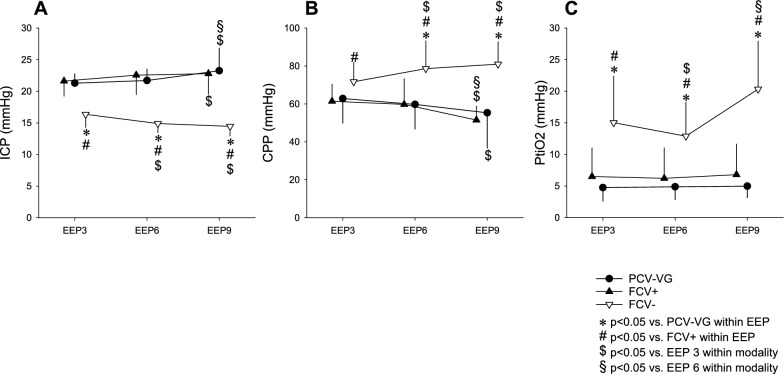
ICP remained stable with low PEEP levels, but significantly decreased with NEEP. Lower ICP following NEEP improved cerebral perfusion pressure and cerebral tissue oxygenation (p < 0.05 for all). FCV with NEEP at EEP-6 and EEP-9 significantly improved cardiac output and mean arterial pressure (MAP), compared to PCV-VG and FCV using PEEP (p < 0.05, respectively). There were no significant differences in gas exchange parameters between modalities (PCV-VG vs FCV), and between the application of PEEP or NEEP. No significant correlations were observed between ΔICP and ΔMAP.
The application of FCV with NEEP appears to be a safe ventilation mode and offers an additional tool for controlling severe intracranial pressure episodes. These findings warrant validation in future studies and may lead to important potential applications in clinical practice.
脑损伤患者常需机械通气。尽管推荐采用肺保护性通气,但由于脑静脉回流改变,增加呼气末正压(PEEP)的应用与颅内压(ICP)升高有关。本研究在颅内高压猪模型中,研究使用呼气末负压(NEEP)的流量控制通气(FCV)对脑血流动力学的影响。
对14头猪建立双侧颅骨钻孔的颅内高压模型。应用带PEEP的压力控制容量保证通气(PCV-VG)以及先使用PEEP然后使用NEEP的FCV。持续监测颅内压和氧合情况,以及全身血流动力学和气体交换参数。在基线以及PCV-VG和FCV通气模式的不同PEEP水平下收集数据。此后,应用FCV通气以及-3、-6和-9 cmH₂O的NEEP水平。
低PEEP水平时ICP保持稳定,但使用NEEP时ICP显著降低。NEEP降低ICP后改善了脑灌注压和脑组织氧合(所有p均<0.05)。与PCV-VG和使用PEEP的FCV相比,EEP-6和EEP-9时使用NEEP的FCV显著改善了心输出量和平均动脉压(MAP)(分别p<0.05)。不同通气模式(PCV-VG与FCV)之间以及PEEP或NEEP应用之间的气体交换参数无显著差异。未观察到ΔICP与ΔMAP之间存在显著相关性。
应用带NEEP的FCV似乎是一种安全的通气模式,并为控制严重颅内压发作提供了一种额外工具。这些发现有待未来研究验证,可能会在临床实践中带来重要的潜在应用。