Andani Sonali, Chen Boqi, Ficek-Pascual Joanna, Heinke Simon, Casanova Ruben, Hild Bernard, Sobottka Bettina, Bodenmiller Bernd, Koelzer Viktor H, Rätsch Gunnar
Department of Computer Science, ETH Zurich, Zurich Switzerland.
Swiss Institute of Bioinformatics, Zurich Switzerland.
medRxiv. 2024 Dec 7:2024.01.26.24301803. doi: 10.1101/2024.01.26.24301803.
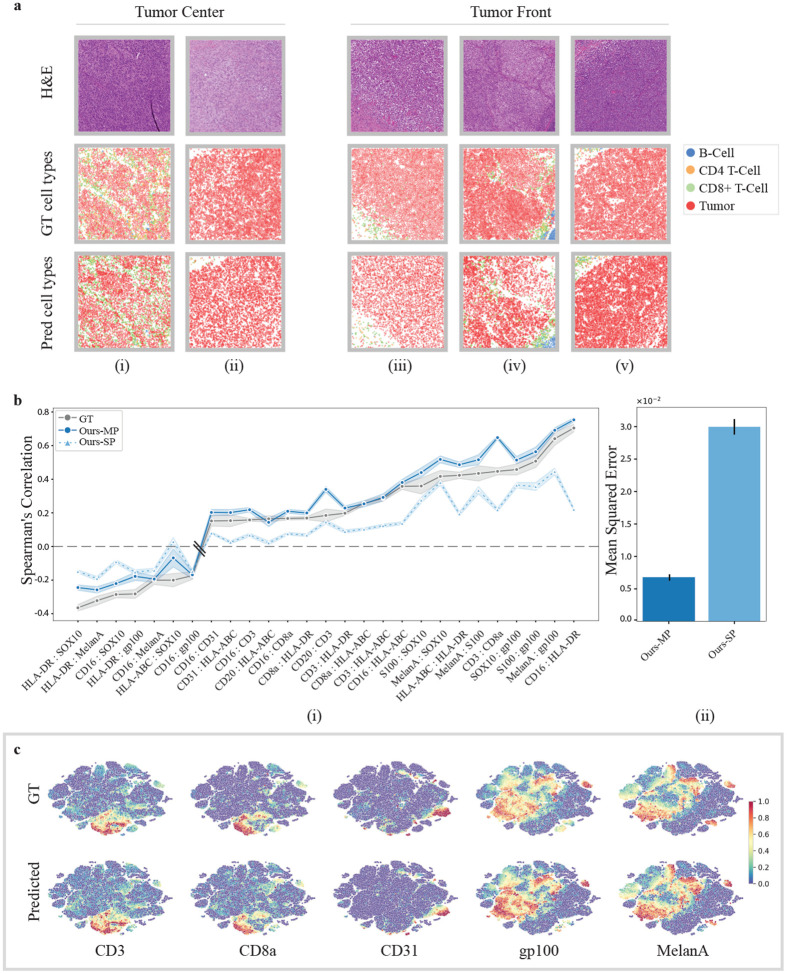
Multiplexed imaging technologies provide crucial insights into interactions between tumors and their surrounding tumor microenvironment (TME), but their widespread adoption is limited by cost, time, and tissue availability. We introduce HistoPlexer, a deep learning (DL) framework that generates spatially-resolved protein multiplexes directly from histopathology images. HistoPlexer employs the conditional generative adversarial networks with custom loss functions that mitigate slice-to-slice variations and preserve spatial protein correlations. In a comprehensive evaluation on metastatic melanoma samples, HistoPlexer consistently outperforms existing approaches, achieving superior Multiscale Structural Similarity Index and Peak Signal-to-Noise Ratio. Qualitative evaluation by domain experts demonstrates that the generated protein multiplexes closely resemble the real ones, evidenced by Human Eye Perceptual Evaluation error rates exceeding the 50% threshold for perceived realism. Importantly, HistoPlexer preserves crucial biological relationships, accurately capturing spatial co-localization patterns among proteins. In addition, the spatial distribution of cell types derived from HistoPlexer-generated protein multiplex enables effective stratification of tumors into immune hot versus cold subtypes. When applied to an independent cohort, incorporating additional features from HistoPlexer-generated multiplexes enhances the performance of the DL model for survival prediction and immune subtyping, outperforming the model reliant solely on Hematoxylin & Eosin (H&E) image features. By enabling the generation of whole-slide protein multiplex from the H&E image, HistoPlexer offers a cost- and time-effective approach to understanding the TME, and holds promise for advancing precision oncology.
多重成像技术为深入了解肿瘤与其周围肿瘤微环境(TME)之间的相互作用提供了关键见解,但其广泛应用受到成本、时间和组织可用性的限制。我们引入了HistoPlexer,这是一个深度学习(DL)框架,可直接从组织病理学图像生成空间分辨的蛋白质多重图谱。HistoPlexer采用带有自定义损失函数的条件生成对抗网络,以减轻切片间的变化并保留空间蛋白质相关性。在对转移性黑色素瘤样本的全面评估中,HistoPlexer始终优于现有方法,实现了卓越的多尺度结构相似性指数和峰值信噪比。领域专家的定性评估表明,生成的蛋白质多重图谱与真实图谱非常相似,人眼感知评估错误率超过50%的感知真实阈值即为证明。重要的是,HistoPlexer保留了关键的生物学关系,准确捕捉了蛋白质之间的空间共定位模式。此外,从HistoPlexer生成的蛋白质多重图谱中得出的细胞类型的空间分布能够有效地将肿瘤分层为免疫热型和冷型亚型。当应用于一个独立队列时,纳入来自HistoPlexer生成的多重图谱的额外特征可提高DL模型用于生存预测和免疫亚型分型的性能,优于仅依赖苏木精和伊红(H&E)图像特征的模型。通过从H&E图像生成全切片蛋白质多重图谱,HistoPlexer提供了一种经济高效的方法来理解TME,并有望推动精准肿瘤学的发展。