Lee Donghoon, Vicari James M, Porras Christian, Spencer Collin, Pjanic Milos, Wang Xinyi, Kinrot Seon, Weiler Philipp, Kosoy Roman, Bendl Jaroslav, Prashant N M, Psychogyiou Konstantina, Malakates Periklis, Hennigan Evelyn, Monteiro Fortes Jennifer, Zheng Shiwei, Therrien Karen, Mathur Deepika, Kleopoulos Steven P, Shao Zhiping, Argyriou Stathis, Alvia Marcela, Casey Clara, Hong Aram, Beaumont Kristin G, Sebra Robert, Kellner Christopher P, Bennett David A, Yuan Guo-Cheng, Voloudakis George, Theis Fabian J, Haroutunian Vahram, Hoffman Gabriel E, Fullard John F, Roussos Panos
Center for Disease Neurogenomics, Icahn School of Medicine at Mount Sinai, New York, NY, USA.
Department of Psychiatry, Icahn School of Medicine at Mount Sinai, New York, NY, USA.
medRxiv. 2024 Dec 5:2023.10.25.23297558. doi: 10.1101/2023.10.25.23297558.
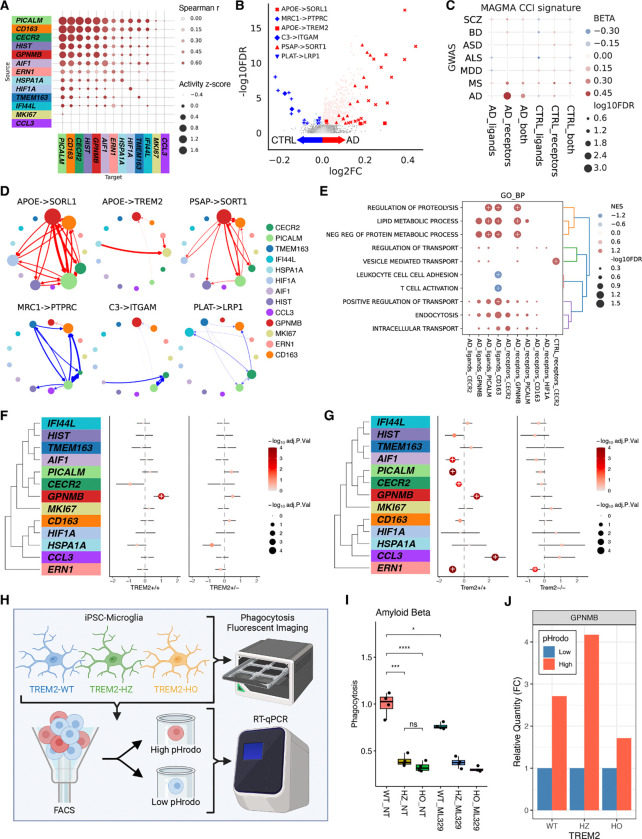
The complex roles of myeloid cells, including microglia and perivascular macrophages, are central to the neurobiology of Alzheimer's disease (AD), yet they remain incompletely understood. Here, we profiled 832,505 human myeloid cells from the prefrontal cortex of 1,607 unique donors covering the human lifespan and varying degrees of AD neuropathology. We delineated 13 transcriptionally distinct myeloid subtypes organized into 6 subclasses and identified AD-associated adaptive changes in myeloid cells over aging and disease progression. The GPNMB subtype, linked to phagocytosis, increased significantly with AD burden and correlated with polygenic AD risk scores. By organizing AD-risk genes into a regulatory hierarchy, we identified and validated as an upstream transcriptional activator of , critical for maintaining phagocytosis. Through cell-to-cell interaction networks, we prioritized - and - ligand-receptor pairs, associated with AD progression. In both human and mouse models, deficiency disrupted GPNMB expansion and reduced phagocytic function, suggesting that GPNMB's role in neuroprotection was -dependent. Our findings clarify myeloid subtypes implicated in aging and AD, advancing the mechanistic understanding of their role in AD and aiding therapeutic discovery.
包括小胶质细胞和血管周围巨噬细胞在内的髓样细胞的复杂作用是阿尔茨海默病(AD)神经生物学的核心,但人们对它们的理解仍不完整。在这里,我们对来自1607名独特捐赠者前额叶皮层的832505个人类髓样细胞进行了分析,这些捐赠者涵盖了人类的整个寿命范围以及不同程度的AD神经病理学特征。我们划分出了13种转录上不同的髓样细胞亚型,这些亚型被组织成6个亚类,并确定了随着衰老和疾病进展,髓样细胞中与AD相关的适应性变化。与吞噬作用相关的GPNMB亚型随着AD负担的增加而显著增加,并与多基因AD风险评分相关。通过将AD风险基因组织成一个调控层次结构,我们鉴定并验证了 作为 的上游转录激活因子,这对维持吞噬作用至关重要。通过细胞间相互作用网络,我们确定了与AD进展相关的 - 和 - 配体-受体对的优先级。在人类和小鼠模型中, 缺陷都会破坏GPNMB的扩增并降低吞噬功能,这表明GPNMB在神经保护中的作用是 - 依赖性的。我们的研究结果阐明了与衰老和AD相关的髓样细胞亚型,推进了对它们在AD中作用的机制理解,并有助于治疗发现。