Klein Dominik, Palla Giovanni, Lange Marius, Klein Michal, Piran Zoe, Gander Manuel, Meng-Papaxanthos Laetitia, Sterr Michael, Saber Lama, Jing Changying, Bastidas-Ponce Aimée, Cota Perla, Tarquis-Medina Marta, Parikh Shrey, Gold Ilan, Lickert Heiko, Bakhti Mostafa, Nitzan Mor, Cuturi Marco, Theis Fabian J
Institute of Computational Biology, Helmholtz Center, Munich, Germany.
Department of Mathematics, Technical University of Munich, Garching, Germany.
Nature. 2025 Feb;638(8052):1065-1075. doi: 10.1038/s41586-024-08453-2. Epub 2025 Jan 22.
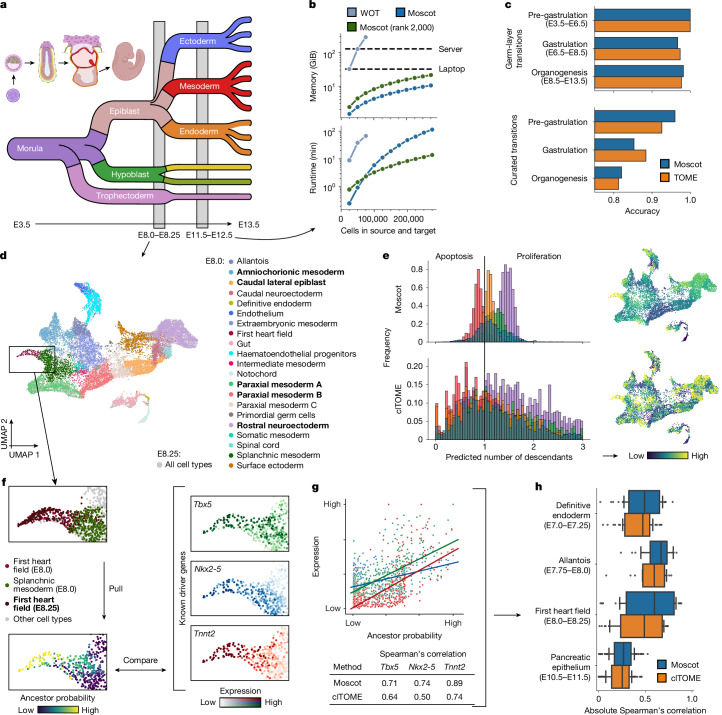
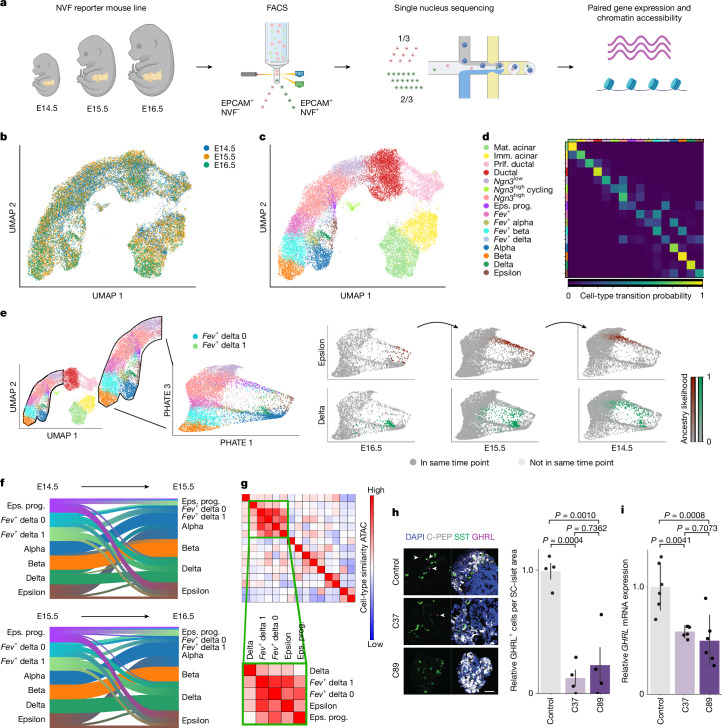
Single-cell genomic technologies enable the multimodal profiling of millions of cells across temporal and spatial dimensions. However, experimental limitations hinder the comprehensive measurement of cells under native temporal dynamics and in their native spatial tissue niche. Optimal transport has emerged as a powerful tool to address these constraints and has facilitated the recovery of the original cellular context. Yet, most optimal transport applications are unable to incorporate multimodal information or scale to single-cell atlases. Here we introduce multi-omics single-cell optimal transport (moscot), a scalable framework for optimal transport in single-cell genomics that supports multimodality across all applications. We demonstrate the capability of moscot to efficiently reconstruct developmental trajectories of 1.7 million cells from mouse embryos across 20 time points. To illustrate the capability of moscot in space, we enrich spatial transcriptomic datasets by mapping multimodal information from single-cell profiles in a mouse liver sample and align multiple coronal sections of the mouse brain. We present moscot.spatiotemporal, an approach that leverages gene-expression data across both spatial and temporal dimensions to uncover the spatiotemporal dynamics of mouse embryogenesis. We also resolve endocrine-lineage relationships of delta and epsilon cells in a previously unpublished mouse, time-resolved pancreas development dataset using paired measurements of gene expression and chromatin accessibility. Our findings are confirmed through experimental validation of NEUROD2 as a regulator of epsilon progenitor cells in a model of human induced pluripotent stem cell islet cell differentiation. Moscot is available as open-source software, accompanied by extensive documentation.
单细胞基因组技术能够在时间和空间维度上对数百万个细胞进行多模态分析。然而,实验限制阻碍了对处于自然时间动态及其自然空间组织微环境中的细胞进行全面测量。最优传输已成为解决这些限制的有力工具,并有助于恢复原始细胞环境。然而,大多数最优传输应用无法整合多模态信息或扩展到单细胞图谱。在这里,我们介绍了多组学单细胞最优传输(moscot),这是一种用于单细胞基因组学中最优传输的可扩展框架,支持所有应用中的多模态。我们展示了moscot能够有效地重建来自小鼠胚胎的170万个细胞在20个时间点的发育轨迹。为了说明moscot在空间方面的能力,我们通过映射小鼠肝脏样本中单细胞图谱的多模态信息来丰富空间转录组数据集,并对齐小鼠大脑的多个冠状切片。我们提出了moscot.spatiotemporal,一种利用跨空间和时间维度的基因表达数据来揭示小鼠胚胎发生时空动态的方法。我们还使用基因表达和染色质可及性的配对测量,解析了一个此前未发表的小鼠时间分辨胰腺发育数据集中δ细胞和ε细胞的内分泌谱系关系。我们的发现通过在人类诱导多能干细胞胰岛细胞分化模型中对NEUROD2作为ε祖细胞调节剂的实验验证得到了证实。moscot作为开源软件提供,并附有详细文档。