Yediay Fulya Eylem, Kroonen Guus, Sabatini Serena, Frei Karin Margarita, Frank Anja B, Pinotti Thomaz, Wigman Andrew, Thorsø Rasmus, Vimala Tharsika, McColl Hugh, Moutafi Ioanna, Altinkaya Isin, Ramsøe Abigail, Gaunitz Charleen, Renaud Gabriel, Martin Alfredo Mederos, Demeter Fabrice, Scorrano Gabriele, Canci Alessandro, Fischer Peter, Duyar Izzet, Serhal Claude, Varzari Alexander, Türkteki Murat, O'Shea John, Rahmstorf Lorenz, Polat Gürcan, Atamtürk Derya, Vinner Lasse, Omura Sachihiro, Matsumura Kimiyoshi, Cao Jialu, Valeur Seersholm Frederik, Morillo Leon Jose Miguel, Voutsaki Sofia, Orgeolet Raphaël, Burke Brendan, Herrmann Nicholas P, Recchia Giulia, Corazza Susi, Borgna Elisabetta, Sampò Mirella Cipolloni, Trucco Flavia, Pando Ana Pajuelo, Schjellerup Jørkov Marie Louise, Courtaud Patrice, Peake Rebecca, Bao Juan Francisco Gibaja, Parditka Györgyi, Stenderup Jesper, Sjögren Karl-Göran, Staring Jacqueline, Olsen Line, Deyneko Igor V, Pálfi György, Aldana Pedro Manuel López, Burns Bryan, Paja László, Mühlenbock Christian, Cavazzuti Claudio, Cazzella Alberto, Lagia Anna, Lambrinoudakis Vassilis, Kolonas Lazaros, Rambach Jörg, Sava Eugen, Agulnikov Sergey, Castañeda Fernández Vicente, Broné Mia, Peña Romo Victoria, Molina González Fernando, Cámara Serrano Juan Antonio, Jiménez Brobeil Sylvia, Nájera Molino Trinidad, Rodríguez Ariza María Oliva, Galán Saulnier Catalina, González Martín Armando, Cauwe Nicolas, Mordant Claude, Roscio Mafalda, Staniaszek Luc, Tafuri Mary Anne, Yıldırım Tayfun, Salzani Luciano, Sand Korneliussen Thorfinn, Moreno-Mayar J Víctor, Allentoft Morten Erik, Sikora Martin, Nielsen Rasmus, Kristiansen Kristian, Willerslev Eske
Lundbeck Foundation GeoGenetics Center, Globe Institute, University of Copenhagen, Copenhagen, Denmark.
Department of Historical Studies, University of Gothenburg, Gothenburg, Sweden.
bioRxiv. 2024 Dec 2:2024.12.02.626332. doi: 10.1101/2024.12.02.626332.
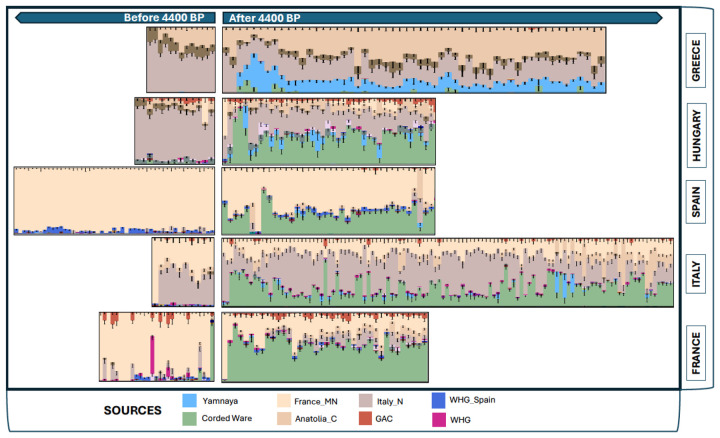
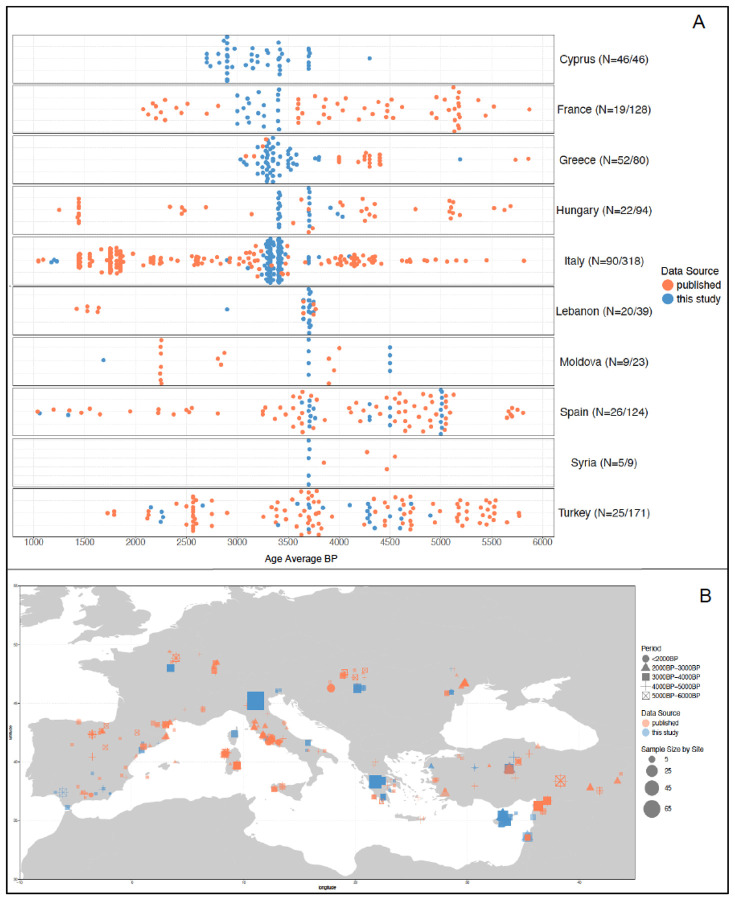
The Indo-European languages are among the most widely spoken in the world, yet their early diversification remains contentious. It is widely accepted that the spread of this language family across Europe from the 5th millennium BP correlates with the expansion and diversification of steppe-related genetic ancestry from the onset of the Bronze Age. However, multiple steppe-derived populations co-existed in Europe during this period, and it remains unclear how these populations diverged and which provided the demographic channels for the ancestral forms of the Italic, Celtic, Greek, and Armenian languages. To investigate the ancestral histories of Indo-European-speaking groups in Southern Europe, we sequenced genomes from 314 ancient individuals from the Mediterranean and surrounding regions, spanning from 5,200 BP to 2,100 BP, and co-analysed these with published genome data. We additionally conducted strontium isotope analyses on 224 of these individuals. We find a deep east-west divide of steppe ancestry in Southern Europe during the Bronze Age. Specifically, we show that the arrival of steppe ancestry in Spain, France, and Italy was mediated by Bell Beaker (BB) populations of Western Europe, likely contributing to the emergence of the Italic and Celtic languages. In contrast, Armenian and Greek populations acquired steppe ancestry directly from Yamnaya groups of Eastern Europe. These results are consistent with the linguistic Italo-Celtic and Graeco-Armenian hypotheses accounting for the origins of most Mediterranean Indo-European languages of Classical Antiquity. Our findings thus align with specific linguistic divergence models for the Indo-European language family while contradicting others. This underlines the power of ancient DNA in uncovering prehistoric diversifications of human populations and language communities.
印欧语系是世界上使用最广泛的语系之一,但其早期的分化仍存在争议。人们普遍认为,从公元前5000年起,这个语系在欧洲的传播与青铜时代开始时与草原相关的基因谱系的扩张和分化有关。然而,在此期间,多个源自草原的群体在欧洲共存,目前尚不清楚这些群体是如何分化的,以及哪些群体为意大利语、凯尔特语、希腊语和亚美尼亚语的原始形式提供了人口渠道。为了研究南欧说印欧语系群体的祖先历史,我们对来自地中海及周边地区的314名古代个体的基因组进行了测序,时间跨度从公元前5200年到公元前2100年,并将这些数据与已发表的基因组数据进行了联合分析。我们还对其中224名个体进行了锶同位素分析。我们发现,青铜时代南欧的草原血统存在明显的东西分化。具体来说,我们表明,西班牙、法国和意大利的草原血统的到来是由西欧的钟杯文化(BB)群体介导的,这可能促成了意大利语和凯尔特语的出现。相比之下,亚美尼亚人和希腊人群体直接从东欧的颜那亚群体那里获得了草原血统。这些结果与解释古典古代大多数地中海印欧语言起源的意大利 - 凯尔特语和希腊 - 亚美尼亚语假说相一致。因此,我们的发现与印欧语系的特定语言分化模型相符,而与其他模型相悖。这凸显了古代DNA在揭示人类群体和语言群落史前分化方面的强大作用。