Xia Cuifen, Zhou Wenwu, Shu Qingtai, Wu Zaikun, Wang Mingxing, Xu Li, Yang Zhengdao, Yu Jinge, Song Hanyue, Duan Dandan
College of Forestry, Southwest Forestry University, Kunming, China.
Guangyuan Forestry Bureau, Guangyuan, China.
Front Plant Sci. 2024 Nov 29;15:1492560. doi: 10.3389/fpls.2024.1492560. eCollection 2024.
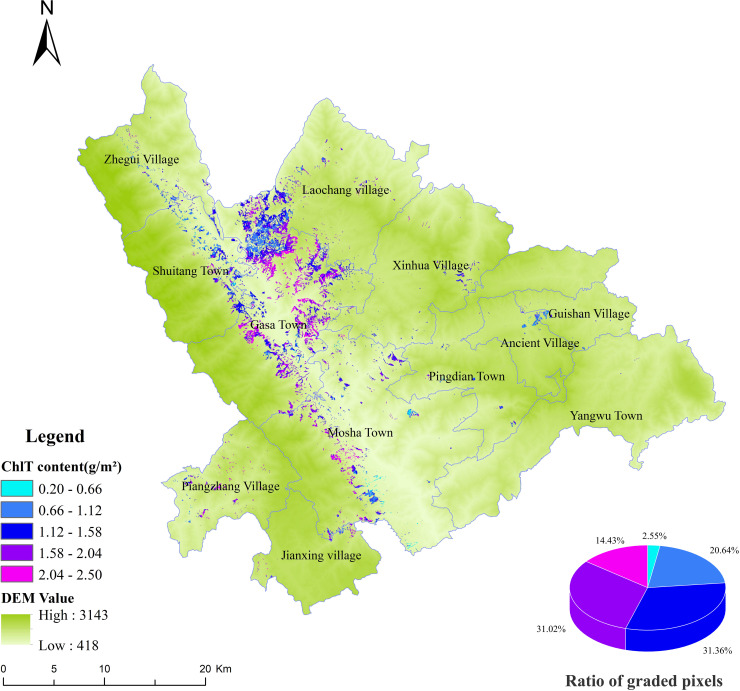
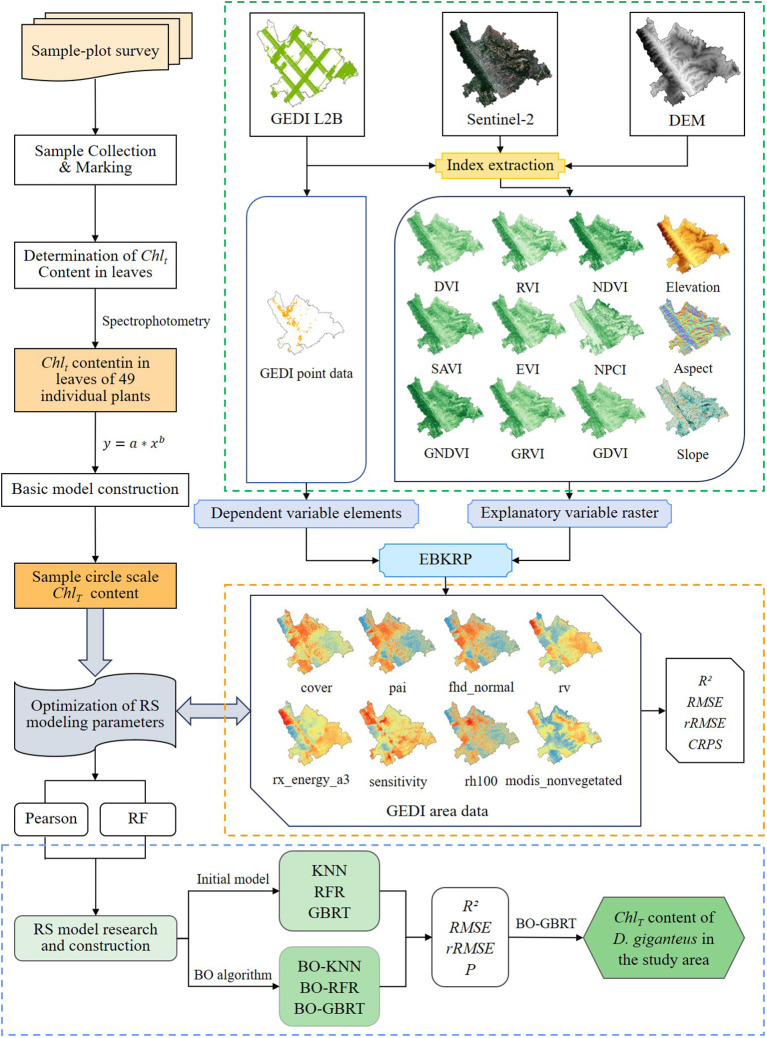
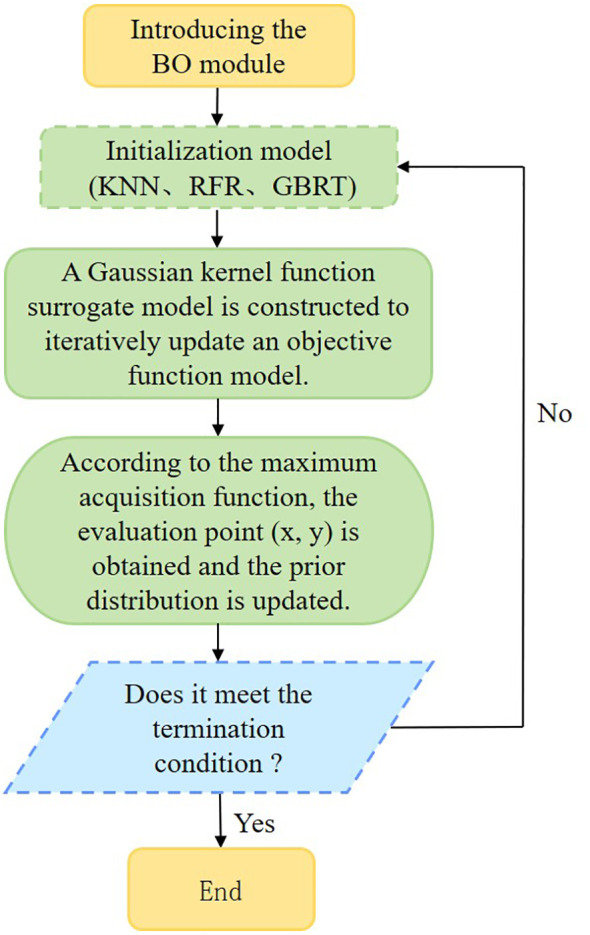
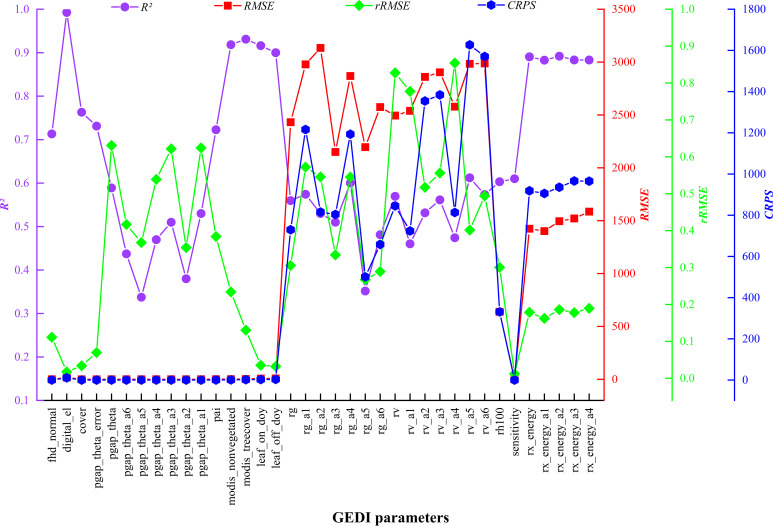
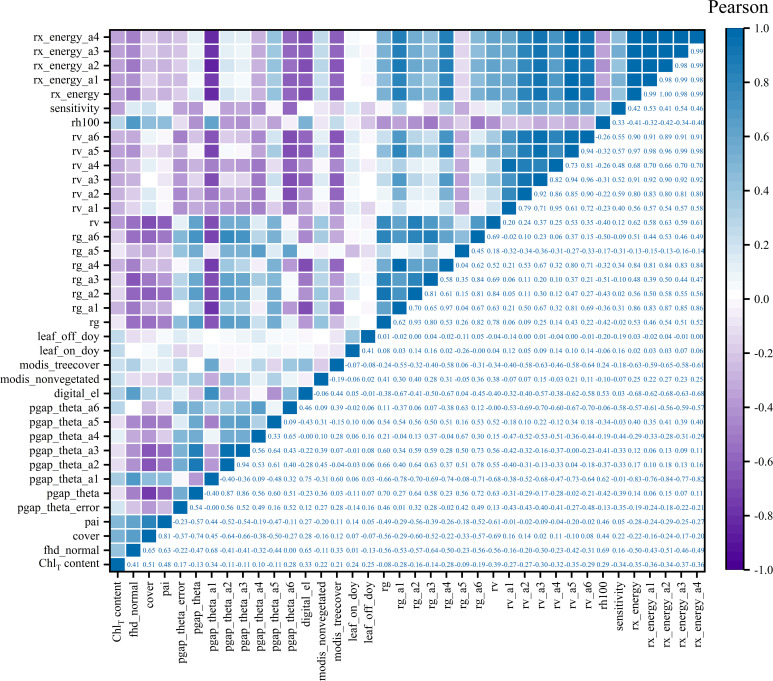
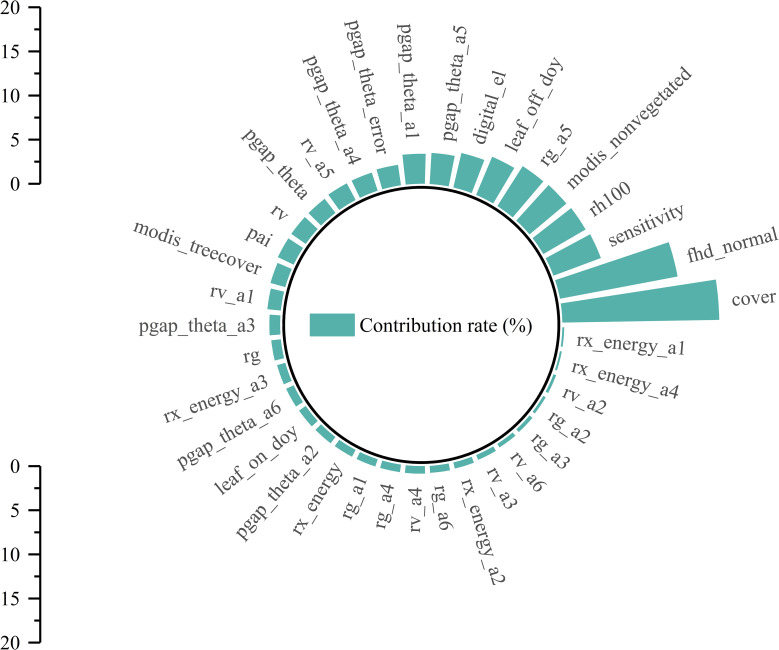
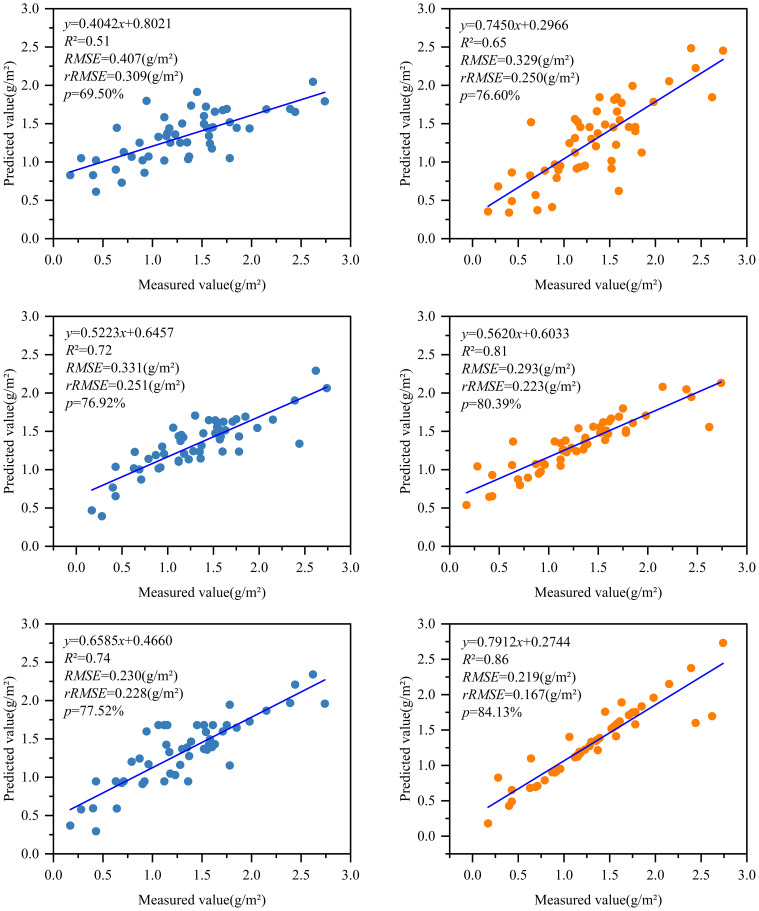
Chlorophyll content is a vital indicator for evaluating vegetation health and estimating productivity. This study addresses the issue of Global Ecosystem Dynamics Investigation (GEDI) data discreteness and explores its potential in estimating chlorophyll content. This study used the empirical Bayesian Kriging regression prediction (EBKRP) method to obtain the continuous distribution of GEDI spot parameters in an unknown space. Initially, 52 measured sample data were employed to screen the modeling parameters with the Pearson and RF methods. Next, the Bayesian optimization (BO) algorithm was applied to optimize the KNN regression model, RFR model, and Gradient Boosting Regression Tree (GBRT) model. These steps were taken to establish the most effective RS estimation model for chlorophyll content in (). The results showed that: (1) The of the EBKRP method was 0.340.99, RMSE was 0.0123,134.005, rRMSE was 0.0110.854, and CRPS was 965.4921,626.887. (2) The Pearson method selects five parameters (cover, pai, fhd_normal, rv, and rx_energy_a3) with a correlation greater than 0.37. The RF method opts for five parameters (cover, fhd_normal, sensitivity, rh100, and modis_nonvegetated) with a contribution threshold greater than 5.5%. (3) The BO-GBRT model in the RF method was used as the best estimation model ( = 0.86, RMSE = 0.219 g/m, rRMSE = 0.167 g/m, = 84.13%) to estimate and map the chlorophyll content of in the study area. The distribution range is 0.20~2.50 g/m. The findings aligned with the distribution of in the experimental area, indicating the reliability of estimating forest biochemical parameters using GEDI data.
叶绿素含量是评估植被健康状况和估算生产力的重要指标。本研究针对全球生态系统动力学调查(GEDI)数据离散性问题展开研究,并探索其在估算叶绿素含量方面的潜力。本研究采用经验贝叶斯克里金回归预测(EBKRP)方法,获取未知空间中GEDI点参数的连续分布。首先,使用52个实测样本数据,通过皮尔逊和随机森林(RF)方法筛选建模参数。接下来,应用贝叶斯优化(BO)算法对K近邻回归模型、随机森林回归(RFR)模型和梯度提升回归树(GBRT)模型进行优化。采取这些步骤,以建立用于估算()中叶绿素含量的最有效遥感(RS)估算模型。结果表明:(1)EBKRP方法的决定系数为0.340.99,均方根误差(RMSE)为0.0123134.005,相对均方根误差(rRMSE)为0.0110.854,连续秩概率评分(CRPS)为965.4921626.887。(2)皮尔逊方法选择了五个相关性大于0.37的参数(覆盖度、pai、fhd_normal、rv和rx_energy_a3)。RF方法选择了五个贡献阈值大于5.5%的参数(覆盖度、fhd_normal、敏感度、rh100和modis非植被)。(3)RF方法中的BO-GBRT模型被用作最佳估算模型(决定系数=0.86,RMSE=0.219 g/m,rRMSE=0.167 g/m,解释方差得分=84.13%),用于估算和绘制研究区域内()的叶绿素含量。分布范围为0.20~2.50 g/m。研究结果与试验区内()的分布情况相符,表明利用GEDI数据估算森林生化参数具有可靠性。