Zhang Lei, Li Changchun, Wu Xifang, Xiang Hengmao, Jiao Yinghua, Chai Huabin
School of Surveying and Land Information Engineering, Henan Polytechnic University, Jiaozuo, China.
Shandong Provincial Land Survey and Planning Institute, Jinan, Shandong, China.
Front Plant Sci. 2024 Dec 20;15:1500499. doi: 10.3389/fpls.2024.1500499. eCollection 2024.
In the context of climate variability, rapid and accurate estimation of winter wheat yield is essential for agricultural policymaking and food security. With advancements in remote sensing technology and deep learning, methods utilizing remotely sensed data are increasingly being employed for large-scale crop growth monitoring and yield estimation.
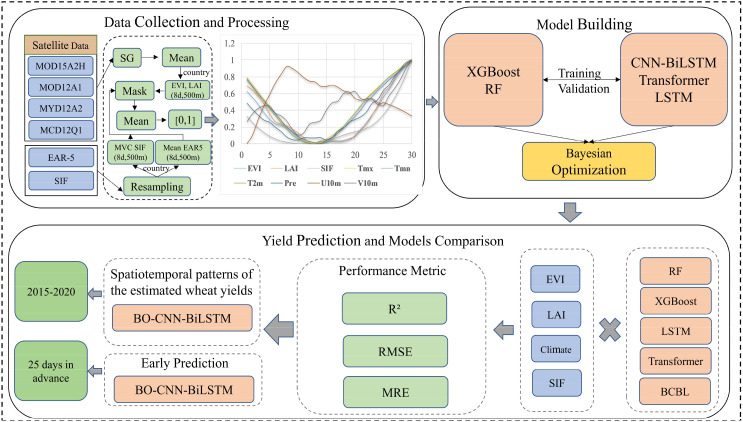
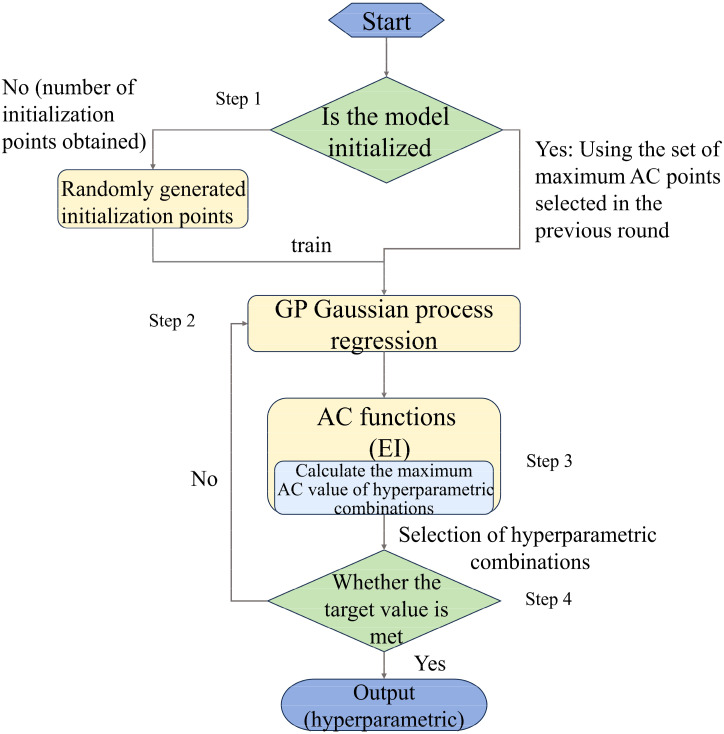
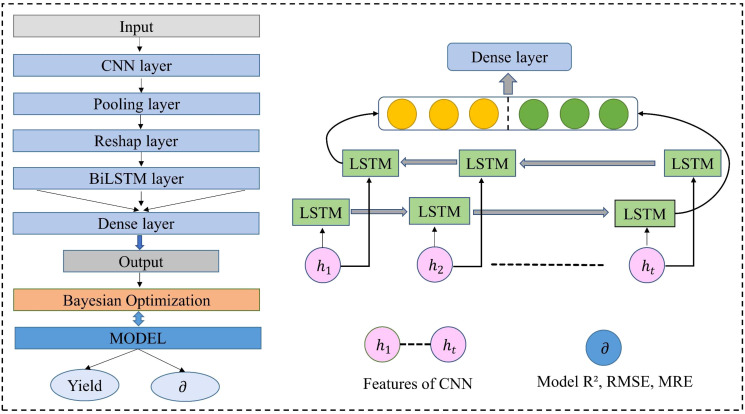
Solar-induced chlorophyll fluorescence (SIF) is a new remote sensing metric that is closely linked to crop photosynthesis and has been applied to crop growth and drought monitoring. However, its effectiveness for yield estimation under various data fusion conditions has not been thoroughly explored. This study developed a deep learning model named BO-CNN-BiLSTM (BCBL), combining the feature extraction capabilities of a convolutional neural network (1DCNN) with the time-series memory advantages of a bidirectional long short-term memory network (BiLSTM). The Bayesian Optimization (BOM) method was employed to determine the optimal hyperparameters for model parameter optimization. Traditional remote sensing variables (TS), such as the Enhanced Vegetation Index (EVI) and Leaf Area Index (LAI), were fused with the SIF and climate data to estimate the winter wheat yields in Henan Province, exploring the SIF's estimation capabilities using various datasets.
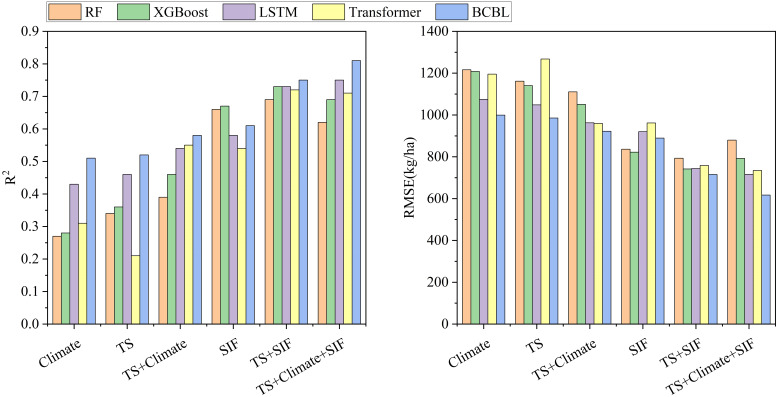
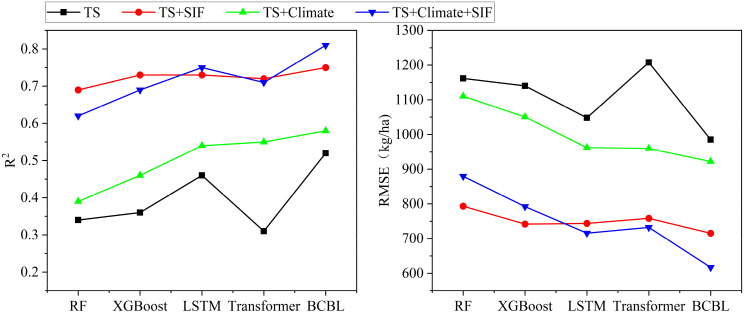
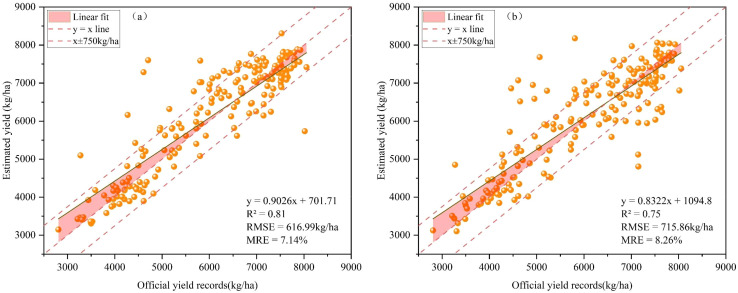
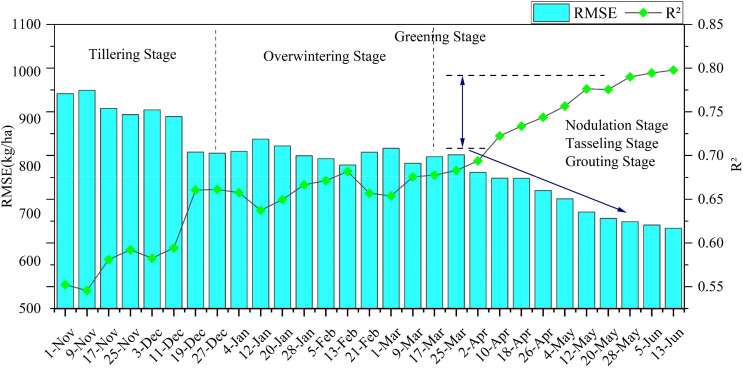
The results demonstrated that the BCBL model, integrating TS, climate, and SIF data, outperformed other models (e.g., LSTM, Transformer, RF, and XGBoost) in the estimation accuracy, with R=0.81, RMSE=616.99 kg/ha, and MRE=7.14%. Stepwise sensitivity analysis revealed that the BCBL model reliably identified the critical stage of winter wheat yield formation (early March to early May) and achieved high yield estimation accuracy approximately 25 d before harvest. Furthermore, the BCBL model exhibited strong stability and generalization across different climatic conditions.
Thus, the BCBL model combined with SIF data can offer reliable winter wheat yield estimates, hold significant potential for application, and provide valuable insights for agricultural policymaking and field management.
在气候变化的背景下,快速准确地估算冬小麦产量对于农业政策制定和粮食安全至关重要。随着遥感技术和深度学习的发展,利用遥感数据的方法越来越多地被用于大规模作物生长监测和产量估算。
太阳诱导叶绿素荧光(SIF)是一种新的遥感指标,与作物光合作用密切相关,已应用于作物生长和干旱监测。然而,其在各种数据融合条件下的产量估算有效性尚未得到充分探索。本研究开发了一种名为BO-CNN-BiLSTM(BCBL)的深度学习模型,将卷积神经网络(1DCNN)的特征提取能力与双向长短期记忆网络(BiLSTM)的时间序列记忆优势相结合。采用贝叶斯优化(BOM)方法确定模型参数优化的最佳超参数。将传统遥感变量(TS),如增强植被指数(EVI)和叶面积指数(LAI),与SIF和气候数据融合,以估算河南省的冬小麦产量,探索利用各种数据集的SIF估算能力。
结果表明,整合TS、气候和SIF数据的BCBL模型在估算精度方面优于其他模型(如LSTM、Transformer、RF和XGBoost),R=0.81,RMSE=616.99 kg/ha,MRE=7.14%。逐步敏感性分析表明,BCBL模型可靠地识别了冬小麦产量形成的关键阶段(3月初至5月初),并在收获前约25天实现了高产估算精度。此外,BCBL模型在不同气候条件下表现出很强的稳定性和泛化性。
因此,结合SIF数据的BCBL模型可以提供可靠的冬小麦产量估算,具有巨大的应用潜力,并为农业政策制定和田间管理提供有价值的见解。