Pham My-Diem Nguyen, Su Chinh Tran-To, Nguyen Thanh-Nhan, Nguyen Hoai-Nghia, Nguyen Dinh Duy An, Giang Hoa, Nguyen Dinh-Thuc, Phan Minh-Duy, Nguyen Vy
Faculty of Information Technology, University of Science, Ho Chi Minh City, Vietnam.
Vietnam National University, Ho Chi Minh City, Vietnam.
Bioinform Adv. 2024 Nov 29;4(1):vbae190. doi: 10.1093/bioadv/vbae190. eCollection 2024.
The prediction of the T-cell receptor (TCR) and antigen bindings is crucial for advancements in immunotherapy. However, most current TCR-peptide interaction predictors struggle to perform well on unseen data. This limitation may stem from the conventional use of TCR and/or peptide sequences as input, which may not adequately capture their structural characteristics. Therefore, incorporating the structural information of TCRs and peptides into the prediction model is necessary to improve its generalizability.
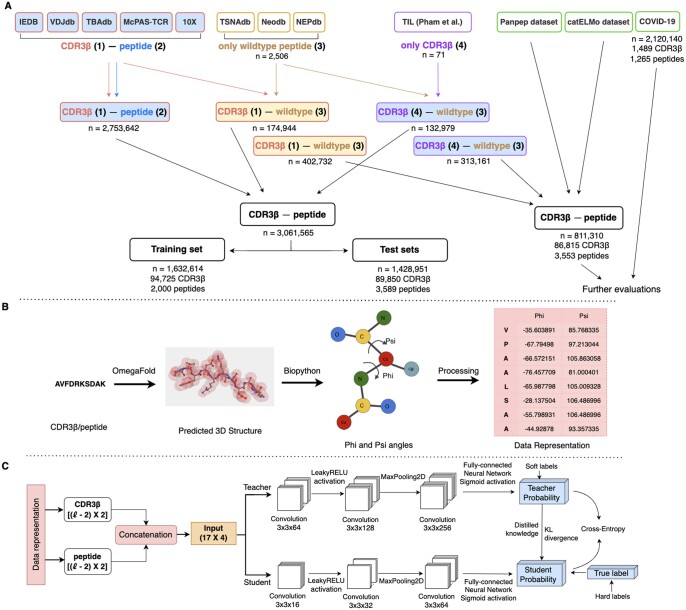
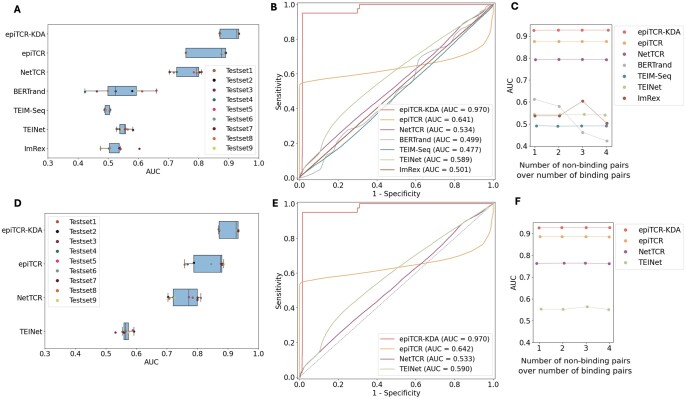
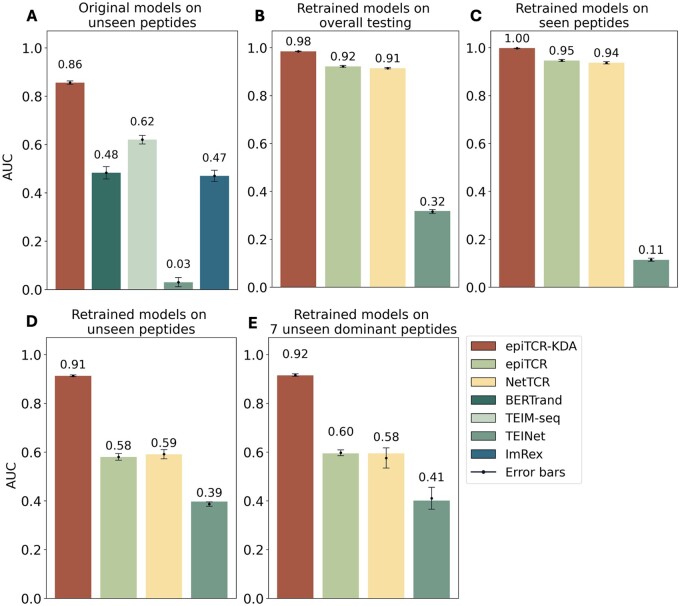
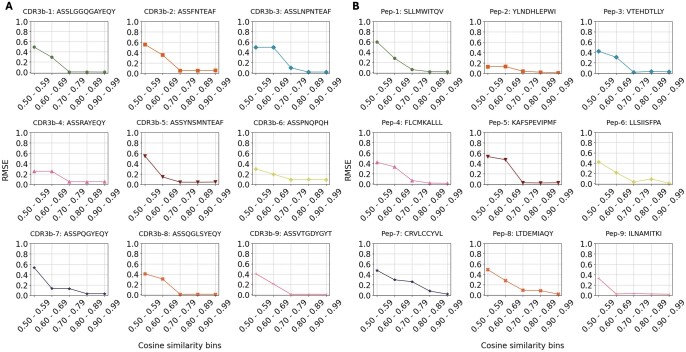
We developed epiTCR-KDA (KDA stands for Knowledge Distillation model on Dihedral Angles), a new predictor of TCR-peptide binding that utilizes the dihedral angles between the residues of the peptide and the TCR as a structural descriptor. This structural information was integrated into a knowledge distillation model to enhance its generalizability. epiTCR-KDA demonstrated competitive prediction performance, with an area under the curve (AUC) of 1.00 for seen data and AUC of 0.91 for unseen data. On public datasets, epiTCR-KDA consistently outperformed other predictors, maintaining a median AUC of 0.93. Further analysis of epiTCR-KDA revealed that the cosine similarity of the dihedral angle vectors between the unseen testing data and training data is crucial for its stable performance. In conclusion, our epiTCR-KDA model represents a significant step forward in developing a highly effective pipeline for antigen-based immunotherapy.
epiTCR-KDA is available on GitHub (https://github.com/ddiem-ri-4D/epiTCR-KDA).
T细胞受体(TCR)与抗原结合的预测对于免疫治疗的进展至关重要。然而,目前大多数TCR-肽相互作用预测器在未见数据上难以表现良好。这种局限性可能源于传统上使用TCR和/或肽序列作为输入,这可能无法充分捕捉它们的结构特征。因此,将TCR和肽的结构信息纳入预测模型对于提高其泛化能力是必要的。
我们开发了epiTCR-KDA(KDA代表基于二面角的知识蒸馏模型),一种新的TCR-肽结合预测器,它利用肽与TCR残基之间的二面角作为结构描述符。这种结构信息被整合到一个知识蒸馏模型中以增强其泛化能力。epiTCR-KDA展示出具有竞争力的预测性能,对于可见数据曲线下面积(AUC)为1.00,对于未见数据AUC为0.91。在公共数据集上,epiTCR-KDA始终优于其他预测器,中位数AUC保持在0.93。对epiTCR-KDA的进一步分析表明,未见测试数据与训练数据之间二面角向量的余弦相似度对其稳定性能至关重要。总之,我们的epiTCR-KDA模型在开发基于抗原的免疫治疗高效流程方面迈出了重要一步。
epiTCR-KDA可在GitHub上获取(https://github.com/ddiem-ri-4D/epiTCR-KDA)。