Cao Li-Jun, Lu Zhong-Hua, Zhang Pin-Jie, Yang Xiang, Yu Wei-Li, Sun Yun
The First Department of Critical Care Medicine, The Second Affiliated Hospital of Anhui Medical University, Hefei 230601, Anhui Province, China.
World J Gastroenterol. 2024 Dec 14;30(46):4929-4936. doi: 10.3748/wjg.v30.i46.4929.
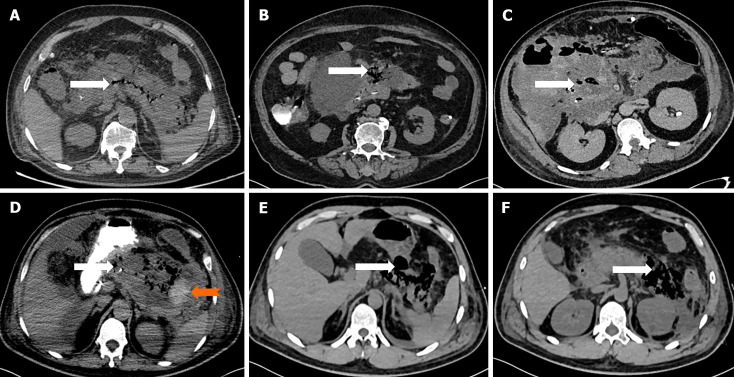
Emphysematous pancreatitis (EP) is a rare, severe form of acute necrotizing pancreatitis characterized by gas in pancreatic or peripancreatic tissue, with a high mortality rate.
To assess the diagnosis, treatment, and outcomes of EP through a series of case studies.
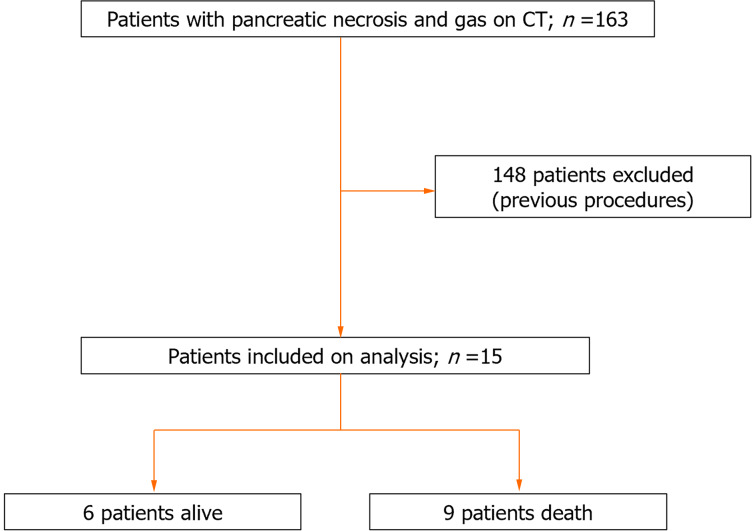
This case series was conducted in intensive care units at the Second Affiliated Hospital of Anhui Medical University. Patients were included if they were diagnosed with pancreatic necrosis and gas computed tomography from June 2018 to June 2024. Patients were categorized into early and late EP groups based on the timing of the appearance of the bubble sign and into extensive and common types based on the distribution range of the bubble sign. The data recorded included sex, age, aetiology, Acute Physiology and Chronic Health Evaluation II score, Sequential Organ Failure Assessment score, Bedside Index for Severity in Acute Pancreatitis score, subtype, gas distribution extent, aetiological diagnostic basis, pathogen categories, intervention measures, and prognosis.
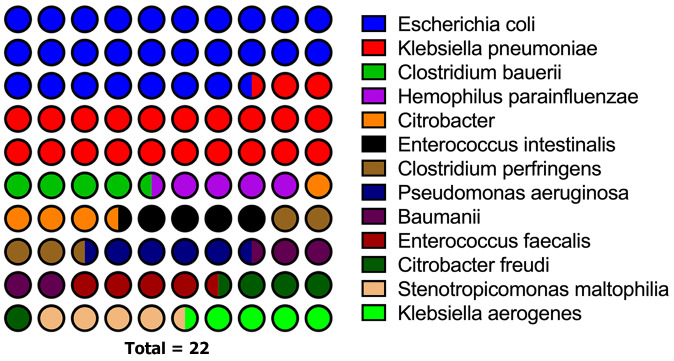
Among the 15 patients, 66.7% had a biliary aetiology and extensive type of EP, 47.1% had early-onset EP, and 73.3% had confirmed aetiological evidence [6 based on bacterial culture, 4 based on both routine culture and next-generation sequencing (NGS), and 1 solely based on NGS]. The common pathogens were and . Six patients survived. Among the 2 patients who did not undergo percutaneous drainage or surgical treatment, 1 survived. Of the 6 patients who underwent percutaneous drainage, 2 survived, 2 survived after subsequent surgery, and 2 died without surgery. Among the 6 patients who underwent surgery alone, 5 died and 1 survived. Among the early-onset EP patients, 4 survived; among the late-onset EP patients, 2 survived. Among the common EP types, 4 survived; among the extensive EP types, only 1 survived.
The mortality rate among patients with EP is considerable, and NGS enhances pathogen identification accuracy. Despite the debate on conservative surgical management, the STEP-UP strategy remains viable. Aggressive antimicrobial therapy, early percutaneous catheter drainage, and other minimally invasive interventions, along with delayed surgical intervention, may improve patient prognosis.
气肿性胰腺炎(EP)是一种罕见的急性坏死性胰腺炎严重类型,其特征为胰腺或胰腺周围组织出现气体,死亡率高。
通过一系列病例研究评估EP的诊断、治疗及预后。
本病例系列研究在安徽医科大学第二附属医院重症监护病房进行。纳入2018年6月至2024年6月期间经计算机断层扫描诊断为胰腺坏死且有气体的患者。根据气泡征出现时间将患者分为早期和晚期EP组,根据气泡征分布范围分为广泛型和普通型。记录的数据包括性别、年龄、病因、急性生理与慢性健康状况评分系统II评分、序贯器官衰竭评估评分、急性胰腺炎严重程度床边指数评分、亚型、气体分布范围、病因诊断依据、病原体类别、干预措施及预后。
15例患者中,66.7%病因是胆源性且为广泛型EP,47.1%为早期发病的EP,73.3%有确诊的病因证据[6例基于细菌培养,4例基于常规培养和二代测序(NGS),1例仅基于NGS]。常见病原体为……。6例患者存活。2例未接受经皮引流或手术治疗的患者中,1例存活。6例接受经皮引流的患者中,2例存活,2例在后续手术后存活,2例未手术死亡。6例仅接受手术的患者中,5例死亡,1例存活。早期发病的EP患者中,4例存活;晚期发病的EP患者中,2例存活。普通型EP患者中,4例存活;广泛型EP患者中,仅1例存活。
EP患者死亡率较高,NGS提高了病原体识别准确性。尽管对于保守治疗还是手术治疗存在争议,但逐步升级策略仍然可行。积极的抗菌治疗、早期经皮导管引流及其他微创干预措施,以及延迟手术干预,可能改善患者预后。