
男男性行为者中基于标准培训的同伴志愿者主导、社交应用招募并使用快速检测试剂盒的人类免疫缺陷病毒检测策略(SPARK):一项基于人群的调查评估
Standardly Trained Peer Volunteer-Led, Social App Recruiting-Based Human Immunodeficiency Virus Testing Strategy Using Rapid Testing Kits (SPARK) Among Men Who Have Sex With Men: A Population-Based Survey Evaluation.
作者信息
Liu Zhongquan, Huang Huijie, Yue Teng, Gebregziabher Nahom Kiros, Gong Hui, Xu Peng, Dong Xiaoyue, Liu Yi, Wu Ziming, Guo Yan, Ning Tielin, Li Long, Zheng Minna, Yang Jie, Ma Jun, Li Changping, Yu Maohe, Cui Zhuang
机构信息
Sexually Transmitted Diseases and AIDS Control and Prevention Section, Tianjin Center for Disease Control and Prevention, Tianjin, China.
Department of Epidemiology and Biostatistics, School of Public Health, Tianjin Medical University, Tianjin, China.
出版信息
Open Forum Infect Dis. 2024 Dec 2;11(12):ofae709. doi: 10.1093/ofid/ofae709. eCollection 2024 Dec.
BACKGROUND
Social app recruiting-based and peer-led testing strategies have been proven effective in increasing human immunodeficiency virus (HIV) testing among men who have sex with men (MSM), though their combination remains underevaluated. We aimed to assess the efficiency of a combined strategy named "standardly trained peer volunteer-led, social app recruiting-based HIV testing strategy using rapid testing kits" (SPARK).
METHODS
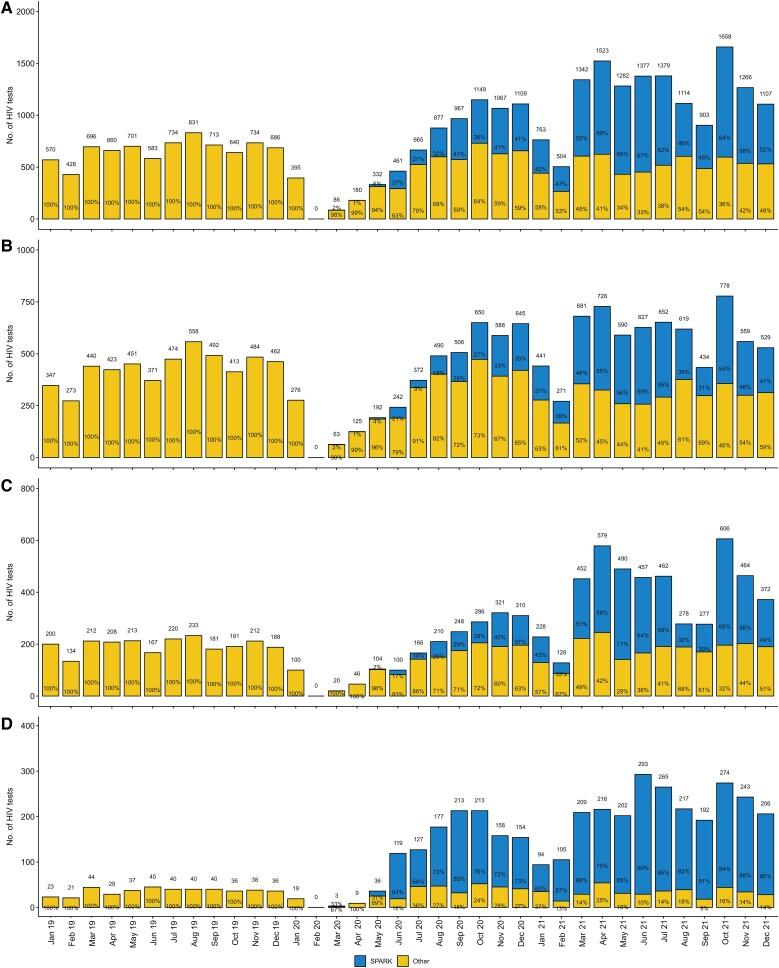
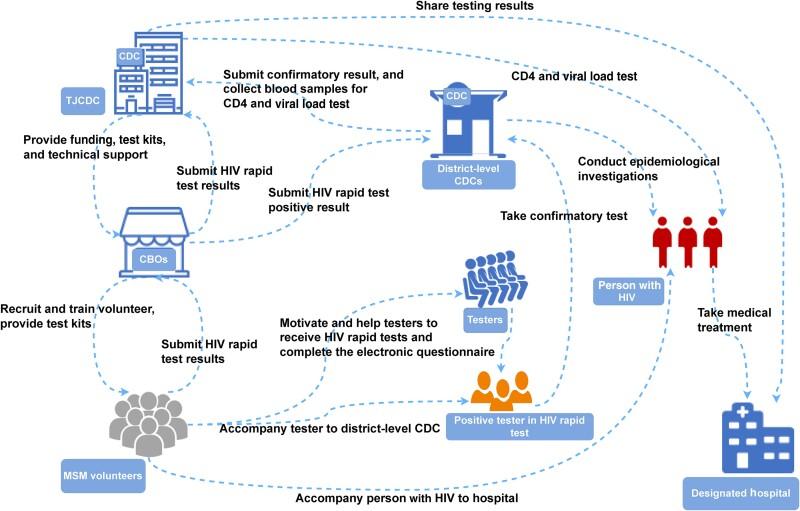
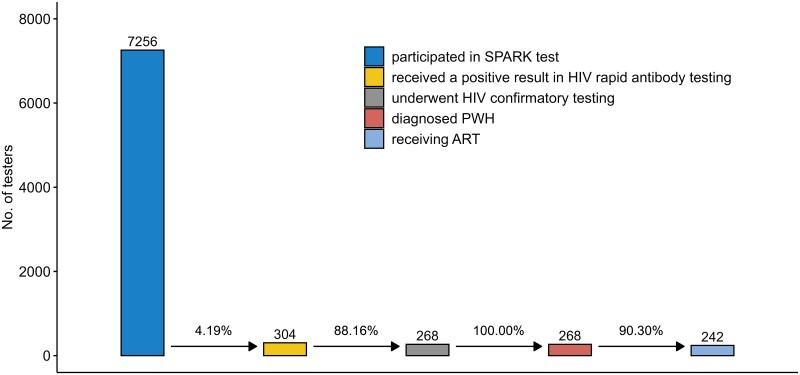
Between March 2020 and December 2021, 177 trained peer volunteers tested 7256 eligible MSM testers. Volunteers primarily recruited testers to undergo HIV testing and counseling in social apps. Volunteers tested testers with HIV rapid antibody tests and interviewed testers while waiting for the results. Moreover, HIV testing data from other testing strategies, both pre- and postimplementation of SPARK, were collected to evaluate the capacity of SPARK to increase HIV testing.
RESULTS
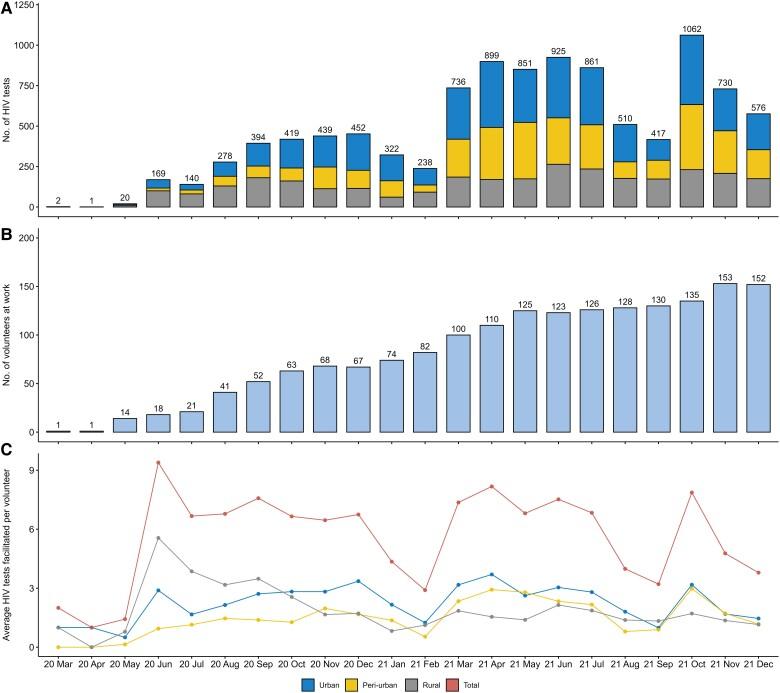
During this study, MSM testers underwent 10 441 HIV tests; HIV testing volume increased 3-fold from 2020 to 2021. On average, each volunteer recruited 40.99 testers and facilitated 58.99 HIV tests. After SPARK implementation, HIV tests in 2021 increased 1-fold compared with those in 2019; especially for rural MSM testers, the number of HIV tests performed in 2020 and 2021 increased to 2.86 and 5.85 times, respectively, that in 2019. In spatial analysis, most testers sought geographical proximity volunteers for testing; similarly, most testers recruited were from volunteers' own or nearby districts. More than 60% of HIV tests were performed outside of working hours on weekdays, regardless of whether the testers came from urban, periurban, or rural areas.
CONCLUSIONS
SPARK, an MSM-friendly, geographically accessible, and time-flexible testing strategy, has the potential to promote HIV testing among MSM.
背景
基于社交应用招募和同伴主导的检测策略已被证明在增加男男性行为者(MSM)的人类免疫缺陷病毒(HIV)检测方面是有效的,但其组合方式仍未得到充分评估。我们旨在评估一种名为“使用快速检测试剂盒的标准培训同伴志愿者主导、基于社交应用招募的HIV检测策略”(SPARK)的联合策略的效率。
方法
在2020年3月至2021年12月期间,177名经过培训的同伴志愿者对7256名符合条件的MSM检测者进行了检测。志愿者主要在社交应用中招募检测者接受HIV检测和咨询。志愿者使用HIV快速抗体检测对检测者进行检测,并在等待结果时对检测者进行访谈。此外,收集了SPARK实施前后其他检测策略的HIV检测数据,以评估SPARK增加HIV检测的能力。
结果
在本研究期间,MSM检测者接受了10441次HIV检测;从2020年到2021年,HIV检测量增加了3倍。平均而言,每名志愿者招募了40.99名检测者,并促成了58.99次HIV检测。SPARK实施后,2021年的HIV检测量与2019年相比增加了1倍;特别是对于农村MSM检测者,2020年和2021年进行的HIV检测数量分别增加到2019年的2.86倍和5.85倍。在空间分析中,大多数检测者会寻找地理位置较近的志愿者进行检测;同样,大多数被招募的检测者来自志愿者所在或附近地区。超过60%的HIV检测在工作日的非工作时间进行,无论检测者来自城市、城郊还是农村地区。
结论
SPARK是一种对MSM友好、地理上可及且时间灵活的检测策略,有潜力促进MSM中的HIV检测。
 Zotero 插件