• 文献检索
  • 文档翻译
  • 深度研究
  • 学术资讯
  • Suppr Zotero 插件Zotero 插件
  • 邀请有礼
  • 套餐&价格
  • 历史记录
应用&插件
Suppr Zotero 插件Zotero 插件浏览器插件Mac 客户端Windows 客户端微信小程序
定价
高级版会员购买积分包购买API积分包
服务
文献检索文档翻译深度研究API 文档MCP 服务
关于我们
关于 Suppr公司介绍联系我们用户协议隐私条款
关注我们

Suppr 超能文献

核心技术专利:CN118964589B侵权必究
粤ICP备2023148730 号-1Suppr @ 2026

文献检索

告别复杂PubMed语法,用中文像聊天一样搜索,搜遍4000万医学文献。AI智能推荐,让科研检索更轻松。

立即免费搜索

文件翻译

保留排版,准确专业,支持PDF/Word/PPT等文件格式,支持 12+语言互译。

免费翻译文档

深度研究

AI帮你快速写综述,25分钟生成高质量综述,智能提取关键信息,辅助科研写作。

立即免费体验

肯尼亚艾滋病毒自我检测市场特征:知晓度与使用情况、采用的障碍与动机以及支付意愿。

Characterising the HIV self-testing market in Kenya: Awareness and usage, barriers and motivators to uptake, and propensity to pay.

作者信息

West Rebecca L, Freeman Lily, Pahe Charlotte, Momanyi Harmon, Kidiga Catherine, Malaba Serah, Ciecielag Joanna, Ridge Mary-Clare, Goldwin Emma, Awsumb Heather, Sharma Sunny

机构信息

Ipsos, London, United Kingdom.

Department of Global Health, Boston University School of Public Health, Boston, Massachusetts, United States of America.

出版信息

PLOS Glob Public Health. 2023 Apr 5;3(4):e0001776. doi: 10.1371/journal.pgph.0001776. eCollection 2023.

DOI:10.1371/journal.pgph.0001776
PMID:37018216
原文链接:https://pmc.ncbi.nlm.nih.gov/articles/PMC10075389/
Abstract

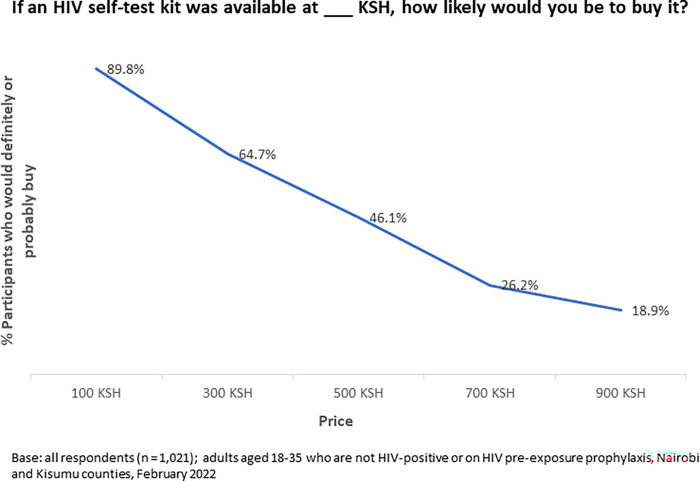
HIVST has a key role in ensuring countries meet their 95-95-95 goals. For HIVST to be sustainable, we should explore sharing costs with users as well as the overall experience. This research explores why a consumer would use HIVST and willingness to pay for HIVST through surveying 1,021 participants 18-35 living in Nairobi or Kisumu who were not diagnosed as HIV positive and who are not currently taking PrEP for HIV. A majority (89.8%) would pay 100 KSH and 64.7% would pay 300 KSH, at higher prices likelihood of paying dropped sharply. Price reduction or subsidization coupled with interventions to address the identified barriers may increase HIVST uptake. We identified 5 distinct groups based on willingness to pay and drivers/ barriers to HIVST uptake. These were created using dimension reduction, hierarchical clustering, and k-means analysis to group respondents. 79% of participants had ever heard of HIVST, and 24% had ever used HIVST. The 5 groups included active users, unlikely users, and three segments interested in HIVST with different barriers: need for HCP support, need for increased privacy/confidentiality, and fear of positive result/disclosure.

摘要

自我检测在确保各国实现其95-95-95目标方面发挥着关键作用。为了使自我检测具有可持续性,我们应该探索与用户分担成本以及整体体验。本研究通过对1021名年龄在18至35岁、居住在内罗毕或基苏木、未被诊断为艾滋病毒阳性且目前未服用艾滋病毒暴露前预防药物的参与者进行调查,探讨了消费者使用自我检测的原因以及为自我检测付费的意愿。大多数人(89.8%)愿意支付100肯尼亚先令,64.7%愿意支付300肯尼亚先令,价格越高支付的可能性急剧下降。降价或补贴以及解决已确定障碍的干预措施可能会增加自我检测的采用率。我们根据支付意愿以及自我检测采用的驱动因素/障碍确定了5个不同的群体。这些群体是通过降维、层次聚类和k均值分析对受访者进行分组而创建的。79%的参与者听说过自我检测,24%的参与者使用过自我检测。这5个群体包括活跃用户、不太可能使用的用户以及对自我检测感兴趣但存在不同障碍的三个细分群体:需要医疗保健人员的支持、需要增强隐私/保密性以及担心检测结果呈阳性/暴露。
https://cdn.ncbi.nlm.nih.gov/pmc/blobs/7ed8/10075389/621ba3a4c0bf/pgph.0001776.g001.jpg

相似文献

1
Characterising the HIV self-testing market in Kenya: Awareness and usage, barriers and motivators to uptake, and propensity to pay.肯尼亚艾滋病毒自我检测市场特征:知晓度与使用情况、采用的障碍与动机以及支付意愿。
PLOS Glob Public Health. 2023 Apr 5;3(4):e0001776. doi: 10.1371/journal.pgph.0001776. eCollection 2023.
2
Enablers and barriers to effective HIV self-testing in the private sector among sexually active youths in Nigeria: A qualitative study using journey map methodology.在尼日利亚,性活跃青年中私营部门有效 HIV 自我检测的促进因素和障碍:使用旅程图方法的定性研究。
PLoS One. 2023 Apr 27;18(4):e0285003. doi: 10.1371/journal.pone.0285003. eCollection 2023.
3
Acceptability and usability of HIV self-tests in two European countries: findings from surveys of clients at non-governmental organisations in Lithuania and Italy.在两个欧洲国家(立陶宛和意大利)的非政府组织服务对象中开展的调查发现,艾滋病毒自检在这两个国家的接受程度和可用性。
BMC Infect Dis. 2021 Sep 13;21(Suppl 2):844. doi: 10.1186/s12879-021-06442-8.
4
A systematic review of qualitative evidence on factors enabling and deterring uptake of HIV self-testing in Africa.一项关于非洲促进和阻碍 HIV 自我检测采用的因素的定性证据的系统评价。
BMC Public Health. 2019 Oct 15;19(1):1289. doi: 10.1186/s12889-019-7685-1.
5
Awareness, willingness and barriers to HIV Self-testing (HIVST) among Men who Have Sex with Men (MSM) in Brazil, Mexico, and Peru: A web-based cross-sectional study.巴西、墨西哥和秘鲁男男性行为者(MSM)中艾滋病病毒自我检测(HIVST)的知晓情况、意愿及障碍:一项基于网络的横断面研究。
PLOS Glob Public Health. 2022 Jul 29;2(7):e0000678. doi: 10.1371/journal.pgph.0000678. eCollection 2022.
6
HIV self-testing for men who have sex with men in Sweden. A cross-sectional study concerning interest to use HIV self-tests.瑞典男男性行为者的 HIV 自我检测。一项关于使用 HIV 自我检测意愿的横断面研究。
Glob Health Action. 2022 Dec 31;15(1):2021631. doi: 10.1080/16549716.2021.2021631.
7
Communication needs for improved uptake of PrEP and HIVST services among key populations in Nigeria: a mixed-method study.改善关键人群对尼日利亚 PrEP 和 HIVST 服务的接受度的沟通需求:一项混合方法研究。
AIDS Res Ther. 2021 Nov 20;18(1):88. doi: 10.1186/s12981-021-00411-6.
8
New HIV testing technologies in the context of a concentrated epidemic and evolving HIV prevention: qualitative research on HIV self-testing among men who have sex with men and transgender women in Yangon, Myanmar.在集中流行和不断演变的艾滋病毒预防背景下的新型艾滋病毒检测技术:对缅甸仰光男男性行为者和变性女性中艾滋病毒自我检测的定性研究
J Int AIDS Soc. 2017 Apr 25;20(1):21796. doi: 10.7448/IAS.20.01.21796.
9
Process evaluation of peer-to-peer delivery of HIV self-testing and sexual health information to support HIV prevention among youth in rural KwaZulu-Natal, South Africa: qualitative analysis.南非夸祖鲁-纳塔尔省农村地区通过同伴传递方式提供 HIV 自我检测和性健康信息以支持青年预防 HIV:过程评价。定性分析。
BMJ Open. 2022 Feb 14;12(2):e048780. doi: 10.1136/bmjopen-2021-048780.
10
Acceptability Study on HIV Self-Testing among Transgender Women, Men who Have Sex with Men, and Female Entertainment Workers in Cambodia: A Qualitative Analysis.柬埔寨变性女性、男男性行为者及女性娱乐工作者中艾滋病毒自我检测的可接受性研究:一项定性分析
PLoS One. 2016 Nov 9;11(11):e0166129. doi: 10.1371/journal.pone.0166129. eCollection 2016.

引用本文的文献

1
Prevalence and factors associated with awareness and use of HIV self-testing kits among young women aged 15-24 in Ghana.加纳15至24岁年轻女性中艾滋病毒自检试剂盒知晓率及使用情况的相关因素与流行率
AIDS Res Ther. 2025 Jul 26;22(1):72. doi: 10.1186/s12981-025-00764-2.
2
What do women want in pharmacy-based HIV prevention services during pregnancy? Developing attributes and levels for a discrete choice experiment in Western Kenya.孕期基于药房的艾滋病毒预防服务中女性想要什么?为肯尼亚西部的一项离散选择实验确定属性和水平。
AIDS Res Ther. 2025 Jun 4;22(1):58. doi: 10.1186/s12981-025-00752-6.
3
Standardly Trained Peer Volunteer-Led, Social App Recruiting-Based Human Immunodeficiency Virus Testing Strategy Using Rapid Testing Kits (SPARK) Among Men Who Have Sex With Men: A Population-Based Survey Evaluation.

本文引用的文献

1
Characteristics of users of HIV self-testing in Kenya, outcomes, and factors associated with use: results from a population-based HIV impact assessment, 2018.肯尼亚艾滋病毒自我检测使用者的特征、结果以及与使用相关的因素:基于人群的艾滋病毒影响评估的结果,2018 年。
BMC Public Health. 2022 Apr 2;22(1):643. doi: 10.1186/s12889-022-12928-0.
2
HIV self-testing: lessons learnt and priorities for adaptation in a shifting landscape.艾滋病毒自我检测:在不断变化的形势下吸取的经验教训及适应重点。
BMJ Glob Health. 2021 Jul;6(Suppl 4). doi: 10.1136/bmjgh-2020-004418.
3
Implementation outcomes of HIV self-testing in low- and middle- income countries: A scoping review.
男男性行为者中基于标准培训的同伴志愿者主导、社交应用招募并使用快速检测试剂盒的人类免疫缺陷病毒检测策略(SPARK):一项基于人群的调查评估
Open Forum Infect Dis. 2024 Dec 2;11(12):ofae709. doi: 10.1093/ofid/ofae709. eCollection 2024 Dec.
4
Evaluating the gap in rapid diagnostic testing: insights from subnational Kenyan routine health data.评估快速诊断检测的差距:来自肯尼亚国家以下一级常规卫生数据的见解。
BMJ Open. 2024 Aug 19;14(8):e081241. doi: 10.1136/bmjopen-2023-081241.
5
Acceptability, usability, and willingness to pay for HIV self-test kits distributed through community-based, PLHIV network-led and private practitioners models in India: Results from the STAR III Initiative.在印度,通过社区为基础、PLHIV 网络主导和私人从业者模式分发 HIV 自检试剂盒的可接受性、可用性和支付意愿:STAR III 倡议的结果。
J Int AIDS Soc. 2024 Aug;27(8):e26348. doi: 10.1002/jia2.26348.
中低收入国家 HIV 自我检测实施结果:范围综述。
PLoS One. 2021 May 3;16(5):e0250434. doi: 10.1371/journal.pone.0250434. eCollection 2021.
4
Targeting interventions for HIV testing and treatment uptake: An attitudinal and behavioural segmentation of men aged 20-34 in KwaZulu-Natal and Mpumalanga, South Africa.针对艾滋病毒检测和治疗的干预措施:南非夸祖鲁-纳塔尔省和姆普马兰加省 20-34 岁男性的态度和行为细分。
PLoS One. 2021 Mar 10;16(3):e0247483. doi: 10.1371/journal.pone.0247483. eCollection 2021.
5
HIV Self-Testing Uptake and Intervention Strategies Among Men in Sub-Saharan Africa: A Systematic Review.撒哈拉以南非洲地区男性的 HIV 自我检测接受度和干预策略:系统评价。
Front Public Health. 2021 Feb 19;9:594298. doi: 10.3389/fpubh.2021.594298. eCollection 2021.
6
Understanding why at-risk population segments do not seek care for tuberculosis: a precision public health approach in South India.了解为何高危人群不寻求结核病治疗:印度南部的精准公共卫生方法。
BMJ Glob Health. 2020 Sep;5(9). doi: 10.1136/bmjgh-2020-002555.
7
Uptake and impact of facility-based HIV self-testing on PrEP delivery: a pilot study among young women in Kisumu, Kenya.基于机构的 HIV 自我检测在 PrEP 提供中的应用和影响:肯尼亚基苏木年轻女性中的一项试点研究。
J Int AIDS Soc. 2020 Aug;23(8):e25561. doi: 10.1002/jia2.25561.
8
A systematic review of qualitative evidence on factors enabling and deterring uptake of HIV self-testing in Africa.一项关于非洲促进和阻碍 HIV 自我检测采用的因素的定性证据的系统评价。
BMC Public Health. 2019 Oct 15;19(1):1289. doi: 10.1186/s12889-019-7685-1.
9
Acceptability and outcomes of distributing HIV self-tests for male partner testing in Kenyan maternal and child health and family planning clinics.在肯尼亚母婴健康和计划生育诊所中分发 HIV 自检试剂用于男伴检测的可接受性和结果。
AIDS. 2019 Jul 1;33(8):1369-1378. doi: 10.1097/QAD.0000000000002211.
10
HIV self-testing: breaking the barriers to uptake of testing among men and adolescents in sub-Saharan Africa, experiences from STAR demonstration projects in Malawi, Zambia and Zimbabwe.艾滋病毒自检:打破撒哈拉以南非洲地区男男性行为者和青少年接受检测的障碍,来自马拉维、赞比亚和津巴布韦 STAR 示范项目的经验。
J Int AIDS Soc. 2019 Mar;22 Suppl 1(Suppl Suppl 1):e25244. doi: 10.1002/jia2.25244.