Zhou Mi, Yu Pengju, Hu Chengcheng, Fang Wenxia, Jin Cheng, Li Shaojie, Sun Xianyun
State Key Laboratory of Mycology, Institute of Microbiology, Chinese Academy of Sciences, Beijing, 100101, China.
National Institute for Radiological Protection, China CDC, Beijing, 100088, China.
Adv Sci (Weinh). 2025 Feb;12(6):e2412514. doi: 10.1002/advs.202412514. Epub 2024 Dec 16.
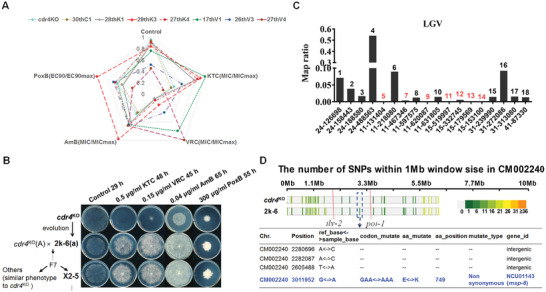
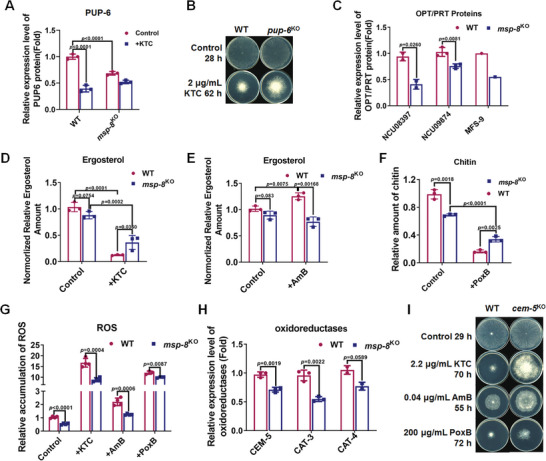
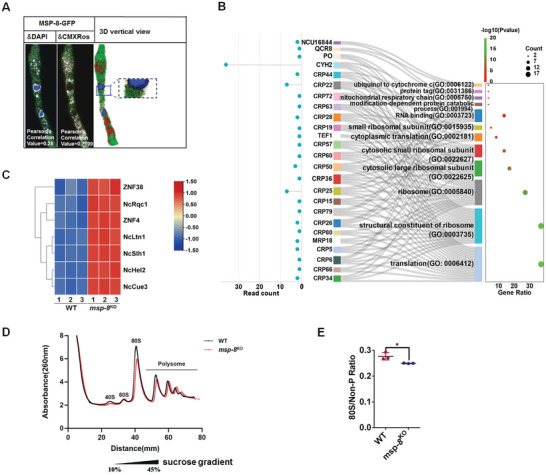
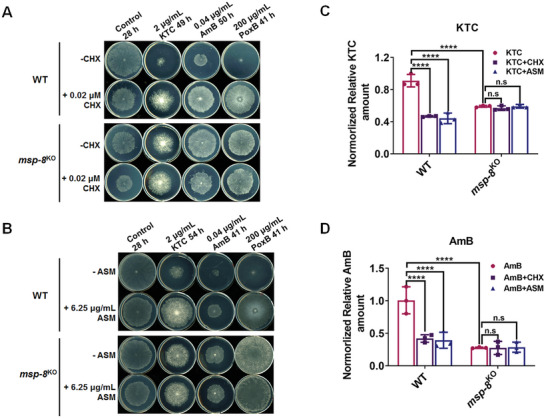
Antifungal resistance, particularly the rise of multidrug-resistance strains, poses a significant public health threat. In this study, the study identifies a novel multidrug-resistance gene, msp-8, encoding a helicase, through experimental evolution with Neurospora crassa as a model. Deletion of msp-8 conferred multidrug resistance in N. crassa, Aspergillus fumigatus, and Fusarium verticillioides. However, the transcript levels of genes encoding known drug targets or efflux pumps remain unaltered with msp-8 deletion. Interestingly, MSP-8 interacted with ribosomal proteins, and this mutant displays compromised ribosomal function, causing translational disturbance. Notably, inhibition of protein translation enhances resistance to azoles, amphotericin B, and polyoxin B. Furthermore, MSP-8 deficiency or inhibition of translation reduces intracellular ketoconazole accumulation and membrane-bound amphotericin B content, directly causing antifungal resistance. Additionaly, MSP-8 deficiency induces cell wall remodeling, and decreases intracellular ROS levels, further contributing to resistance. The findings reveal a novel multidrug resistance mechanism independent of changes in drug target or efflux pump, while MSP-8 deficiency suppresses protein translation, thereby facilitating the development of resistance with fitness cost. This study provides the first evidence that MSP-8 participates in protein translation and that translation suppression can cause multidrug resistance in fungi, offering new insights into resistance mechanisms in clinical and environmental fungal strains.
抗真菌耐药性,尤其是多重耐药菌株的增加,对公共卫生构成了重大威胁。在本研究中,该研究以粗糙脉孢菌为模型,通过实验进化鉴定出一个新的多重耐药基因msp-8,其编码一种解旋酶。缺失msp-8可使粗糙脉孢菌、烟曲霉和轮枝镰孢菌产生多重耐药性。然而,编码已知药物靶点或外排泵的基因转录水平在缺失msp-8后并未改变。有趣的是,MSP-8与核糖体蛋白相互作用,且该突变体表现出核糖体功能受损,导致翻译紊乱。值得注意的是,抑制蛋白质翻译可增强对唑类、两性霉素B和多氧霉素B的耐药性。此外,MSP-8缺陷或翻译抑制会减少细胞内酮康唑的积累和膜结合两性霉素B的含量,直接导致抗真菌耐药性。另外,MSP-8缺陷会诱导细胞壁重塑,并降低细胞内活性氧水平,进一步导致耐药性。这些发现揭示了一种独立于药物靶点或外排泵变化的新型多重耐药机制,而MSP-8缺陷会抑制蛋白质翻译,从而以适应性代价促进耐药性的产生。本研究首次证明MSP-8参与蛋白质翻译,且翻译抑制可导致真菌产生多重耐药性,为临床和环境真菌菌株的耐药机制提供了新的见解。