Amonchaiyapitak Orana, Santiwong Busayarat, Wasanapiarnpong Thanakorn, Chanamuangkon Theerapat, Linsuwanont Pairoj
Department of Pediatric Dentistry, Faculty of Dentistry, Chulalongkorn University, 34 Henri-Dunant Road, Wangmai, Pathumwan, Bangkok, 10330, Thailand.
Department of Materials of Science, Faculty of Science, Chulalongkorn University, 254 Phayathai Road, Wangmai, Pathumwan, Bangkok, 10330, Thailand.
BDJ Open. 2024 Dec 17;10(1):93. doi: 10.1038/s41405-024-00281-w.
Hard-setting calcium hydroxide-based materials, e.g., Dycal and Life, have been widely used for direct pulp capping. However, various studies have shown undesirable effects such as high solubility and unpredictable dentine bridge formation. Bioceramic, mainly composed of tricalcium and dicalcium silicates, e.g., mineral trioxide aggregate and Biodentine, have provided more desirable physical and biological properties. This study aims to measure the physical properties, chemical properties, and biological response of human dental pulp cells (HDPCs) on three dental pulp-capping materials, Dycal, Life, and cockle shell-derived tricalcium silicate pulp capping material (C-Cap).
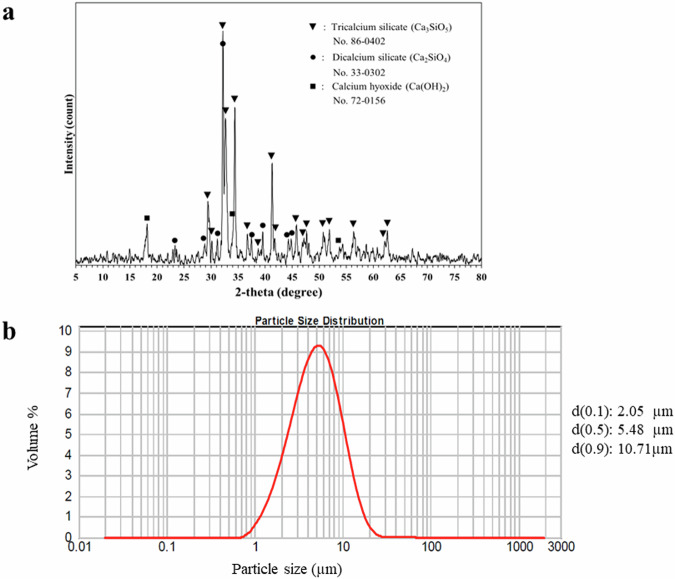
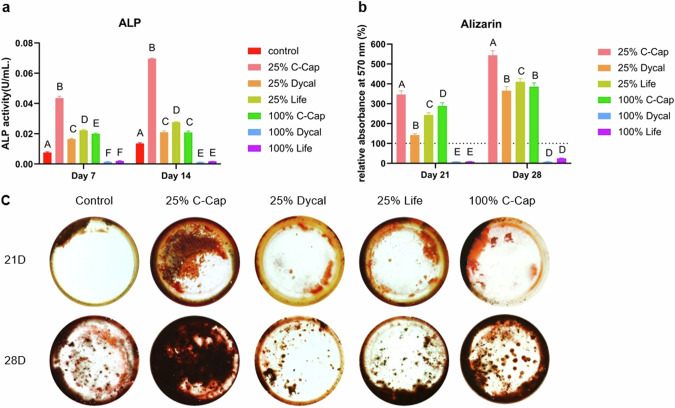
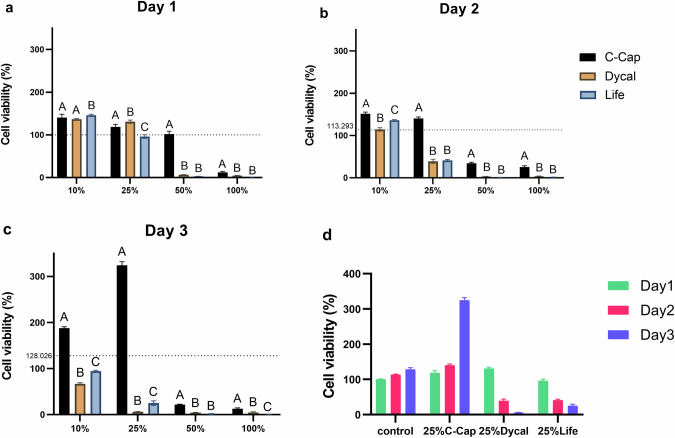
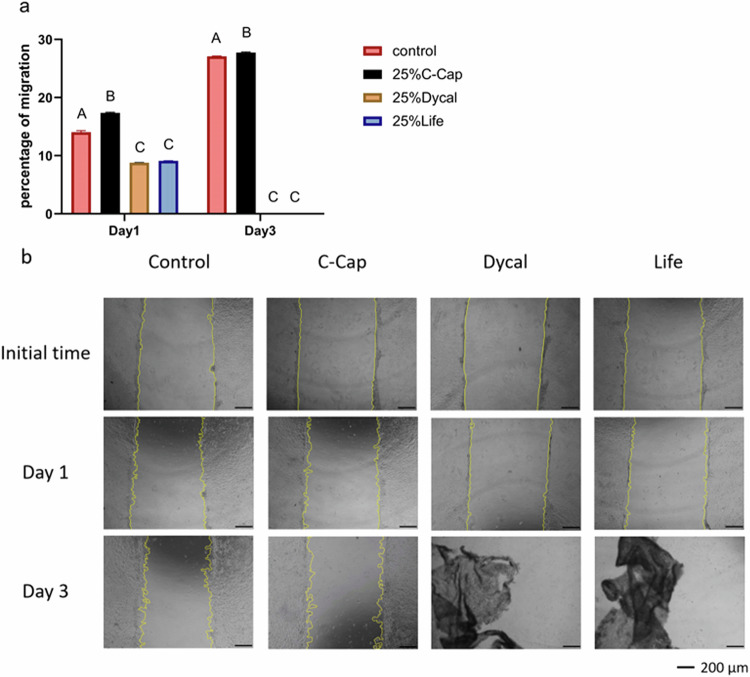
C-Cap was prepared from cockle shells and rice husk ash. Its chemical composition was identified using X-ray diffractometry. The setting time, flow, solubility, and radiopacity tests were performed following the International Organization for Standardization 6876:2012. pH and calcium ion release were measured. The materials were subjected to an extraction medium at various concentrations and subsequently measured for cytotoxicity and migration on HDPCs, from three healthy, mature permanent teeth from different donors. Osteogenic differentiation was assessed by examining alkaline phosphatase enzyme activity and alizarin red staining assay. The data were tested for a normal distribution. The differences among groups were statistically analyzed using ANOVA and Tukey's multiple comparison test (p < 0.05).
The setting time of each material was approximately 1-2 min. C-Cap showed the lowest solubility (10.27% ± 1.02%) compared to Dycal (12.67% ± 0.94%) and Life (12.74% ± 1.33%), with a significant difference (p < 0.05). All materials exhibited radiopacity ranging from 2.4 to 2.9 mm of aluminum. C-Cap had the highest flow, alkalinity, and calcium ion release. C-Cap was significantly less cytotoxic than Dycal and Life (p < 0.05). The migration of HDPCs cultured in C-Cap extraction medium (27.74% ± 0.12%) was comparable to that in serum-free medium (27.09% ± 0.08%) with a significant difference (p < 0.05). The mineralization by HDPCs maintained in C-Cap extraction medium was significantly higher than those in Dycal and Life extraction mediums with a significant difference (p < 0.05).
C-Cap, a tricalcium silicate-based pulp capping material has potential for further development. C-Cap exhibited comparable physical properties and superior biological properties when compared to Dycal and Life.
硬性氢氧化钙基材料,如Dycal和Life,已广泛用于直接盖髓术。然而,各种研究表明其存在不良影响,如高溶解性和不可预测的牙本质桥形成。生物陶瓷主要由硅酸三钙和硅酸二钙组成,如矿物三氧化物凝聚体和Biodentine,具有更理想的物理和生物学特性。本研究旨在测量人牙髓细胞(HDPCs)对三种牙髓盖髓材料Dycal、Life和蚶壳衍生硅酸三钙牙髓盖髓材料(C-Cap)的物理性能、化学性能和生物学反应。
C-Cap由蚶壳和稻壳灰制备而成。使用X射线衍射仪鉴定其化学成分。按照国际标准化组织6876:2012进行凝固时间、流动性、溶解性和不透射线性测试。测量pH值和钙离子释放量。将材料置于不同浓度的提取介质中,随后测量其对来自不同供体的三颗健康、成熟恒牙的HDPCs的细胞毒性和迁移情况。通过检测碱性磷酸酶活性和茜素红染色试验评估成骨分化。对数据进行正态分布检验。使用方差分析和Tukey多重比较检验对组间差异进行统计学分析(p < 0.05)。
每种材料的凝固时间约为1 - 2分钟。与Dycal(12.67% ± 0.94%)和Life(12.74% ± 1.33%)相比,C-Cap的溶解性最低(10.27% ± 1.02%),差异有统计学意义(p < 0.05)。所有材料的不透射线性范围为2.4至2.9毫米铝当量。C-Cap具有最高的流动性、碱性和钙离子释放量。C-Cap的细胞毒性明显低于Dycal和Life(p < 0.05)。在C-Cap提取介质中培养的HDPCs的迁移率(27.74% ± 0.12%)与无血清培养基中的迁移率(27.09% ± 0.08%)相当,差异有统计学意义(p < 0.05)。在C-Cap提取介质中培养的HDPCs的矿化程度明显高于Dycal和Life提取介质中的矿化程度,差异有统计学意义(p < 0.05)。
C-Cap,一种硅酸三钙基牙髓盖髓材料具有进一步开发的潜力。与Dycal和Life相比,C-Cap表现出相当的物理性能和卓越的生物学性能。