John Stephen, Abdulkarim Suraj, Usman Salisu, Rahman Md Toufiq, Creswell Jacob
Janna Health Foundation, Yola, Adamawa State, Nigeria.
SUFABEL Community Development Initiative, Gombe, Gombe State, Nigeria.
BMC Glob Public Health. 2023 Oct 6;1(1):17. doi: 10.1186/s44263-023-00017-2.
Ultra-portable X-ray devices with artificial intelligence (AI) are increasingly used to screen for tuberculosis (TB). Few studies have documented their performance. We aimed to evaluate the performance of chest X-ray (CXR) and symptom screening for active case finding of TB among remote populations using ultra-portable X-ray and AI.
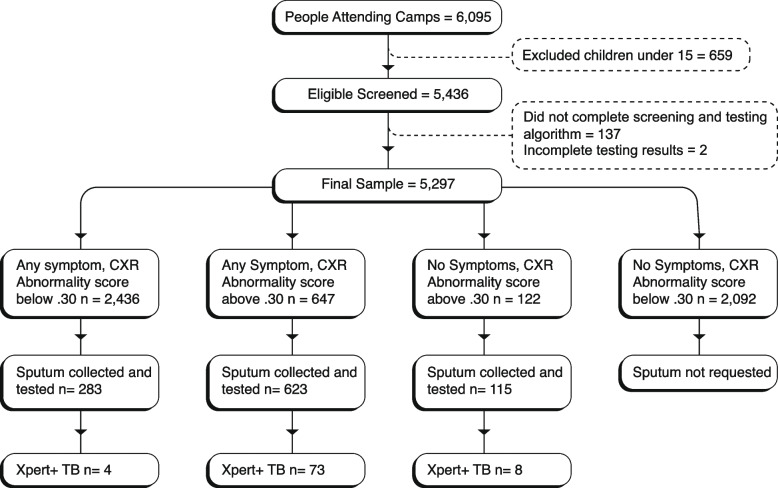
We organized screening camps in rural northeast Nigeria, and all consenting individuals ≥ 15 years were screened for TB symptoms (cough, fever, night sweats, and weight loss) and received a CXR. We used a MinXray Impact system interpreted by AI (qXR V3), which is a wireless setup and can be run without electricity. We collected sputum samples from individuals with an qXR abnormality score of 0.30 or higher or if they reported any TB symptoms. Samples were tested with Xpert MTB/RIF. We documented the TB screening cascade and evaluated the performance of screening with different combinations of symptoms and CXR interpreted by AI.
We screened 5297 individuals during 66 camps: 2684 (51%) were females, and 2613 (49%) were males. Using ≥ 2 weeks of cough to define presumptive TB, 1056 people (20%) would be identified. If a cough of any duration was used, the number with presumptive TB increased to 1889 (36%) and to 3083 (58%) if any of the four symptoms were used. Overall, 769 (14.5%) had abnormality scores of 0.3 or higher, and 447 (8.4%) had a score of 0.5 or higher. We collected 1021 samples for Xpert testing and detected 85 (8%) individuals with TB. Screening for prolonged cough only identified 40% of people with TB. Any symptom detected 90.6% of people with TB, but specificity was 11.4%. Using an AI abnormality score of 0.50 identified 89.4% of people with TB with a specificity of 62.8%.
Ultra-portable CXR can be used to provide more efficient TB screening in hard-to-reach areas. Symptom screening missed large proportions of people with bacteriologically confirmed TB. Employing AI to read CXR can improve triaging when human readers are unavailable and can save expensive diagnostic testing costs.
配备人工智能(AI)的超便携式X射线设备越来越多地用于结核病(TB)筛查。很少有研究记录其性能。我们旨在评估使用超便携式X射线和AI对偏远地区人群进行活动性结核病病例发现时胸部X线(CXR)和症状筛查的性能。
我们在尼日利亚东北部农村地区组织了筛查营地,所有年龄≥15岁且同意参与的个体均接受了结核病症状(咳嗽、发热、盗汗和体重减轻)筛查,并进行了胸部X线检查。我们使用了由AI(qXR V3)解读的MinXray Impact系统,这是一种无线设备,无需电力即可运行。我们从qXR异常评分≥0.30或报告有任何结核病症状的个体中采集痰液样本。样本用Xpert MTB/RIF进行检测。我们记录了结核病筛查流程,并评估了由AI解读的不同症状和CXR组合的筛查性能。
我们在66个营地筛查了5297人:2684人(51%)为女性,2613人(49%)为男性。使用≥2周咳嗽来定义疑似结核病,将识别出1056人(20%)。如果使用任何持续时间的咳嗽,疑似结核病患者人数增加到1889人(36%),如果使用四种症状中的任何一种,则增加到3083人(58%)。总体而言,769人(14.5%)的异常评分≥0.3,447人(8.4%)的评分≥0.5。我们采集了1021份样本进行Xpert检测,检测出85例(8%)结核病患者。仅筛查长时间咳嗽只能识别出40%的结核病患者。任何症状检测出90.6%的结核病患者,但特异性为11.4%。使用AI异常评分0.50可识别出89.4%的结核病患者,特异性为62.8%。
超便携式胸部X线可用于在难以到达的地区提供更高效的结核病筛查。症状筛查遗漏了很大比例的经细菌学确诊的结核病患者。在没有人工阅片人员时,采用AI解读胸部X线可以改善分流,并可节省昂贵的诊断检测成本。