Theodorakis Nikolaos, Kreouzi Magdalini, Hitas Christos, Anagnostou Dimitrios, Nikolaou Maria
School of Medicine, National and Kapodistrian University of Athens, 75 Mikras Asias, 11527 Athens, Greece.
Department of Cardiology & Heart Failure Outpatient Clinic, Sismanogleio-Amalia Fleming General Hospital, 14 25is Martiou Str., 15127 Melissia, Greece.
Diagnostics (Basel). 2024 Nov 27;14(23):2677. doi: 10.3390/diagnostics14232677.
Cardiometabolic heart failure with preserved ejection fraction (HFpEF) is largely driven by obesity-related factors, including adipokines and bioactive peptides primarily secreted by the adipose tissue, such as leptin, adiponectin, and resistin. These molecules link metabolic dysregulation to cardiovascular dysfunction, influencing HFpEF progression and patient outcomes Methods: A comprehensive literature search was conducted in PubMed up to 20 November 2024, using keywords and MeSH terms, such as "HFpEF", "adipokines", "leptin", "adiponectin", and "resistin", yielding 723 results. Boolean operators refined the search, and reference lists of key studies were reviewed. After screening for duplicates and irrelevant studies, 103 articles were included, providing data on adipokines' roles in HFpEF pathophysiology, biomarkers, and therapeutic implications.
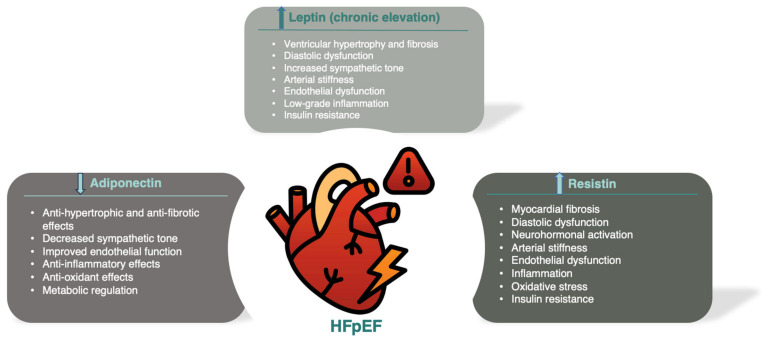
Both preclinical and clinical studies have demonstrated that adipokines play a role in modulating cardiovascular function, thereby contributing to the development of cardiometabolic HFpEF. Leptin promotes myocardial hypertrophy, fibrosis, endothelial dysfunction, and inflammation, though contradictory evidence suggests potential cardioprotective roles in subgroups like obese African American women. Adiponectin generally offers protective effects but presents a paradox, where elevated levels may correlate with worse outcomes, which may reflect either a compensatory response to cardiac dysfunction or a maladaptive state characterized by adiponectin resistance. Resistin is associated with increased cardiovascular risk through pro-inflammatory and pro-fibrotic effects, though its role in HFpEF requires further clarification. Other adipokines, like retinol-binding protein 4 and omentin-1, have emerged as potential contributors. Despite growing insights, clinical translation remains limited, underscoring a significant gap between experimental evidence and therapeutic application.
Future research should focus on targeted interventions that modulate adipokine pathways to potentially improve HFpEF outcomes. Innovative treatment strategies addressing underlying metabolic disturbances and adipokine dysregulation are essential for advancing the management of this challenging condition.
射血分数保留的心脏代谢性心力衰竭(HFpEF)在很大程度上由肥胖相关因素驱动,包括主要由脂肪组织分泌的脂肪因子和生物活性肽,如瘦素、脂联素和抵抗素。这些分子将代谢失调与心血管功能障碍联系起来,影响HFpEF的进展和患者预后。方法:截至2024年11月20日,在PubMed中进行了全面的文献检索,使用了“HFpEF”、“脂肪因子”、“瘦素”、“脂联素”和“抵抗素”等关键词和医学主题词,共得到723条结果。使用布尔运算符对检索进行了优化,并对关键研究的参考文献列表进行了审查。在筛选重复和不相关的研究后,纳入了103篇文章,提供了关于脂肪因子在HFpEF病理生理学、生物标志物和治疗意义方面作用的数据。
临床前和临床研究均表明,脂肪因子在调节心血管功能中发挥作用,从而促进心脏代谢性HFpEF的发展。瘦素可促进心肌肥大、纤维化、内皮功能障碍和炎症,不过有矛盾的证据表明,在肥胖非裔美国女性等亚组中,瘦素可能具有心脏保护作用。脂联素通常具有保护作用,但存在一个矛盾现象,即其水平升高可能与更差的预后相关,这可能反映了对心脏功能障碍的代偿反应或以脂联素抵抗为特征的适应不良状态。抵抗素通过促炎和促纤维化作用与心血管风险增加相关,不过其在HFpEF中的作用尚需进一步阐明。其他脂肪因子,如视黄醇结合蛋白4和网膜素-1,也已成为潜在的影响因素。尽管认识不断增加,但临床转化仍然有限,这凸显了实验证据与治疗应用之间的巨大差距。
未来的研究应侧重于靶向干预,调节脂肪因子途径,以潜在改善HFpEF的预后。针对潜在代谢紊乱和脂肪因子失调的创新治疗策略对于推进对这一具有挑战性疾病的管理至关重要。