Younis Eman M G, Mahmoud Mahmoud N, Albarrak Abdullah M, Ibrahim Ibrahim A
Faculty of Computers and Information, Minia University, Minia 61519, Egypt.
College of Computer and Information Sciences, Imam Mohammad Ibn Saud Islamic University (IMSIU), Riyadh 13318, Saudi Arabia.
Diagnostics (Basel). 2024 Nov 30;14(23):2710. doi: 10.3390/diagnostics14232710.
Cancer ranks second among the causes of mortality worldwide, following cardiovascular diseases. Brain cancer, in particular, has the lowest survival rate of any form of cancer. Brain tumors vary in their morphology, texture, and location, which determine their classification. The accurate diagnosis of tumors enables physicians to select the optimal treatment strategies and potentially prolong patients' lives. Researchers who have implemented deep learning models for the diagnosis of diseases in recent years have largely focused on deep neural network optimization to enhance their performance. This involves implementing models with the best performance and incorporating various network architectures by configuring their hyperparameters.
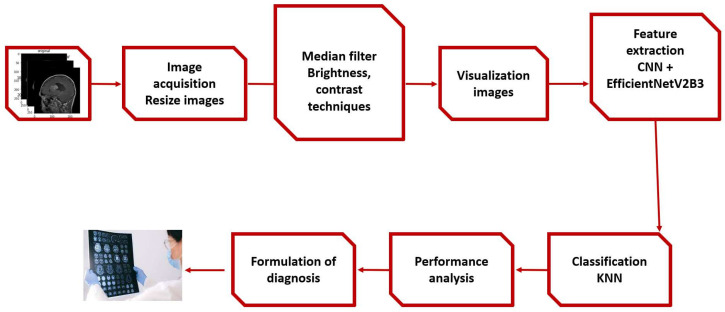
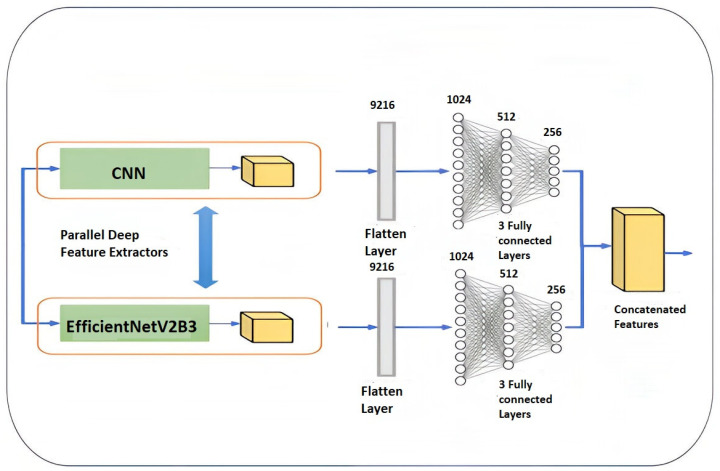
This paper presents a novel hybrid approach for improved brain tumor classification by combining CNNs and EfficientNetV2B3 for feature extraction, followed by K-nearest neighbors (KNN) for classification, which has been described as one of the simplest machine learning algorithms based on supervised learning techniques. The KNN algorithm assumes similarities between new cases and available cases and assigns new cases to the category that most closely resembles the available categories.
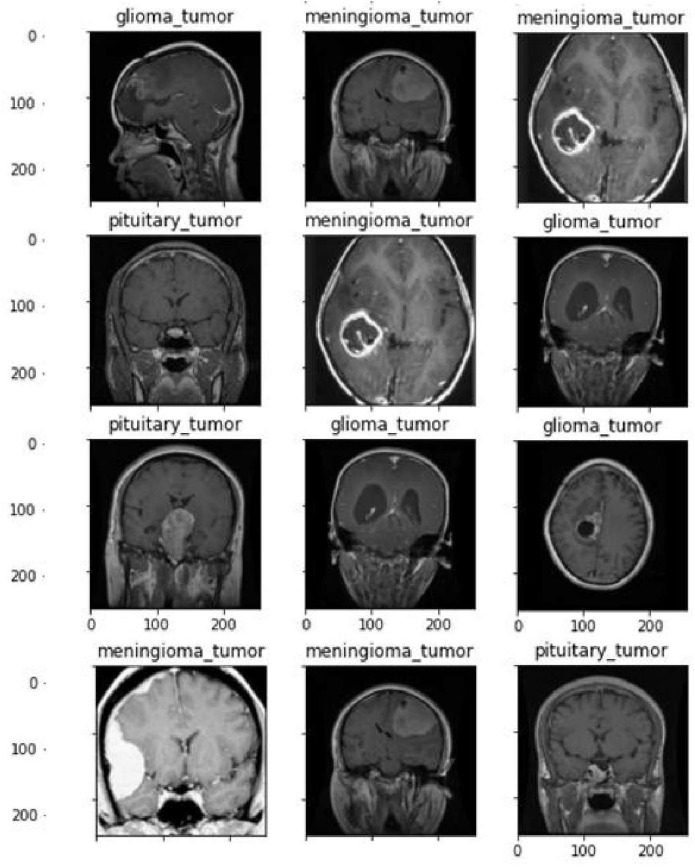
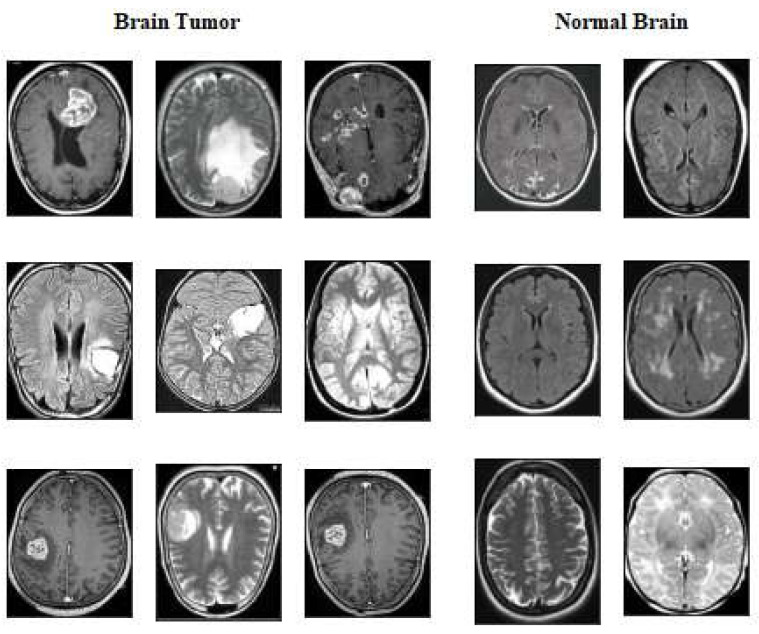
To evaluate the recommended method's efficacy, two widely known benchmark MRI datasets were utilized in the experiments. The initial dataset consisted of 3064 MRI images depicting meningiomas, gliomas, and pituitary tumors. Images from two classes, consisting of healthy brains and brain tumors, were included in the second dataset, which was obtained from Kaggle.
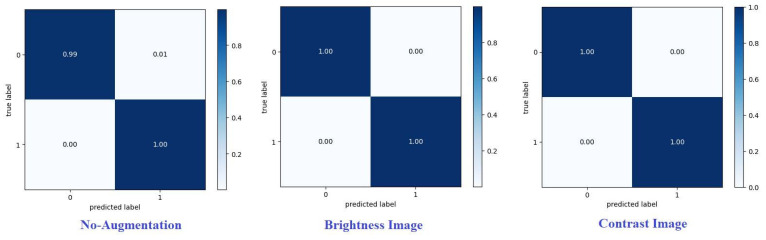
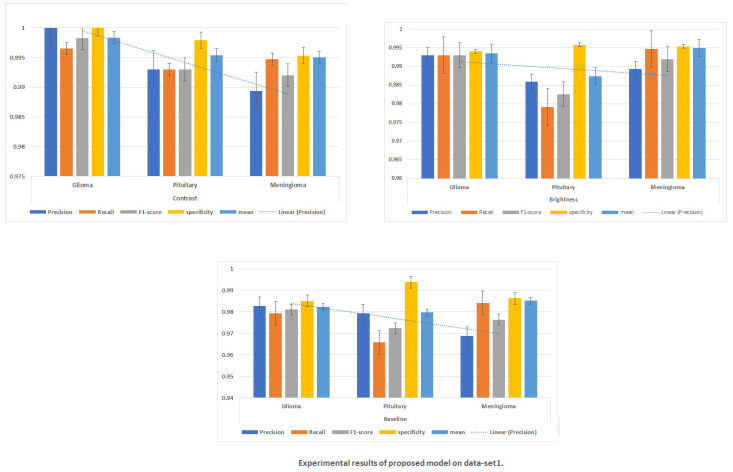
In order to enhance the performance even further, this study concatenated the CNN and EfficientNetV2B3's flattened outputs before feeding them into the KNN classifier. The proposed framework was run on these two different datasets and demonstrated outstanding performance, with accuracy of 99.51% and 99.8%, respectively.
癌症在全球死亡原因中位列第二,仅次于心血管疾病。特别是脑癌,在所有癌症类型中生存率最低。脑肿瘤在形态、质地和位置上各不相同,这些因素决定了它们的分类。肿瘤的准确诊断使医生能够选择最佳治疗策略,并有可能延长患者的生命。近年来,采用深度学习模型进行疾病诊断的研究人员主要专注于深度神经网络优化以提高其性能。这包括实现性能最佳的模型,并通过配置超参数来融合各种网络架构。
本文提出了一种新颖的混合方法,通过结合卷积神经网络(CNNs)和高效网络V2B3(EfficientNetV2B3)进行特征提取,随后使用K近邻(KNN)进行分类,KNN被认为是基于监督学习技术的最简单机器学习算法之一。KNN算法假定新病例与现有病例之间存在相似性,并将新病例分配到与现有类别最相似的类别中。
为了评估所推荐方法的有效性,实验中使用了两个广为人知的基准磁共振成像(MRI)数据集。初始数据集由3064张描绘脑膜瘤、神经胶质瘤和垂体瘤的MRI图像组成。第二个数据集包含来自两个类别的图像,即健康大脑和脑肿瘤,该数据集取自Kaggle。
为了进一步提高性能,本研究在将卷积神经网络和高效网络V2B3的展平输出输入到KNN分类器之前将它们连接起来。所提出的框架在这两个不同的数据集上运行,并展示出了出色的性能,准确率分别为99.51%和99.8%。