Lin Nan, Paul Rudy, Guerra Santiago, Liu Yan, Doulgeris James, Shi Min, Lin Maohua, Engeberg Erik D, Hashemi Javad, Vrionis Frank D
Department of Gastroenterology, The Affiliated Hospital of Putian University, Putian 351100, China.
Department of Ocean & Mechanical Engineering, Florida Atlantic University, Boca Raton, FL 33431, USA.
Healthcare (Basel). 2024 Nov 21;12(23):2330. doi: 10.3390/healthcare12232330.
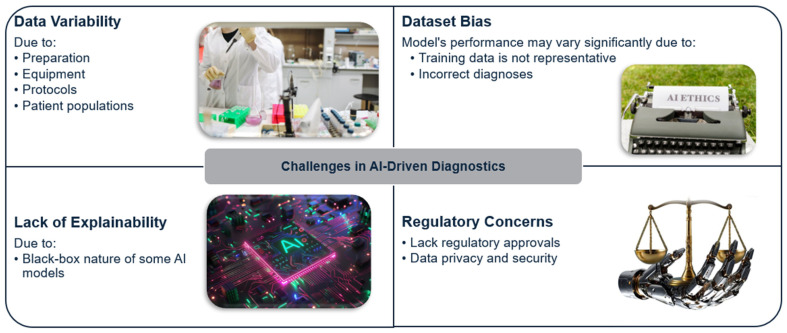
Artificial Intelligence (AI) is poised to revolutionize numerous aspects of human life, with healthcare among the most critical fields set to benefit from this transformation. Medicine remains one of the most challenging, expensive, and impactful sectors, with challenges such as information retrieval, data organization, diagnostic accuracy, and cost reduction. AI is uniquely suited to address these challenges, ultimately improving the quality of life and reducing healthcare costs for patients worldwide. Despite its potential, the adoption of AI in healthcare has been slower compared to other industries, highlighting the need to understand the specific obstacles hindering its progress. This review identifies the current shortcomings of AI in healthcare and explores its possibilities, realities, and frontiers to provide a roadmap for future advancements.
人工智能(AI)有望彻底改变人类生活的诸多方面,医疗保健是将从这一变革中受益的最关键领域之一。医学仍然是最具挑战性、成本最高且影响最大的行业之一,面临着信息检索、数据组织、诊断准确性和成本降低等挑战。人工智能特别适合应对这些挑战,最终改善全球患者的生活质量并降低医疗成本。尽管其潜力巨大,但与其他行业相比,人工智能在医疗保健领域的应用速度较慢,这凸显了了解阻碍其发展的具体障碍的必要性。本综述确定了人工智能在医疗保健领域当前的不足之处,并探讨了其可能性、现状和前沿领域,以为未来的发展提供路线图。