Brailova Marina, Audin Marie, Raconnat Julien, Bouillon-Minois Jean-Baptiste, Schmidt Jeannot, Pereira Bruno, Bouvier Damien, Sapin Vincent
Biochemistry and Molecular Genetic Department, CHU Clermont-Ferrand, F-63000 Clermont-Ferrand, France.
Adult Emergency Department, CHU Clermont-Ferrand, F-63000 Clermont-Ferrand, France.
J Clin Med. 2024 Nov 26;13(23):7174. doi: 10.3390/jcm13237174.
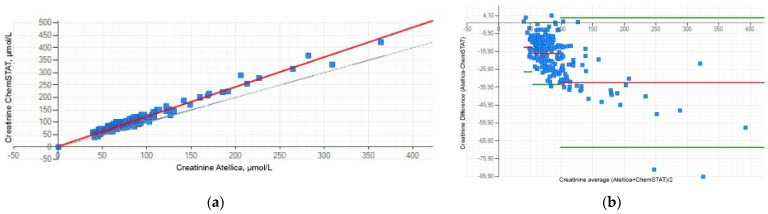
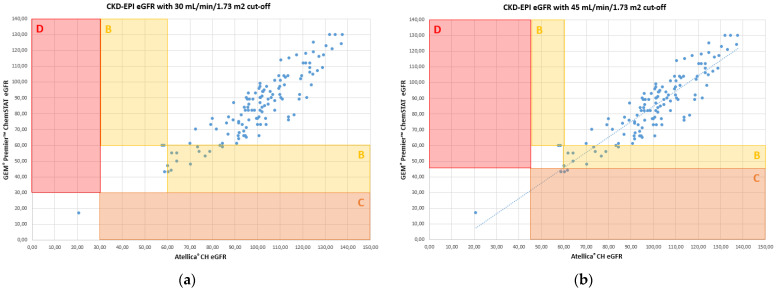
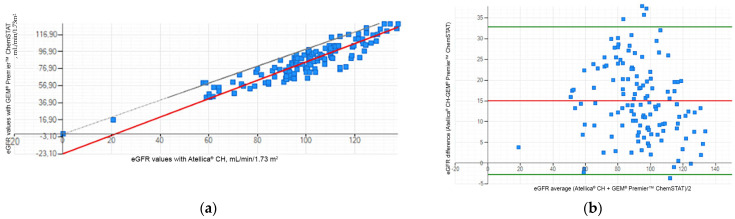
Having a laboratory renal profile for medical imaging examinations requiring contrast media (CM) administration is strongly advised. Creatinine helps identify patients at risk of contrast-induced nephropathy (CIN). The GEM Premier™ ChemSTAT (Werfen) is a point-of-care (POC) analyzer with 12 emergency parameters, including a creatinine assay. This study aims to compare ChemSTAT with the central analytical solution of the University Hospital of Clermont-Ferrand and to evaluate the interest in using POC creatinine in the emergency department (ED) to optimize the flow of patients, especially when CM administration is necessary. More than 200 whole blood (WB) samples from the ED were evaluated on the ChemSTAT analyzer. As comparative methods, the plasma aliquots from the same samples were assayed on an Atellica CH (Siemens Healthineers). The clinical concordance was assessed according to the decision cut-offs of the French Society of Radiology for the risk of CIN. The availability times of biological results between ChemSTAT and the central laboratory were studied. WB results from the ChemSTAT analyzer correlated well with those from the Atellica CH, except for tCO2 (the known bias between the Siemens and Cobas Roche methods for predicting ChemSTAT values). The results of the creatinine assay allow for identical medical decisions in comparison to the renal-risk cut-offs. The availability of the biological results was reduced by 50 min on average with ChemSTAT vs the central laboratory. Computed tomography (CT) was performed for 44.7% of patients, including the injection of the CM in 68% of cases. For these patients, the availability of creatinine results relative to imaging time is faster with the ChemSTAT by an average of 45.2 min. Great analytical and clinical correlations for creatinine assays allow for the safe identification of patients at risk of CIN, and improve patient flow in ED, especially for those requiring computed tomography with CM.
强烈建议在进行需要使用造影剂(CM)的医学影像检查时进行实验室肾脏检查。肌酐有助于识别有造影剂肾病(CIN)风险的患者。GEM Premier™ ChemSTAT(Werfen)是一种即时检验(POC)分析仪,具有12项急诊参数,包括肌酐检测。本研究旨在将ChemSTAT与克莱蒙费朗大学医院的中央分析解决方案进行比较,并评估在急诊科(ED)使用POC肌酐检测以优化患者流程的意义,特别是在需要使用CM时。对来自急诊科的200多个全血(WB)样本在ChemSTAT分析仪上进行了评估。作为比较方法,对相同样本的血浆等分试样在Atellica CH(西门子医疗)上进行检测。根据法国放射学会关于CIN风险的判定临界值评估临床一致性。研究了ChemSTAT与中央实验室之间生物学结果的可得时间。ChemSTAT分析仪的WB结果与Atellica CH的结果相关性良好,但总二氧化碳(tCO2)除外(西门子和科巴斯罗氏方法在预测ChemSTAT值方面已知存在偏差)。与肾脏风险临界值相比,肌酐检测结果允许做出相同的医疗决策。与中央实验室相比,ChemSTAT的生物学结果可得时间平均缩短了50分钟。44.7%的患者进行了计算机断层扫描(CT),其中68%的病例注射了CM。对于这些患者,ChemSTAT的肌酐结果相对于成像时间的可得速度平均快45.2分钟。肌酐检测具有良好的分析和临床相关性,能够安全地识别有CIN风险的患者,并改善急诊科的患者流程,特别是对于那些需要使用CM进行计算机断层扫描的患者。