Nakae Aya, Bu-Omer Hani M, Chang Wei-Chuan, Kishimoto Chie, Sumioka Hidenobu
Presence Media Research Group, Hiroshi Ishiguro Laboratories, Deep Interaction Laboratory Group, Advanced Telecommunications Research Institute International (ATR), 2-2-2 Hikaridai, Seika-Cho, Soraku-Gun, Kyoto 619-0288, Japan.
Global Center for Medical Engineering and Informatics, Graduate School of Medicine, Osaka University, 2-2 Yamadaoka, Suita City 565-0871, Japan.
Sensors (Basel). 2024 Nov 26;24(23):7541. doi: 10.3390/s24237541.
As the Internet of Things (IoT) expands, it enables new forms of communication, including interactions mediated by teleoperated robots like avatars. While extensive research exists on the effects of these devices on communication partners, there is limited research on the impact on the operators themselves. This study aimed to objectively assess the psychological and physiological effects of operating a teleoperated robot, specifically Telenoid, on its human operator.
Twelve healthy participants (2 women and 10 men, aged 18-23 years) were recruited from Osaka University. Participants engaged in two communication sessions with a first-time partner: face-to-face and Telenoid-mediated. Telenoid is a minimalist humanoid robot teleoperated by a participant. Blood samples were collected before and after each session to measure hormonal and oxidative markers, including cortisol, diacron reactive oxygen metabolites (d-ROMs), and the biological antioxidat activity of plasma (BAP). Psychological stress was assessed using validated questionnaires (POMS-2, HADS, and SRS-18).
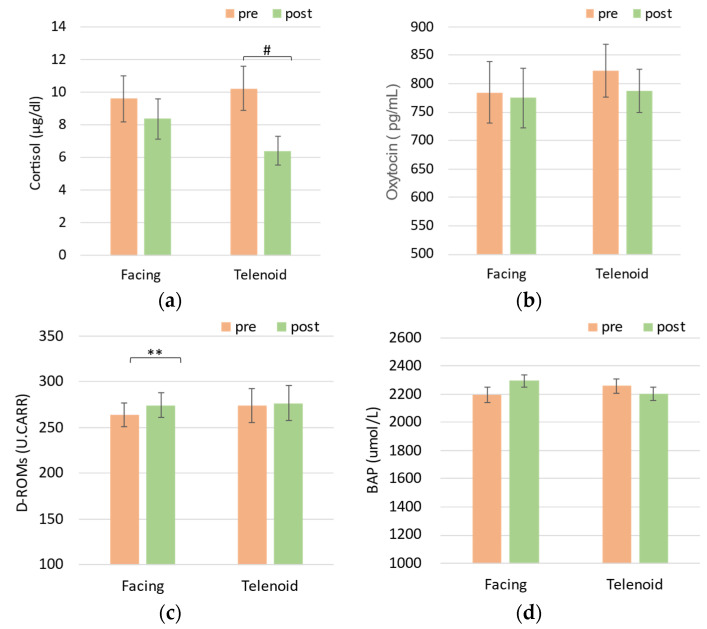
A trend of a decrease in cortisol levels was observed during Telenoid-mediated communication, whereas face-to-face interactions showed no significant changes. Oxidative stress, measured by d-ROMs, significantly increased after face-to-face interactions but not in Telenoid-mediated sessions. Significant correlations were found between oxytocin and d-ROMs and psychological stress scores, particularly in terms of helplessness and total stress measures. However, no significant changes were observed in other biomarkers or between the two conditions for most psychological measures.
These findings suggest that cortisol and d-ROMs may serve as objective biomarkers for assessing psychophysiological stress during robot-mediated communication. Telenoid's minimalist design may help reduce social pressures and mitigate stress compared to face-to-face interactions. Further research with larger, more diverse samples and longitudinal designs is needed to validate these findings and explore the broader impacts of teleoperated robots.
随着物联网(IoT)的扩展,它催生了新的通信形式,包括由远程操作机器人(如化身)介导的交互。虽然关于这些设备对通信伙伴的影响已有大量研究,但对操作者自身影响的研究却很有限。本研究旨在客观评估操作远程操作机器人(特别是Telenoid)对人类操作者的心理和生理影响。
从大阪大学招募了12名健康参与者(2名女性和10名男性,年龄在18 - 23岁之间)。参与者与初次见面的伙伴进行了两次交流:面对面交流和通过Telenoid介导的交流。Telenoid是一个由参与者远程操作的简约人形机器人。在每次交流前后采集血样,以测量激素和氧化应激标志物,包括皮质醇、二乙酰反应性氧代谢产物(d-ROMs)和血浆的生物抗氧化活性(BAP)。使用经过验证的问卷(POMS - 2、HADS和SRS - 18)评估心理压力。
在通过Telenoid介导的交流过程中观察到皮质醇水平有下降趋势,而面对面交流则无显著变化。通过d-ROMs测量的氧化应激在面对面交流后显著增加,但在Telenoid介导的交流中没有增加。发现催产素与d-ROMs以及心理压力评分之间存在显著相关性,特别是在无助感和总压力测量方面。然而,在其他生物标志物方面以及两种交流条件下的大多数心理测量指标均未观察到显著变化。
这些发现表明,皮质醇和d-ROMs可能作为评估机器人介导交流过程中心理生理压力的客观生物标志物。与面对面交流相比,Telenoid的简约设计可能有助于减轻社会压力并缓解应激。需要进行更大规模、更多样化样本以及纵向设计的进一步研究来验证这些发现,并探索远程操作机器人的更广泛影响。