
探索地热能消耗在实现碳中和和环境可持续性方面的作用。
Exploring the role of geothermal energy consumption in achieving carbon neutrality and environmental sustainability.
作者信息
Idroes Ghalieb Mutig, Afjal Mohd, Khan Mohsin, Haseeb Mohammad, Hardi Irsan, Noviandy Teuku Rizky, Idroes Rinaldi
机构信息
Department of Economics, Faculty of Economics and Business, Universitas Syiah Kuala, Banda Aceh, 23111, Indonesia.
Energy and Green Economics Unit, Graha Primera Saintifika, Aceh Besar, 23371, Indonesia.
出版信息
Heliyon. 2024 Nov 27;10(23):e40709. doi: 10.1016/j.heliyon.2024.e40709. eCollection 2024 Dec 15.
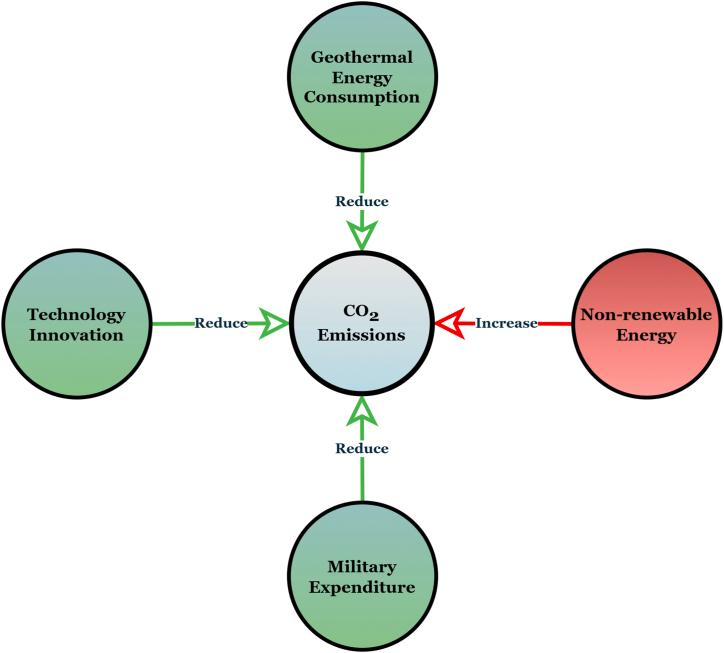
While there is extensive research on the environmental impacts of renewable energy sources, a notable gap remains in understanding the specific environmental effects of geothermal energy. This knowledge shortfall is particularly critical for Indonesia, which holds the world's second-largest geothermal potential but has yet to effectively harness these valuable resources. This study aims to address this gap by providing a preliminary evaluation of the dynamic impact of geothermal energy consumption and various macroeconomic variables on carbon dioxide (CO) emissions in Indonesia from 1995 to 2020. The study employs the Fully Modified Ordinary Least Squares (FMOLS) method and conducts robustness checks using the Dynamic Ordinary Least Squares (DOLS) method. Our findings reveal that geothermal energy consumption, military expenditure, and technology innovation contribute to a reduction in CO emissions, while non-renewable energy consumption increases CO emissions. Additionally, the pairwise Granger causality test results indicate a unidirectional causality running from geothermal energy consumption to CO emissions, suggesting that trends in geothermal energy use can reliably predict changes in CO levels. This study provides valuable insights for policymakers and stakeholders in formulating sustainable policies for carbon reduction in Indonesia.
虽然对可再生能源的环境影响已有广泛研究,但在了解地热能的具体环境影响方面仍存在显著差距。这种知识缺口对印度尼西亚尤为关键,该国拥有世界第二大地热能潜力,但尚未有效利用这些宝贵资源。本研究旨在通过初步评估1995年至2020年期间地热能消费和各种宏观经济变量对印度尼西亚二氧化碳(CO)排放的动态影响来填补这一差距。该研究采用完全修正普通最小二乘法(FMOLS),并使用动态普通最小二乘法(DOLS)进行稳健性检验。我们的研究结果表明,地热能消费、军事支出和技术创新有助于减少CO排放,而非可再生能源消费会增加CO排放。此外,成对格兰杰因果关系检验结果表明,从地热能消费到CO排放存在单向因果关系,这表明地热能使用趋势能够可靠地预测CO水平的变化。本研究为政策制定者和利益相关者制定印度尼西亚可持续的碳减排政策提供了有价值的见解。


 Zotero 插件