Koziy Roman V, Katselis George S, Yoshimura Seiji, Simko Elemir, Bracamonte José L
Departments of Veterinary Pathology, University of Saskatchewan, Saskatoon, SK, Canada.
Western College of Veterinary Medicine, and Canadian Centre for Rural and Agricultural Health, Department of Medicine, College of Medicine, University of Saskatchewan, Saskatoon, SK, Canada.
J Vet Diagn Invest. 2025 Jan;37(1):42-54. doi: 10.1177/10406387241299873. Epub 2024 Dec 17.
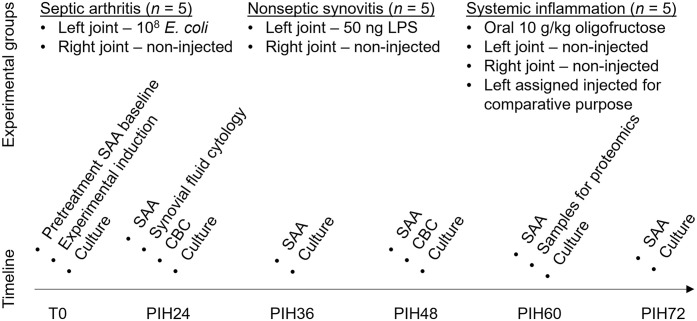
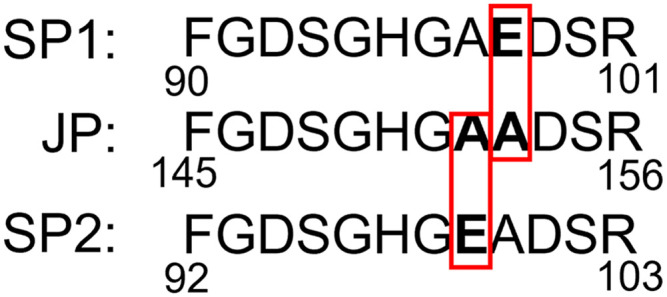
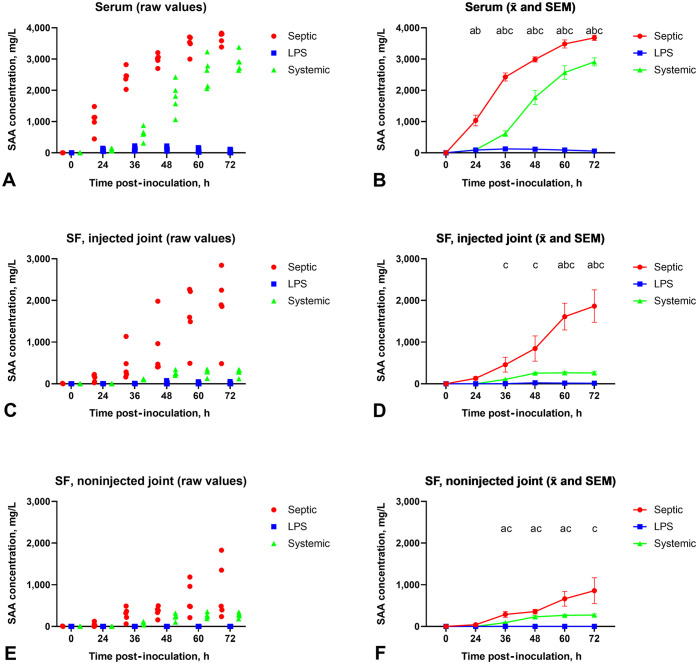
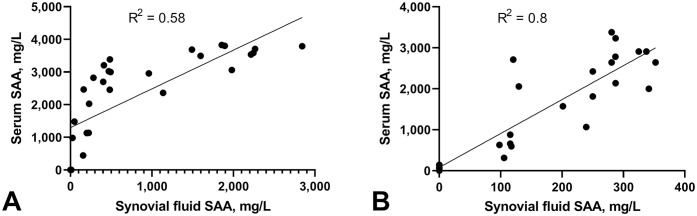
Prompt diagnosis of equine septic arthritis is crucial for successful treatment. Serum amyloid A (SAA) has been suggested as a reliable biomarker. However, we previously found that synovial fluid SAA increases in nonaffected joints of horses with septic arthritis. We hypothesized that systemic SAA may leak into the nonaffected joints. If this is the case, we also hypothesized that locally produced joint SAA isoforms may be better candidates for septic arthritis biomarkers. Thus, our objectives were 1) to evaluate the temporal kinetics of systemic and synovial fluid SAA in horses with septic arthritis ( = 5), non-septic synovitis ( = 5), and systemic inflammation ( = 5), examining both affected and contralateral joints; and 2) investigate putative locally produced joint SAA isoforms and detect amino-acid differences between them. We confirmed that SAA increases significantly in synovial fluid in nonaffected joints of horses with systemic inflammation (≤352 mg/L), as well as in contralateral nonaffected joins in horses with septic arthritis (≤1,830 mg/L) compared to baseline at time 0 (<0.2 mg/L). We also identified a putative locally produced joint SAA peptide in synovial fluid (FGDSGHGAADSR) that differed in 1 amino acid from 2 systemic peptides found both in plasma and synovial fluid. The putative joint SAA isoform was present in joints of horses with both septic arthritis and systemic inflammation (ion intensities 10-10). Thus, the increase of synovial fluid SAA may be both due to the leakage of SAA from serum into joints and local production of joint SAA isoforms.
马属动物脓毒性关节炎的及时诊断对于成功治疗至关重要。血清淀粉样蛋白A(SAA)已被认为是一种可靠的生物标志物。然而,我们之前发现,脓毒性关节炎马的未受影响关节的滑液SAA会升高。我们推测全身SAA可能会渗入未受影响的关节。如果是这样,我们还推测局部产生的关节SAA异构体可能是脓毒性关节炎生物标志物的更好候选者。因此,我们的目标是:1)评估脓毒性关节炎马(n = 5)、非脓毒性滑膜炎马(n = 5)和全身性炎症马(n = 5)的全身和滑液SAA的时间动力学,同时检查患侧和对侧关节;2)研究假定的局部产生的关节SAA异构体,并检测它们之间的氨基酸差异。我们证实,与0时刻的基线(<0.2 mg/L)相比,全身性炎症马(≤352 mg/L)的未受影响关节的滑液SAA以及脓毒性关节炎马的对侧未受影响关节的滑液SAA(≤1830 mg/L)均显著升高。我们还在滑液中鉴定出一种假定的局部产生的关节SAA肽(FGDSGHGAADSR),它与在血浆和滑液中发现的两种全身肽在1个氨基酸上有所不同。假定的关节SAA异构体存在于脓毒性关节炎马和全身性炎症马的关节中(离子强度为10 - 10)。因此,滑液SAA的升高可能既是由于SAA从血清渗入关节,也是由于关节SAA异构体的局部产生。