Glynne Sarah, Reisel Daniel, Kamal Aini, Neville Amy, McColl Lynsey, Lewis Rebecca, Newson Louise
From the Portland Hospital, London, United Kingdom.
EGA Institute for Women's Health, Faculty of Population Health Sciences, University College London, London, United Kingdom.
Menopause. 2025 Feb 1;32(2):103-111. doi: 10.1097/GME.0000000000002459. Epub 2024 Dec 17.
The aims of the study are to explore the range and variation in serum estradiol concentration, and to estimate the prevalence of "poor absorption" (women using licensed estradiol doses with subtherapeutic levels), in perimenopausal and postmenopausal women using transdermal estradiol in the real world.
This is a cross-sectional analysis in a specialist menopause clinic in the UK.
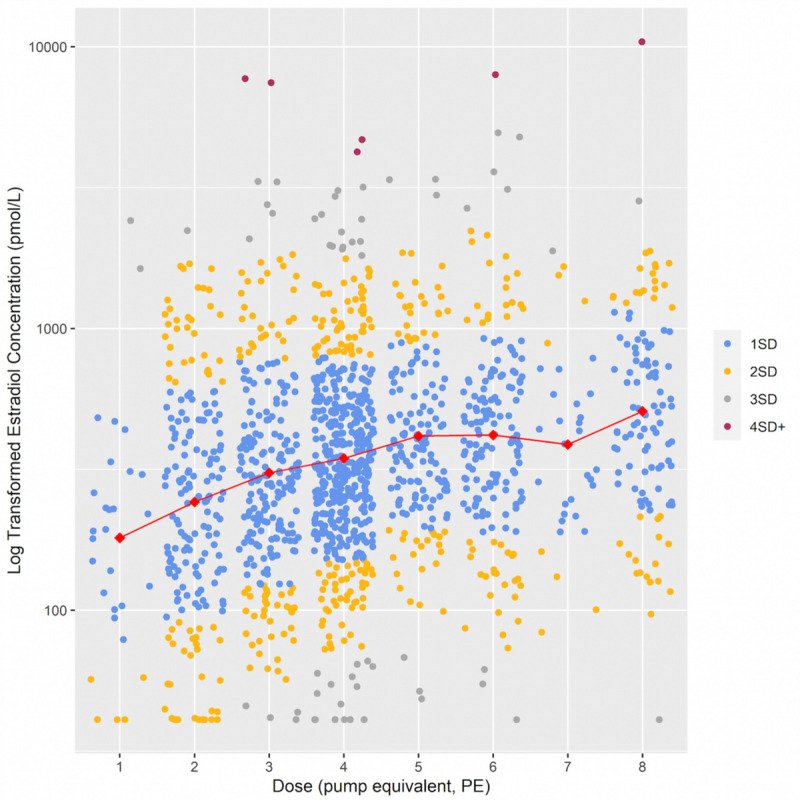
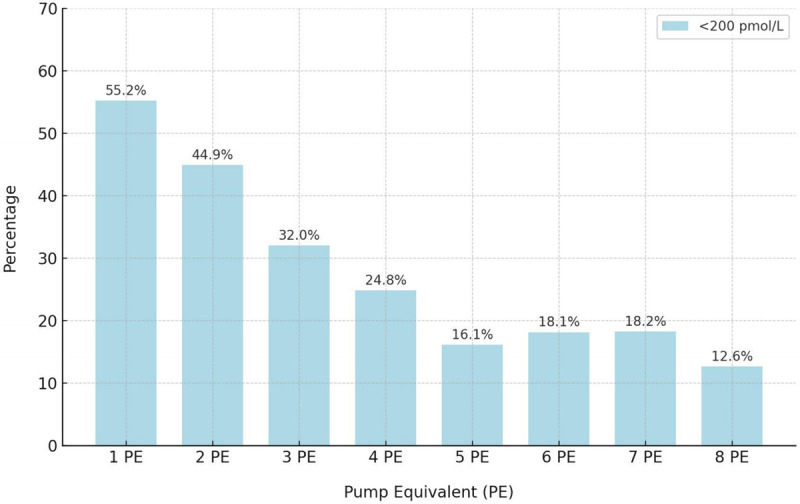
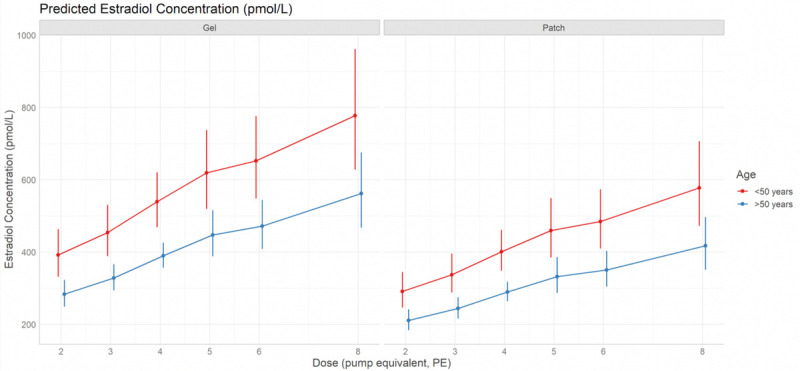
Serum samples were obtained from 1,508 perimenopausal and postmenopausal women. A total of 61.87% were using licensed doses. The median estradiol concentration was 355.26 pmol/L (interquartile range 198.44-646.15 pmol/L). A reference interval for the whole cohort was defined as 54.62-2,050.55 pmol/L. There was substantial interindividual variation across the dose range. Variance was greater in younger women ( P = 0.002) and gel users ( P = 0.002). There was a trend toward greater variance in women using higher doses, but the association failed to reach statistical significance ( P = 0.074). One in four women (24.84%) using the highest licensed dose had subtherapeutic levels (<200 pmol/L). Older women (≥50 y) and patch users were more likely to have low levels (odds ratio 1.77, 95% confidence interval 1.22-2.62, P = 0.003; and odds ratio 1.51, 95% confidence interval 1.18-1.95, P = 0.001, respectively).
The reference interval for perimenopausal and postmenopausal women using on-label and off-label doses of transdermal estradiol in the real world is wide, and there is considerable interindividual variation. The number of estradiol users with low estradiol levels (<200 pmol/L) is higher than previously recognized. Measurement of serum estradiol can be helpful to identify women who may benefit from an off-label dose. Dose customization is key to ensure that all women can reap the benefits of HT.
本研究旨在探讨围绝经期和绝经后女性使用经皮雌二醇后血清雌二醇浓度的范围及变化,并估计“吸收不良”(使用许可剂量雌二醇但血药浓度低于治疗水平的女性)的发生率。
这是一项对英国一家更年期专科诊所进行的横断面分析。
采集了1508名围绝经期和绝经后女性的血清样本。共有61.87%的女性使用许可剂量。雌二醇浓度中位数为355.26 pmol/L(四分位间距为198.44 - 646.15 pmol/L)。整个队列的参考区间定义为54.62 - 2050.55 pmol/L。在整个剂量范围内个体间差异很大。年轻女性(P = 0.002)和使用凝胶剂的女性(P = 0.002)差异更大。使用较高剂量的女性有差异更大的趋势,但该关联未达到统计学显著性(P = 0.074)。使用最高许可剂量的女性中有四分之一(24.84%)血药浓度低于治疗水平(<200 pmol/L)。老年女性(≥50岁)和使用贴片的女性血药浓度较低的可能性更大(优势比分别为1.77,95%置信区间1.22 - 2.62,P = 0.003;以及优势比1.51,95%置信区间1.18 - 1.95,P = 0.001)。
在现实世界中,围绝经期和绝经后女性使用经皮雌二醇的标签上和标签外剂量时,参考区间很宽,个体间差异很大。雌二醇水平低(<200 pmol/L)的使用者数量高于先前的认识。测定血清雌二醇有助于识别可能从标签外剂量中获益的女性。剂量定制是确保所有女性都能从激素替代疗法中获益的关键。