Domínguez-López Inés, Lamuela-Raventós Rosa M, Razquin Cristina, Arancibia-Riveros Camila, Galkina Polina, Salas-Salvadó Jordi, Alonso-Gómez Ángel M, Fitó Montserrat, Fiol Miquel, Lapetra José, Gómez-Gracia Enrique, Sorlí José V, Ruiz-Canela Miguel, Castañer Olga, Liang Liming, Serra-Majem Lluis, Hu Frank B, Ros Emilio, Martínez-González Miguel Ángel, Estruch Ramon
Polyphenol Research Group, Departament de Nutrició, Ciències de l'Alimentació i Gastronomía, Facultat de Farmacia, Universitat de Barcelona (UB), Av. de Joan XXII, 27-31, Barcelona 08028, Spain.
Institut de Nutrició i Seguretat Alimentària (INSA), Universitat de Barcelona (UB), Santa Coloma de Gramanet 08921, Spain.
Eur Heart J. 2025 Jan 7;46(2):161-172. doi: 10.1093/eurheartj/ehae804.
Moderate wine consumption has been associated with lower cardiovascular disease (CVD) risk in older populations. However, wine consumption information through self-reports is prone to measurement errors inherent to subjective assessments. The aim of this study was to evaluate the association between urinary tartaric acid, an objective biomarker of wine consumption, and the rate of a composite clinical CVD event.
A case-cohort nested study was designed within the PREDIMED trial with 1232 participants: 685 incident cases of CVD and a random subcohort of 625 participants (including 78 overlapping cases). Wine consumption was registered using validated food frequency questionnaires. Liquid chromatography-tandem mass spectrometry was used to measure urinary tartaric acid at baseline and after one year of intervention. Weighted Cox regression models were used to estimate hazard ratios (HRs) of CVD.
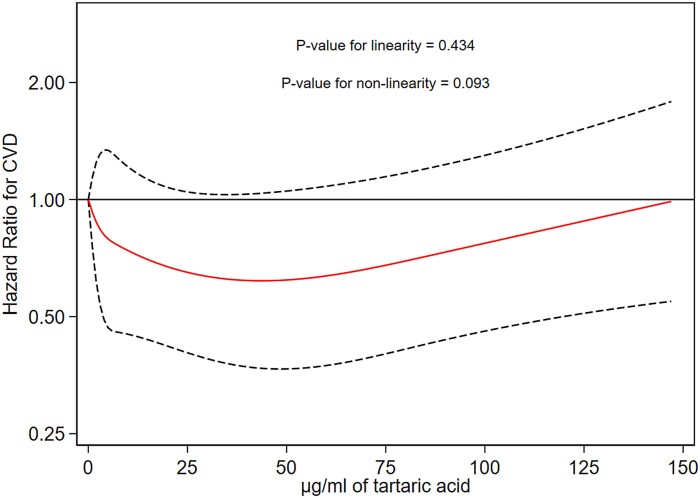
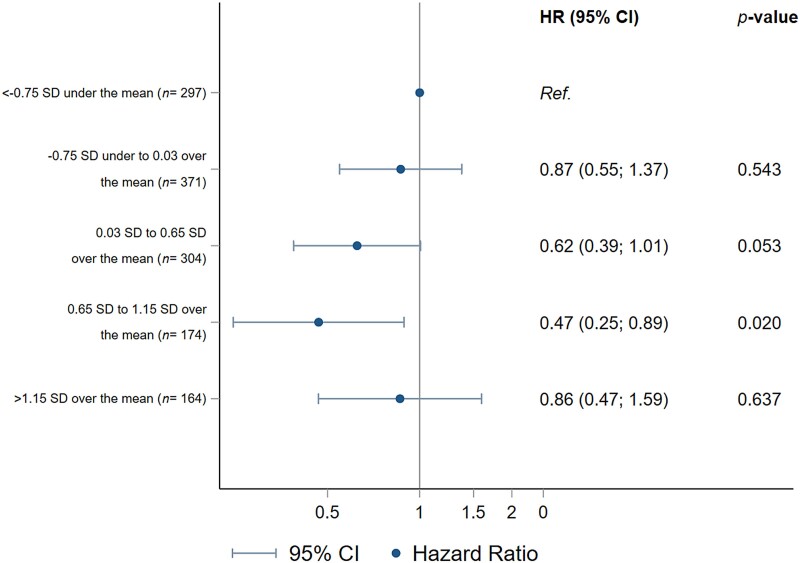
Tartaric acid was correlated with self-reported wine consumption at baseline [r = 0.46 (95% CI 0.41; 0.50)]. Five categories of post hoc urinary tartaric acid excretion were used for better representation of risk patterns. Concentrations of 3-12 and 12-35 μg/mL, which reflect ∼3-12 and 12-35 glasses/month of wine, were associated with lower CVD risk [HR 0.62 (95% CI 0.38; 1.00), P = .050 and HR 0.50 (95% CI 0.27; 0.95), P = .035, respectively]. Less significant associations between self-reported wine consumption and CVD risk were observed.
Light-to-moderate wine consumption, measured through an objective biomarker (tartaric acid), was prospectively associated with lower CVD rate in a Mediterranean population at high cardiovascular risk.
适度饮用葡萄酒与老年人群较低的心血管疾病(CVD)风险相关。然而,通过自我报告获取的葡萄酒饮用信息容易出现主观评估固有的测量误差。本研究的目的是评估葡萄酒饮用的客观生物标志物——尿酒石酸与复合临床CVD事件发生率之间的关联。
在PREDIMED试验中设计了一项病例队列嵌套研究,共有1232名参与者:685例CVD新发病例和一个由625名参与者组成的随机子队列(包括78例重叠病例)。使用经过验证的食物频率问卷记录葡萄酒饮用情况。采用液相色谱-串联质谱法在基线和干预一年后测量尿酒石酸。使用加权Cox回归模型估计CVD的风险比(HR)。
酒石酸与基线时自我报告的葡萄酒饮用情况相关[r = 0.46(95%CI 0.41;0.50)]。事后采用五类尿酒石酸排泄情况以更好地呈现风险模式。3 - 12和12 - 35μg/mL的浓度分别反映约每月3 - 12杯和12 - 35杯葡萄酒,与较低的CVD风险相关[HR分别为0.62(95%CI 0.38;1.00),P = 0.050和HR 0.50(95%CI 0.27;0.95),P = 0.035]。自我报告的葡萄酒饮用与CVD风险之间的关联不太显著。
通过客观生物标志物(酒石酸)测量的轻度至适度葡萄酒饮用与心血管风险较高的地中海人群中较低的CVD发生率存在前瞻性关联。